A Tuya Smart Life WiFi energy meter allows homeowners, installers, and energy management providers to monitor electricity consumption through the Tuya smart home ecosystem. Tuya provides the underlying IoT platform, while Smart Life is a Tuya-powered mobile app for monitoring and managing compatible smart devices. Depending on the meter model, users can view real-time power, historical energy usage, grid electricity import and export in solar installations, and create automations with other compatible smart devices.
However, not all Tuya WiFi energy meters offer the same features. Some are designed for single-phase circuits with 80A CT clamps, while others support split-phase or three-phase electrical systems. Home Assistant integration and Ethernet connectivity also depend on the specific model.
This guide explains how to choose a Tuya WiFi energy meter based on electrical compatibility, CT sensors, monitoring requirements, and smart home integration.
What Is a Tuya Smart Life WiFi Energy Meter?
A Tuya Smart Life WiFi energy meter measures electrical parameters and sends supported readings to the Tuya Smart or Smart Life app through a compatible WiFi network.
Depending on the model, users can monitor:
- Voltage (V) and current (A) — Electrical supply and current measurements.
- Active power (W or kW) — Real-time electricity demand.
- Energy consumption (kWh) — Accumulated electricity usage.
- Power factor and frequency — Additional electrical measurements.
- Historical energy data — Daily or monthly consumption trends.
- Bidirectional energy flow — Grid import and export on supported models.
Many Tuya WiFi energy meters use external current transformer (CT) clamps to measure current in selected electrical conductors. Combined with voltage measurements, the meter calculates power and energy consumption.
This makes CT-based monitoring suitable for existing residential and commercial electrical installations, provided the meter and sensors are correctly selected and installed.
How Does a Tuya WiFi Energy Meter Work with the Smart Life App?
A typical CT-based Tuya energy monitoring system includes an energy meter, one or more CT clamps, and a WiFi connection.
The monitoring process follows a simple sequence:
Electrical Circuit → CT Clamp → WiFi Energy Meter → Tuya / Smart Life App
The CT clamp measures current in the conductor, while the meter uses the appropriate voltage reference to calculate power and energy.
Once the device is connected to a supported 2.4GHz WiFi network and paired with the app, users can access available measurements remotely.
What Can You Monitor in the App?
Depending on the meter and its Tuya integration, the app may provide real-time readings, historical energy records, and automation functions.
For example, a homeowner may review daily electricity consumption, while a property manager may use historical readings to compare energy usage across different periods.
Some compatible devices also allow energy-related conditions to trigger automation with other Tuya products.
The exact data fields, historical reporting options, and automation functions should be confirmed for the selected meter.
Tuya Smart Life WiFi Energy Meter with 80A CT Clamps
An 80A Tuya Smart Life WiFi energy meter is a practical option for monitoring electricity consumption in compatible European residential installations.
Many European homes use 230V single-phase electricity, with main protective devices rated at 40A, 63A, or other values depending on the installation. For a home with a 63A main protective device, an 80A CT clamp may offer a suitable measurement range.
Unlike an 80A circuit breaker, an 80A CT clamp measures current rather than providing electrical protection. It can help monitor household electricity usage without carrying the full load current through the meter.
For example, the OWON PC311 WiFi energy meter supports CT-based monitoring and Tuya-compatible WiFi connectivity, making it suitable for selected single-phase residential applications.
When choosing between 80A and higher-rated CT sensors, consider the expected circuit current, measurement accuracy, and meter compatibility.
Single-Phase vs. Three-Phase Tuya WiFi Energy Meters
One of the most important purchasing decisions is choosing a meter compatible with the building’s electrical system.
A single-phase energy meter is typically used for individual circuits or compatible residential supplies.
A split-phase system, common in North American homes, requires a meter specifically designed for that electrical arrangement.
Three-phase meters are generally used in commercial buildings, larger properties, and certain residential installations.
| Electrical System | Typical Application | What to Check |
|---|---|---|
| Single-phase | Residential circuits and smaller installations | Voltage range and CT configuration |
| Split-phase | North American residential supplies | L1/L2 measurement support |
| Three-phase four-wire | Commercial and building energy monitoring | Three-phase voltage and CT connections |
| Three-phase three-wire | Selected industrial and commercial systems | Explicit 3P3W compatibility |
Important: A meter described as “three-phase” does not necessarily support three-phase three-wire or delta systems.
For example, the OWON PC4713 smart energy meter supports single-phase, split-phase, and three-phase four-wire systems. Its standard specification support three-phase three-wire or delta connections.
A separate PC4713 variant is available for applications requiring three-phase three-wire compatibility.
Always check the exact model suffix before selecting a meter.
Can a Tuya Smart Life WiFi Energy Meter Work with Home Assistant?
Home Assistant is widely used to combine smart home devices and energy information in one interface.
A compatible Tuya energy meter may provide useful power and energy data for a Home Assistant installation.
However, Tuya compatibility does not automatically guarantee full Home Assistant energy monitoring support.
Before purchasing a meter, confirm:
- Whether the exact device is supported by the intended integration
- Whether active power readings are available
- Whether accumulated energy data is exposed in kWh
- Whether import and export values are available when required
- Whether the necessary energy entities can be used in the Home Assistant Energy dashboard
Some Tuya devices expose only part of their measurement data through a particular integration.
For projects where Home Assistant is a primary requirement, it is better to select a meter with documented compatibility rather than assuming every Smart Life device will provide the same functions.
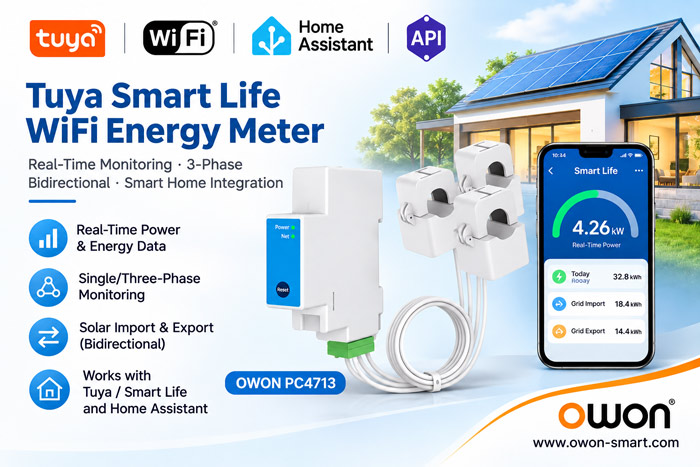
OWON PC4713 for Tuya and Home Assistant Projects
The OWON PC4713 combines Tuya-compatible energy monitoring with WiFi and Ethernet connectivity.
Its product specification also identifies Home Assistant platform integration.
This makes it a relevant option for projects requiring both Smart Life monitoring and smart home energy integration.
The supported Home Assistant entities and integration method should still be verified for the exact firmware and platform configuration.
Bidirectional Tuya WiFi Energy Meters for Solar Monitoring
A Tuya bidirectional energy meter can measure electricity flowing in both directions at a monitored connection.
This is especially useful for homes with rooftop solar panels.
For example:
- Grid import: Electricity supplied from the utility grid to the property.
- Grid export: Surplus electricity sent from the property back to the grid.
By monitoring these values, users can better understand how their electricity demand interacts with solar generation.
However, grid import/export monitoring is not the same as measuring total solar panel production.
A meter installed at the grid connection measures electricity flow at that point. Measuring total solar generation independently may require another measurement point.
OWON offers Tuya-compatible CT energy meters with bidirectional measurement, including selected PC311, PC321, PC472, PC473, and PC4713 configurations.
The appropriate model depends on the electrical system and the required monitoring arrangement.
WiFi Energy Meter with CT Sensors: Clamp or DIN Rail?
CT-based energy meters are available in different installation formats.
A compact clamp-type monitoring unit may be suitable when the project requires flexible placement near the distribution panel.
A DIN rail energy meter is designed to mount on a standard electrical rail inside a compatible enclosure.
The CT clamps measure current, while the meter’s voltage terminals and other connections must be wired according to its installation instructions.
The best installation format depends on available panel space, electrical requirements, and maintenance access.
For example, OWON’s PC472 is a single-phase DIN rail energy meter with external CT sensors.
The PC311 offers a compact alternative for single-phase monitoring.
Both use 2.4GHz WiFi and support Tuya-compatible energy monitoring.
Electrical panel installation should be performed by qualified personnel. CT orientation, conductor selection, and voltage connections must follow the manufacturer’s instructions.
Choosing an OWON Tuya Smart Life WiFi Energy Meter
OWON provides several Tuya-compatible WiFi energy meters for different monitoring requirements.
| OWON Model | Electrical System | Key Features | Recommended Application |
|---|---|---|---|
| PC311 | Single-phase | Two CT channels, 80A standard CT, Tuya WiFi | Residential circuits and single-phase monitoring |
| PC472 | Single-phase | DIN rail mounting, two CT channels, Tuya WiFi | Distribution panel monitoring |
| PC321 | Single-phase, split-phase, three-phase four-wire | Three CT channels, Tuya WiFi | Whole-home and three-phase monitoring |
| PC473 | Compatible single-phase and three-phase systems | DIN rail mounting, optional relay functionality | Energy monitoring with supported control applications |
| PC4713 | Single-phase, split-phase, three-phase four-wire | WiFi + Ethernet, bidirectional monitoring, Home Assistant integration | Solar homes and integrated energy projects |
For a basic single-phase installation, the PC311 or PC472 may be suitable.
For three-phase monitoring, the PC321 or PC473 may provide a better fit.
For applications requiring Ethernet connectivity and documented Home Assistant integration, the PC4713 is worth considering.
The final choice should be based on electrical system compatibility, CT requirements, installation format, and integration needs.
Frequently Asked Questions
Does a Tuya Smart Life WiFi energy meter require a hub?
Many Tuya WiFi energy meters connect directly to a compatible 2.4GHz WiFi network and do not require a separate Zigbee gateway. However, requirements depend on the specific product.
Can I use an 80A CT clamp with a Tuya WiFi energy meter?
Yes, if the meter supports the specified 80A CT. The CT must match the meter’s electrical and measurement requirements. CT sensors should not be assumed interchangeable across different models.
Can a Tuya WiFi energy meter monitor three-phase electricity?
Yes. Selected models support three-phase systems. Confirm whether the required installation is three-phase four-wire or three-phase three-wire before choosing a meter.
Can a Tuya Smart Life WiFi energy meter connect to Home Assistant?
Some models support Home Assistant integration, but compatibility and available energy data vary. Verify the exact device and integration before purchasing.
Can a Tuya energy meter measure solar electricity?
Selected models support bidirectional monitoring of electricity import and export. Independent measurement of total solar generation may require additional measurement points.
Can I check daily or monthly electricity usage in Smart Life?
Many compatible Tuya energy meters provide historical energy records. Available daily, monthly, and export functions depend on the device and app implementation.
Is a Tuya WiFi energy meter the same as an MQTT energy meter?
No. Tuya/Smart Life compatibility and MQTT are different integration approaches. A Tuya-compatible meter does not necessarily provide direct MQTT access.
Does an energy meter with a relay act as a circuit breaker?
No. A relay output and a protective circuit breaker serve different purposes. Relay ratings and functions must be checked separately, and appropriate circuit protection is still required.
Conclusion
A Tuya Smart Life WiFi energy meter provides a practical way to monitor electricity usage, review historical consumption, and connect compatible energy measurements with smart home automation.
The most important selection factors are the electrical system, CT current range, installation format, bidirectional monitoring capability, and software integration.
For single-phase applications, compact or DIN rail CT meters may be sufficient. Three-phase and solar monitoring projects often require additional measurement capabilities.
OWON Technology develops Tuya-compatible WiFi energy meters for residential, commercial, and OEM/ODM energy management applications.
Explore OWON WiFi smart power meters to compare available monitoring solutions and discuss suitable configurations for your project.
Post time: Nov-04-2026