A thermostat in a home or building is usually installed where occupants can easily reach it. That is convenient, but it can also create problems when users change temperature settings, schedules, or HVAC configuration without authorization.
A lockable thermostat helps solve this problem by restricting access to some or all thermostat controls. Depending on the model, locking may be achieved through a password, PIN code, screen lock, temperature limits, installer lock, or administrator settings.
For homeowners, landlords, property managers, hotels, and commercial building operators, the right locking method depends on an important question: Do you want to prevent all changes, or simply keep users within approved settings?
This guide explains how lockable thermostats work, the different types of thermostat locks, and what to consider when choosing one.
What Is a Lockable Thermostat?
A lockable thermostat is a thermostat designed to prevent unauthorized users from changing selected temperature or HVAC settings.
Traditional solutions often use a physical thermostat cover, guard, or lock box. Modern smart thermostats can provide another approach by restricting access through software.
Depending on the thermostat, lockable controls may include:
- Password or PIN protection
- Touchscreen or keypad lockout
- Adjustable heating and cooling limits
- Installer or configuration lock
- Administrator access
- Remote management
This means “locking” a thermostat does not necessarily mean preventing someone from touching it. A smart thermostat may remain accessible while restricting which settings can actually be changed.
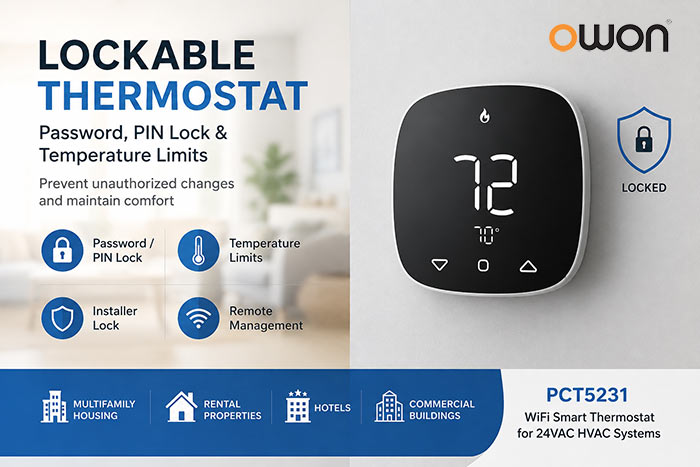
How Can a Thermostat Be Locked?
There is no single thermostat locking method. Different applications require different levels of control.
1. Password or PIN Lock
A lockable thermostat with password or PIN protection requires an authorized code before protected settings can be changed.
This can help prevent occupants, guests, employees, or other unauthorized users from modifying important thermostat settings.
Depending on the product design, a PIN lock may protect the entire interface or only specific configuration menus.
This approach is particularly useful when authorized staff still need convenient access without using a physical key.
2. Screen or Keypad Lock
A screen or keypad lock restricts changes directly from the thermostat interface.
Some systems provide different locking levels. For example, an administrator may allow basic temperature adjustment while preventing changes to schedules or HVAC configuration.
This can provide a better balance between user comfort and system control than completely disabling the thermostat.
3. Temperature Limits
A thermostat does not always need to be completely locked.
Temperature limiting allows administrators to define an approved heating and cooling range while occupants retain some control.
For example, users may be allowed to adjust the setpoint within a defined range but cannot select extreme temperatures outside the configured limits.
This can be useful in:
- Rental properties
- Multifamily apartments
- Hotels
- Offices
- Other shared or managed spaces
For many property applications, temperature limits can be more practical than a full thermostat lock.
4. Installer Lock
An installer lock protects technical HVAC settings that normal occupants should not change.
Depending on the thermostat and HVAC system, these may include system configuration, equipment type, staging, heat pump parameters, calibration, and other installation settings.
This is especially important for professional HVAC projects because an accidental configuration change can affect system operation—not just room temperature.
Full Thermostat Lock vs Temperature Limits: Which Is Better?
The best approach depends on who should be allowed to control the HVAC system.
Full Lock
A full lock provides stronger restrictions and may be appropriate when users should not modify thermostat settings.
It can be useful in controlled-access areas or applications where HVAC settings are managed entirely by authorized personnel.
Temperature Limits
Temperature limits offer more flexibility.
Occupants can still adjust comfort within an approved range, while property managers retain control over the minimum and maximum settings.
For rental properties, multifamily housing, hospitality, and similar applications, this can provide a practical compromise between:
Occupant comfort + HVAC control + energy management
For this reason, buyers should look beyond the simple question of whether a thermostat “locks” and consider what can be locked and what users are still allowed to adjust.
Lockable Thermostat for Landlords and Rental Properties
One of the clearest applications for a lockable thermostat for landlords is controlling HVAC settings in rental properties.
Landlords and property managers may want to prevent:
- Extreme heating or cooling settings
- Unauthorized schedule changes
- Changes to installer configuration
- Unnecessary HVAC operation
However, completely removing tenant control is not always desirable.
A thermostat that combines PIN or password protection with configurable temperature limits can allow residents to make normal comfort adjustments while keeping critical settings protected.
For multifamily projects, connected thermostats can add another capability: remote thermostat management.
Instead of visiting every apartment to check or adjust a thermostat, authorized property teams may be able to manage compatible connected devices remotely through the appropriate platform.
Lockable Thermostat vs Thermostat Cover or Lock Box
A physical cover and a digitally lockable thermostat solve a similar problem in different ways.
| Solution | How It Works | Best Suited For |
|---|---|---|
| Thermostat cover or guard | Restricts physical access | Simple physical protection |
| Thermostat lock box | Encloses thermostat, often with a key | Strong physical access restriction |
| Password/PIN thermostat | Restricts controls digitally | Homes and managed properties |
| Temperature limits | Restricts allowable setpoints | Rentals, apartments and hospitality |
| Smart lockable thermostat | Combines access control with connected functions | Connected property and commercial projects |
A physical cover may be sufficient when the primary requirement is simply preventing access.
A smart lockable thermostat becomes more useful when the project also requires scheduling, remote access, configurable limits, or connected HVAC management.
For a broader discussion of physical and digital protection methods, see our tamper proof thermostat solutions guide.
Is There a Smart Thermostat That Can Be Locked?
Yes. Some smart thermostats combine connected HVAC functions with software-based access restrictions.
Depending on the model, features may include:
- Password or PIN protection
- Screen lock
- Temperature limits
- Installer settings protection
- Scheduling
- Remote control
- Energy reporting
The advantage is that locking becomes part of a broader HVAC management strategy rather than relying only on physical protection.
For a homeowner, this may simply prevent unwanted changes.
For a property operator or system integrator, the same concept can become part of a larger connected HVAC deployment.
Example of a Lockable Smart Thermostat for 24VAC HVAC Systems
For example, the OWON PCT5231 WiFi thermostat is designed for North American 24VAC HVAC systems and provides access-control features relevant to managed residential and light commercial applications.
These include:
- Password protection
- Installer lock
- Configurable temperature limits
- 7-day scheduling
- Remote management
- Energy usage reporting
The PCT5231 also supports conventional and heat pump HVAC configurations, including multi-stage and dual fuel applications.
For projects where administrators need to protect HVAC settings while maintaining connected control capabilities, these features provide a practical foundation for a lockable smart thermostat solution.
What to Look for When Choosing a Lockable Thermostat
The best lockable thermostat is not necessarily the model with the strongest possible lock. It is the thermostat that provides the appropriate level of control for the intended application.
Consider the following factors.
Locking Method
Determine whether you need:
- Password/PIN protection
- Full interface lock
- Installer lock
- Temperature limits
- Physical protection
User Access
Ask what occupants should still be able to control.
A hotel guest, apartment tenant, office employee, and HVAC technician may require very different levels of access.
HVAC Compatibility
For North American HVAC projects, verify compatibility with:
- 24VAC systems
- Conventional heating and cooling
- Heat pumps
- Multi-stage equipment
- Auxiliary or emergency heat
- Dual fuel systems, where required
Access-control features do not replace proper HVAC compatibility.
Remote Management
For multiple apartments or buildings, consider whether authorized users need to monitor or manage thermostats remotely.
This becomes increasingly important as the number of installed devices grows.
Installation and Administration
A good lockable thermostat should protect important settings without making routine maintenance unnecessarily difficult for authorized personnel.
Lockable Thermostats for Commercial and Multifamily Projects
Locking features become particularly valuable when thermostats are installed in locations where many different users can access them.
Typical applications include:
- Multifamily apartments
- Rental properties
- Hotels
- Offices
- Light commercial buildings
- Managed residential properties
For these projects, thermostat selection should consider more than the lock itself.
Property operators and system integrators may also need:
- Remote management
- Energy reporting
- HVAC compatibility
- Multi-device deployment
- Platform integration
- OEM or private-label options
This is where smart thermostat access control becomes part of a broader connected HVAC strategy.
OEM and ODM Lockable Thermostat Solutions
For HVAC brands, property technology companies, and system integrators, locking requirements may vary between projects.
For example, one customer may require configurable temperature limits, while another may prioritize password-protected installer settings or integration with a connected management platform.
OWON develops smart thermostat solutions for North American HVAC applications and supports OEM and ODM thermostat projects, including hardware, firmware, branding, and platform integration requirements based on the intended deployment.
This allows partners to develop thermostat solutions around their own HVAC systems, property management requirements, and market positioning rather than relying on a single fixed configuration.
Frequently Asked Questions
Is it possible to lock a thermostat?
Yes. Depending on the thermostat, settings can be restricted using password or PIN protection, keypad or touchscreen locks, temperature limits, installer locks, or administrator controls. Physical thermostat covers and lock boxes are another option.
Is there a smart thermostat that can be locked?
Yes. Some smart thermostats combine software-based locking with features such as scheduling, remote control, temperature limits, and connected HVAC management.
Can landlords use a lockable thermostat?
A lockable thermostat can be useful in rental properties where landlords or property managers need to protect certain HVAC settings while allowing occupants appropriate temperature control. Any restrictions should comply with applicable lease requirements, building codes, and local regulations.
What is the difference between a thermostat PIN lock and temperature limits?
A PIN lock restricts access to protected controls unless an authorized code is entered. Temperature limits allow users to change the setpoint but only within a predefined heating or cooling range.
Is it illegal to lock a thermostat?
Rules vary by location and application. Landlords and property operators should consider local laws, lease requirements, building codes, and minimum heating or cooling obligations before restricting thermostat access.
Conclusion
A lockable thermostat can do much more than simply prevent someone from touching the controls.
Modern thermostat locking can include password or PIN protection, temperature limits, installer restrictions, and different levels of user access. The right approach depends on whether the goal is complete restriction or controlled adjustment within approved settings.
For landlords, multifamily properties, hotels, and commercial projects, smart locking features can also work alongside scheduling and remote management to provide more flexible HVAC control.
For example, OWON’s connected thermostat solutions combine HVAC control with configurable access features for North American 24VAC applications. For HVAC brands, system integrators, and property technology providers, OWON also supports OEM and ODM development for customized thermostat projects.
Related reading:
[ Smart Thermostat API: How Open APIs Enable HVAC and IoT Integration ]
Post time: Aug-14-2026


