For an established smart home, home comfort, appliance, or consumer hardware brand, adding a thermostat does not necessarily mean becoming a thermostat company.
A Tuya smart thermostat OEM platform can provide a practical way to add climate control to an existing product portfolio—especially for brands that already use Tuya for other connected products.
Instead of developing a new HVAC controller, cloud connection, app experience, and manufacturing program from the ground up, brands can start with a mature thermostat platform and focus on what matters most to their market: product positioning, brand experience, channel strategy, and customer needs.
Why a Thermostat Can Be an Adjacent Product Category
A common assumption is that a thermostat must directly control another product already sold by the brand.
That is not always necessary.
A ceiling fan brand, appliance company, air-conditioning brand, or other home-comfort business may already have retail distribution, customer recognition, and an established connected-product strategy.
A smart thermostat can become an adjacent product category sold through those same channels—even when it is designed to control a compatible HVAC system rather than another product in the brand’s existing portfolio.
This creates an opportunity to expand into climate control without rebuilding the entire business around HVAC.
The key question becomes:
How can the brand add a thermostat while keeping product development, IoT integration, cost, and customer experience manageable?
Already Using Tuya? Keep the Thermostat in the Same IoT Strategy
For a brand already using the Tuya platform, adding one thermostat should not automatically require building a second IoT ecosystem.
A Tuya-based thermostat can fit into the brand’s broader connected-product strategy rather than becoming an isolated device with a completely separate digital experience.
This matters because consumers experience the products through the brand—not through the different engineering teams and suppliers behind them.
If customers already use connected products from the same brand, the thermostat should ideally feel like another member of that product family.
For product teams, this can also simplify the decision-making process. Instead of asking how to create an entirely new cloud and connected-device architecture for one thermostat, the focus can shift toward how climate control should fit into the existing product strategy.
Why Building a Separate Thermostat Ecosystem Adds Complexity
The thermostat itself is only one part of a connected HVAC product.
For North American applications, product development may involve:
- 24V HVAC compatibility
- conventional and heat pump configurations
- WiFi connectivity
- mobile app functions
- installation requirements
- product validation
- branding and user experience
- after-sales technical support
Developing all of these elements specifically for one new product category can require significant engineering resources.
A mature OEM thermostat platform changes the starting point.
Rather than beginning with a blank hardware design, a brand can evaluate an existing thermostat architecture and determine which elements need to be adapted for its target market.
This is particularly relevant when the thermostat is intended to become one additional SKU within a much larger smart home or home-comfort portfolio.
Match the Thermostat Platform to Your Retail Position
More features do not automatically create a better retail product.
A large color display, additional sensors, premium materials, or more complex hardware can all influence manufacturing cost and final retail positioning.
For a high-volume retail program, a simpler display platform may provide the essential functions customers expect—such as HVAC control, scheduling, WiFi connectivity, and app access—without pushing the product into a premium price category.
For higher-end channels, a touchscreen or more advanced thermostat platform may make more sense.
The right decision depends on the intended market position.
Brands should consider:
Who is the target customer?
A value-oriented retail thermostat and a premium connected thermostat may require very different hardware strategies.
What HVAC systems need to be supported?
North American 24V conventional and heat pump systems have different requirements from other heating and cooling applications.
Which connected functions actually matter?
App control, scheduling, sensors, automation, and integration should support the product strategy rather than simply increase the feature count.
The objective is to select a thermostat architecture that matches the market—not to maximize specifications.
Keep the Thermostat Consistent with Your Brand Experience
OEM development should also consider what the customer sees.
A thermostat is installed prominently on the wall and may be used every day. A product that looks completely unrelated to the rest of the brand’s portfolio can weaken the overall experience.
Depending on the OEM program, customization may extend beyond the logo to areas such as product appearance, user interface, packaging, feature configuration, and app experience.
The goal is not simply to place a different brand name on an existing device.
The thermostat should fit naturally into the brand’s product family and retail positioning.
What Should Brands Evaluate Before Adding a 24V Smart Thermostat?
Before starting a Tuya smart thermostat OEM project, it helps to define several requirements clearly.
| Area | Questions to Evaluate |
|---|---|
| HVAC Compatibility | Which 24V conventional or heat pump systems need to be supported? |
| Target Market | Is the product intended for retail, smart home, HVAC, property, or another channel? |
| Product Positioning | Is the thermostat entry-level, mainstream, or premium? |
| IoT Strategy | Should the thermostat fit into an existing Tuya-based connected-product strategy? |
| User Experience | Which app, scheduling, interface, and connected functions are actually required? |
| Customization | How much differentiation is needed in appearance, UI, packaging, features, and branding? |
| Commercial Scale | What are the expected volumes, target cost, and future product roadmap? |
Answering these questions before selecting hardware can help prevent unnecessary development and keep the thermostat aligned with the wider product strategy.
How OWON Supports Tuya Smart Thermostat OEM Projects
For brands looking to add climate control to an existing connected-product portfolio, OWON provides a mature thermostat platform that can reduce the need to develop HVAC hardware and connected functions from the ground up.
With experience in 24VAC HVAC control, WiFi connectivity, Tuya integration and OEM/ODM development, OWON can support different stages of a thermostat project—from selecting an appropriate hardware platform to adapting the product for a brand’s target market.
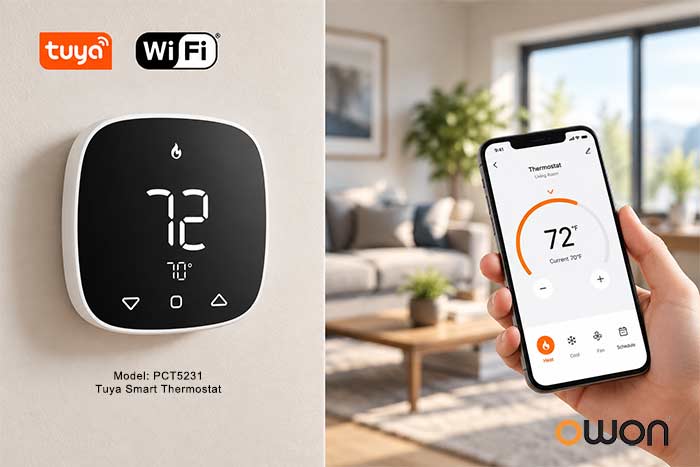
For example, the PCT5231 24VAC WiFi thermostat provides a platform for compatible North American conventional and heat pump systems, with Tuya connectivity, remote sensors, scheduling and connected control capabilities.
Depending on project requirements, OEM/ODM development can also address areas such as product appearance, branding, user interface, feature configuration, packaging and system integration.
For established smart home and home-comfort brands, the value is not simply sourcing another thermostat. It is having an experienced HVAC and IoT development partner that can help turn an existing thermostat platform into a product that fits the brand’s own portfolio and market strategy.
Add Climate Control Without Becoming a Thermostat Company
For an established brand, entering the smart thermostat category does not have to mean developing every part of the HVAC and IoT stack internally.
A mature Tuya smart thermostat OEM platform provides a practical starting point for brands that want to expand into climate control while continuing to focus on their customers, channels and product positioning.
This approach is particularly relevant for companies already operating within the Tuya ecosystem. Rather than creating a separate connected-product strategy for one thermostat, brands can evaluate how a 24V thermostat platform fits into the ecosystem and product portfolio they already have.
OWON supports this process with existing smart thermostat platforms and OEM/ODM development capabilities for brands planning connected HVAC products for their target markets.
The result is a more focused question:
Not “How do we become a thermostat company?” but “How should a thermostat fit into the product ecosystem we already have?”
Post time: Sep-29-2026


