Introduction
Managing HVAC systems across multiple buildings has traditionally required local access to each thermostat. For residential properties, this approach may work well when managing one or two devices. However, for multifamily communities, hotels, and commercial buildings with hundreds of HVAC units, manual thermostat management becomes inefficient and difficult to scale.
A modern remote thermostat management solution enables property operators, HVAC integrators, and smart building providers to monitor, configure, and control connected thermostats remotely through cloud platforms and IoT ecosystems.
By combining smart thermostat hardware, wireless connectivity, cloud services, and software integration, remote thermostat management helps organizations improve HVAC visibility, reduce maintenance workload, and optimize energy usage across large-scale deployments.
What Is Remote Thermostat Management?
Remote thermostat management refers to the ability to monitor and manage connected thermostats from a centralized platform without physically visiting each device location.
Unlike traditional thermostat control, which requires users to adjust settings directly on the wall-mounted device, remote thermostat management allows authorized users to perform operations such as:
- Checking thermostat status
- Adjusting temperature settings
- Updating schedules
- Managing multiple devices
- Monitoring HVAC operation
For a single home, remote control may simply mean adjusting temperature from a mobile app.
However, for commercial applications, remote thermostat management focuses on managing multiple connected HVAC devices across different rooms, apartments, or buildings.
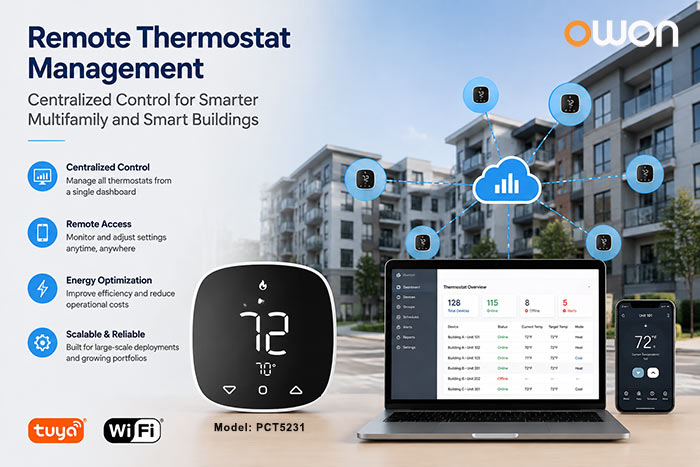
Remote Thermostat Control vs Remote Thermostat Management
Although these terms are often used interchangeably, they serve different purposes.
Remote Thermostat Control
Remote thermostat control is typically designed for individual users.
Examples:
- Homeowners controlling a thermostat from a smartphone
- Users changing temperature settings while away from home
- Smart home automation
Remote Thermostat Management
Remote thermostat management is designed for organizations managing multiple devices.
Examples:
- Property managers managing apartment HVAC systems
- HVAC contractors supporting customer installations
- Building operators monitoring multiple locations
The key difference is scale.
Remote control manages one device.
Remote thermostat management manages an entire fleet of connected HVAC devices.
How Does Remote Thermostat Management Work?
A typical remote thermostat management architecture includes several layers:
Smart Thermostat

↓

WiFi / IoT Connectivity

↓

Cloud Platform

↓

Device Management System

↓

Property Management Platform / Customer Application

↓

Operator Dashboard
The thermostat acts as the HVAC control device, while cloud connectivity enables remote communication and centralized management.
Depending on project requirements, the system may support:
- Mobile applications
- Web dashboards
- API integration
- Smart building platforms
- Property management software
Why Multifamily Properties Need Remote Thermostat Management
Multifamily buildings often contain hundreds or thousands of individual HVAC systems.
Managing these systems manually creates several challenges.
1. Centralized Control Across Multiple Units
Property operators need visibility across different apartments and buildings.
Remote thermostat management helps teams:
- View connected devices
- Adjust settings remotely
- Apply operating schedules
- Identify device issues
This improves operational efficiency compared with managing each thermostat individually.
2. Managing Vacant Apartments
Vacant units are a common source of unnecessary HVAC energy consumption.
Property teams can remotely manage thermostat settings in unoccupied apartments to:
- Reduce unnecessary heating or cooling
- Maintain basic temperature protection
- Prepare units before tenant move-in
3. Improving Maintenance Efficiency
Traditional HVAC troubleshooting often requires technicians to visit each location.
Connected thermostat systems can provide useful information remotely, such as:
- Device connectivity status
- Temperature conditions
- Configuration information
This helps maintenance teams respond faster and reduce unnecessary site visits.
Remote Thermostat Management for Smart Building Applications
Beyond multifamily properties, remote thermostat management is also valuable for other connected building applications.
Hotels and Hospitality
Hotel operators can manage guest room HVAC systems more efficiently by integrating connected thermostats with broader building systems.
Commercial Buildings
Office buildings and mixed-use properties can use remote HVAC management to improve:
- Energy efficiency
- Scheduling control
- Building automation
Property Technology Platforms
PropTech companies can integrate thermostat devices into their own platforms to provide connected property services.
Key Features to Consider in a Remote Thermostat Management Solution
When selecting a connected thermostat solution, organizations should consider several important capabilities.
Cloud Connectivity
Reliable cloud connectivity enables communication between thermostats and management platforms.
Multi-Device Management
For large deployments, the system should support:
- Multiple thermostats
- Multiple buildings
- Scalable device management
Remote Configuration
Administrators may need to remotely configure:
- Temperature limits
- Operating schedules
- Device parameters
Energy Monitoring and Optimization
Energy-related features can help operators understand HVAC operation and improve efficiency.
Examples include:
- Energy usage reports
- Schedule optimization
- Temperature management strategies
Integration Capability
For smart building projects, thermostat integration is important.
Common integration options include:
- Cloud platforms
- APIs
- IoT ecosystems
- Building automation systems
Tuya IoT Integration for Remote Thermostat Management
For many smart building projects, cloud infrastructure and device management capabilities are essential.
OWON smart thermostat solutions can integrate with the Tuya IoT ecosystem, providing partners with connected HVAC solutions that support cloud-based device management.
Through Tuya-based integration, connected thermostats can support functions such as:
- Device registration
- Remote device control
- Cloud connectivity
- Application integration
- Smart automation
This enables HVAC brands, system integrators, and property technology providers to develop connected thermostat applications more efficiently.
For customers with their own software platforms, OWON also supports integration approaches based on project requirements.
OWON Remote Thermostat Management Solution Example
As an experienced smart thermostat manufacturer, OWON provides WiFi thermostat platforms designed for North American 24VAC HVAC applications.
For example, the OWON PCT5231 WiFi thermostat is designed for residential and light commercial HVAC projects requiring remote control capability and flexible system integration.
Key features include:
- 24VAC HVAC compatibility
- Conventional and heat pump support
- Dual fuel / hybrid heat capability
- Multi-stage HVAC control
- Remote room sensor support
- Energy usage reporting
- Smart scheduling
- Locking functions
The PCT5231 can serve as a connected HVAC control device within smart building and property management applications.
When integrated with compatible cloud ecosystems, such as Tuya-based solutions, it provides partners with a flexible foundation for developing remote thermostat management applications.
OEM and ODM Support for Connected Thermostat Projects
Different customers may require customized thermostat solutions based on their markets and application requirements.
OWON supports:
- HVAC equipment manufacturers
- Smart home brands
- System integrators
- Property technology companies
through OEM and ODM thermostat services.
Customization options include:
- Hardware customization
- Firmware adaptation
- Private label development
- Platform integration support
This allows partners to create connected HVAC solutions that match their business requirements.
How to Choose the Right Remote Thermostat Management Solution
Before selecting a solution, project teams should evaluate:
Deployment Scale
Consider:
- Number of thermostats
- Number of buildings
- Future expansion plans
HVAC Compatibility
Confirm:
- HVAC system type
- Voltage requirements
- Heating and cooling stages
Integration Requirements
Evaluate:
- Cloud platform compatibility
- API requirements
- Existing property management systems
Long-Term Support
For large projects, choose a thermostat partner with:
- Manufacturing capability
- Engineering support
- Product customization experience
Frequently Asked Questions
Can you control a thermostat remotely?
Yes. Smart thermostats can be controlled remotely through mobile apps, cloud platforms, or connected management systems.
For individual homes, this usually means remote temperature adjustment. For commercial applications, remote thermostat management enables centralized control of multiple devices.
How does a remote thermostat work?
A remote thermostat connects to a network through WiFi or another communication technology. The device communicates with a cloud platform, allowing users or operators to monitor and control HVAC settings remotely.
What is the difference between remote thermostat control and remote thermostat management?
Remote thermostat control usually refers to controlling one thermostat remotely, while remote thermostat management focuses on managing multiple connected thermostats across different locations.
Can remote thermostat management help reduce energy costs?
Yes. Remote thermostat management can help optimize HVAC operation through scheduling, temperature adjustments, and energy monitoring features.
Can OWON thermostats support remote management applications?
Yes. OWON WiFi thermostat platforms support connected HVAC applications and can integrate with compatible cloud ecosystems, APIs, and customer software platforms.
Conclusion
As buildings become more connected, HVAC management is moving from individual thermostat adjustment toward centralized digital management.
A remote thermostat management solution enables property operators, HVAC integrators, and smart building providers to monitor and control connected thermostats more efficiently across multiple locations.
By combining smart thermostat hardware, cloud connectivity, IoT integration, and OEM/ODM capabilities, OWON helps partners develop scalable HVAC solutions for multifamily properties, commercial buildings, and smart building applications.
Related reading:
[ Heat Pump Thermostat with Emergency Heat: A Compatibility Guide for HVAC Professionals ]
Post time: Aug-04-2026


