Introduction
Choosing the right smart apartment thermostat manufacturer is no longer only about hardware appearance or basic temperature control. For multifamily housing, hospitality, student apartments, senior living communities, and PropTech platforms, thermostats are now part of a larger connected property management system.
A professional apartment thermostat manufacturer must support centralized fleet management, Tuya SaaS integration, remote configuration, tenant control restrictions, offline resiliency, and HVAC equipment protection. These requirements are especially important in North American multifamily buildings, where property operators need to manage hundreds or even thousands of HVAC endpoints across different rooms, units, and locations.
This article explains what PropTech integrators, property managers, and HVAC solution providers should evaluate when choosing a smart apartment thermostat manufacturer for unified backend management.
1. The Realities of Multifamily IoT: Fleet Management via Tuya SaaS Integration
In North American multifamily and hospitality sectors, localized climate control can account for a large share of total building energy expenditure. Vacancy periods, guest turnover, room transition gaps, and inconsistent resident behavior often create unnecessary HVAC runtime.
For enterprise PropTech integrators, managing this waste requires more than a consumer-grade smart thermostat app. It requires a centralized, industrial-scale HVAC control approach.
A smart apartment thermostat manufacturer should be able to provide commercial thermostats that operate as native Tuya SaaS hardware nodes. This allows integrators to leverage the Tuya ecosystem while still building a scalable property management thermostat platform.
Through deep Tuya SaaS integration, asset managers can bypass fragmented consumer apps and achieve centralized remote fleet management. This enables:
- automatic temperature setbacks after guest checkout or tenant vacancy
- batch parameter deployment across hundreds or thousands of units
- centralized thermostat status monitoring
- remote configuration updates
- real-time energy audits
- integration with Property Management Software (PMS) through cloud APIs
For apartment operators, hospitality groups, and PropTech platforms, this type of Tuya thermostat platform helps connect HVAC hardware with daily building operations.
As one example, the OWON PCT5231 smart thermostat is designed for North American 24VAC HVAC systems and can support commercial apartment, hospitality, and light commercial HVAC applications where remote control, scheduling, and smart backend integration are required. 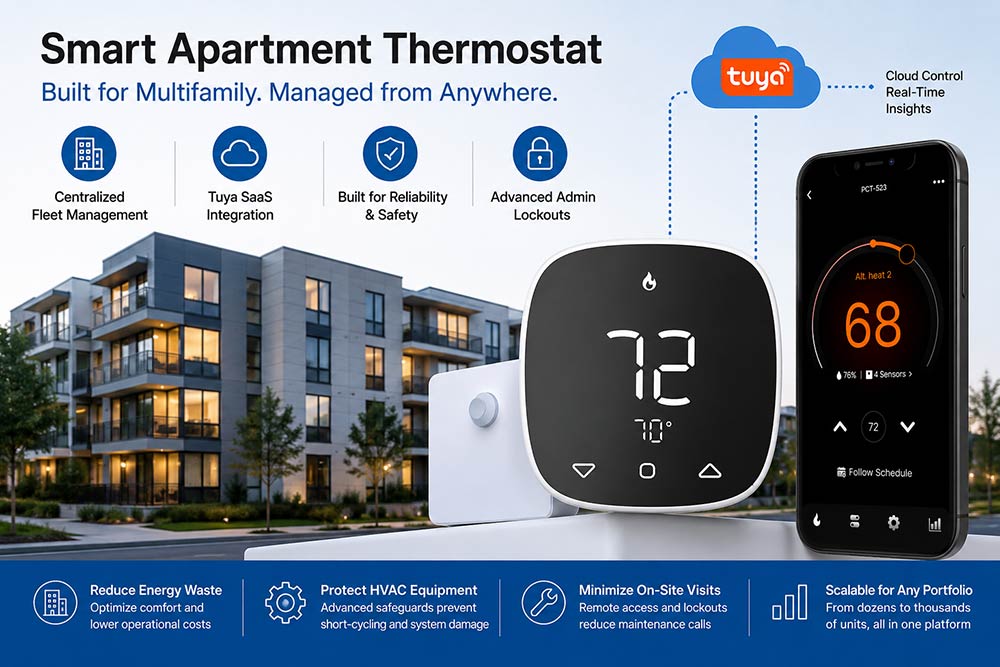
2. Built for Grid Vulnerability: Power Failure and Offline Resiliency
Managed properties frequently suffer from localized power outages, voltage fluctuations, and network dropouts. Under these conditions, standard retail smart thermostats may lose programming, disconnect from the network, or require emergency maintenance visits.
For multifamily property management, this creates a serious operational issue. A thermostat that fails after a power interruption can generate unnecessary service tickets, tenant complaints, and HVAC downtime.
A commercial-grade apartment thermostat platform should be engineered for operational autonomy.
Non-Volatile Memory Protection
In the event of absolute power loss, localized schedules, network credentials, HVAC equipment parameters, and system settings should remain permanently retained offline.
This is important because property managers cannot afford to recommission each thermostat manually after every outage. A professional smart apartment thermostat manufacturer should design hardware with non-volatile memory retention to reduce maintenance risk and improve long-term reliability.
Intelligent Power-Restoration Protection
When power suddenly returns to a multifamily building, hundreds of HVAC systems may attempt to start at the same time. This simultaneous startup can increase electrical stress and may shorten the life of compressors and other HVAC equipment.
A commercial thermostat platform should include intelligent power-restoration logic, such as randomized or staggered warm-start delay routines. This helps protect both the electrical infrastructure and the property’s HVAC assets.
For PropTech integrators, offline resiliency is not a minor feature. It is a key requirement for large-scale apartment thermostat deployment.
3. Tenant Tampering and the Need for Advanced Administrator Lockouts
A major operational drain often overlooked by consumer thermostat brands is tenant tampering.
In long-term rentals, student housing, apartment communities, and hospitality rooms, occupants may attempt unauthorized adjustments, factory resets, WiFi clearing, or local configuration changes to bypass property policy constraints.
This creates a recurring maintenance burden. Every reset or disrupted network node may require an onsite technician to recommission the device, reconnect it to the backend, and restore the correct operating parameters.
A property management thermostat should reduce this risk through advanced administrator controls.
Advanced Administrator PIN-Lock and Factory Reset Protection
A commercial smart thermostat platform should allow integrators or property managers to enforce a secure master password or access PIN directly from the backend SaaS system.
Local physical keys can be restricted so occupants only adjust temperature within predefined comfort and energy-saving limits. This protects both user experience and property-level energy policy.
Hardware-Level Configuration Locks
Hardware-level configuration locks help prevent unauthorized changes to critical HVAC settings, WiFi credentials, system mode, and factory reset functions.
For apartment operators and hospitality managers, this reduces emergency site visits and improves the reliability of the entire thermostat fleet.
This is one reason why choosing the right smart apartment thermostat manufacturer is important. The difference between a consumer thermostat and a commercial apartment thermostat is often not the display—it is the backend control logic, device permission structure, and long-term serviceability.
4. Engineering Safety: Preventing Heat Pump Compressor Damage
The ultimate metric for an enterprise-grade thermostat is not only comfort control. It is HVAC equipment protection.
Unvetted hardware suppliers may use substandard switching control loops that fail to manage complex North American HVAC configurations properly. Poor engineering execution can result in short cycling, conflicting auxiliary heat engagement, signal cross-talk, or incorrect heat pump control.
For multifamily operators, this can create expensive liability. Damaged compressors, unstable auxiliary heat behavior, and unnecessary equipment wear can quickly turn a low-cost thermostat purchase into a long-term maintenance problem.
A professional HVAC thermostat manufacturer should design firmware and hardware around real HVAC protection requirements.
Validated Inductive Load Switching
North American 24VAC HVAC control boards often involve inductive loads and relay switching requirements. Commercial thermostat hardware should use reliable relay arrays designed for these operating conditions.
This helps reduce the risk of signal instability, relay failure, and equipment stress.
Built-In Anti-Short-Cycle Protection
Advanced firmware should include anti-short-cycle timers and compressor minimum-run safeguards.
These protections should not be easily overridden by local user adjustments or delayed network commands. For apartment and hospitality projects, this ensures HVAC equipment remains protected even when the thermostat is managed remotely through cloud platforms.
Heat Pump and Dual Fuel Logic
Many North American properties use heat pumps, auxiliary heat, emergency heat, or dual fuel HVAC systems.
A commercial apartment thermostat manufacturer should understand these system requirements and provide proper control logic for heat pump operation, outdoor temperature-based switching, auxiliary heat coordination, and compressor protection.
For multifamily HVAC projects, this type of engineering depth is often more important than consumer-facing app features.
5. Key Features to Evaluate in a Smart Apartment Thermostat Manufacturer
When choosing a smart apartment thermostat manufacturer for multifamily property management, buyers should evaluate more than product appearance.
| Evaluation Area | Why It Matters for Multifamily Projects |
|---|---|
| Tuya SaaS Integration | Enables centralized fleet management, remote configuration, and cloud API integration |
| PMS / PropTech Backend Compatibility | Helps connect thermostat data with property management systems |
| Offline Resiliency | Reduces maintenance risks during power outages or network failures |
| Administrator Lockouts | Prevents tenant tampering, factory resets, and unauthorized HVAC changes |
| HVAC Equipment Protection | Helps prevent short cycling, compressor damage, and incorrect heat pump operation |
| Remote Sensor Support | Improves comfort balance across rooms, suites, and apartment layouts |
| OEM / ODM Customization | Supports branding, firmware customization, and project-specific requirements |
This evaluation process helps property managers and system integrators avoid consumer-grade devices that are not designed for commercial deployment.
6. Where OWON Fits into Smart Apartment Thermostat Projects
OWON Technology develops and manufactures smart thermostats, energy management devices, sensors, gateways, and wireless BMS solutions for global IoT and HVAC applications.
For apartment, hospitality, and light commercial HVAC projects, OWON provides WiFi HVAC thermostat hardware such as the PCT5231, designed for North American 24VAC HVAC systems. It supports heat pump configurations, dual fuel or hybrid heat control, remote sensors, scheduling, usage tracking, and smart app-based management.
For PropTech integrators, property management platforms, and HVAC solution providers, OWON can also support OEM/ODM customization, device-level integration, and broader smart building deployment requirements.
FAQ
What is a smart apartment thermostat manufacturer?
A smart apartment thermostat manufacturer designs and produces connected thermostat hardware for apartment buildings, multifamily housing, hospitality properties, and PropTech platforms. These devices usually support remote management, scheduling, backend integration, administrator controls, and HVAC equipment protection.
Why do multifamily properties need commercial-grade smart thermostats?
Multifamily properties need commercial-grade thermostats because they manage many units at scale. Remote fleet management, tenant access control, power failure recovery, and HVAC protection are often more important than basic consumer app features.
What is a property management thermostat?
A property management thermostat is a connected thermostat designed for centralized control across apartments, hotel rooms, rental units, or managed buildings. It allows operators to configure settings, limit user adjustments, monitor HVAC status, and reduce unnecessary energy waste.
Why is Tuya SaaS integration useful for apartment thermostats?
Tuya SaaS integration helps PropTech integrators and property managers manage thermostat fleets through cloud platforms, mobile apps, automation rules, and APIs. It can simplify deployment and reduce the need to build a full IoT backend from scratch.
Can smart apartment thermostats help protect HVAC equipment?
Yes. Commercial-grade smart apartment thermostats can help protect HVAC equipment through anti-short-cycle timers, compressor delay logic, proper heat pump control, and power-restoration safeguards.
Conclusion
Choosing a smart apartment thermostat manufacturer for multifamily property management requires more than comparing product appearance or app features.
For PropTech platforms, apartment operators, hospitality groups, and HVAC integrators, the most important factors include Tuya SaaS integration, centralized fleet management, offline resiliency, administrator lockouts, PMS compatibility, and HVAC equipment protection.
A commercial-grade thermostat platform should help property managers reduce energy waste, prevent tenant tampering, simplify backend control, and protect valuable HVAC assets.
For projects requiring professional WiFi thermostat hardware, remote sensor support, and North American 24VAC HVAC compatibility, OWON PCT5231 provides one practical example of how smart apartment thermostat hardware can support modern multifamily and PropTech deployment needs.
Related reading:
[Thermostat PMS Integration: How Smart Hotel HVAC Systems Improve Guest Comfort and Energy Efficiency]
Post time: Jun-04-2026