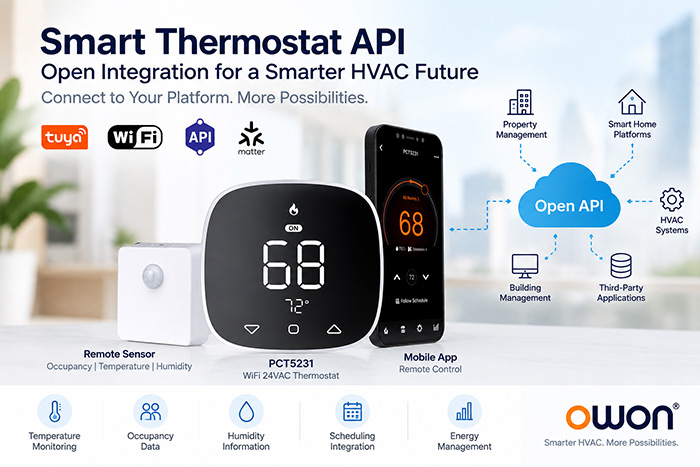
A smart thermostat API allows connected thermostats to exchange supported data and commands with third-party software, cloud platforms, mobile applications, or other IoT systems.
For HVAC manufacturers, smart home brands, system integrators, and property technology companies, API support can be just as important as HVAC compatibility. A thermostat may control heating and cooling perfectly on its own, but an API can make it possible to integrate that thermostat into a larger connected HVAC ecosystem.
This guide explains how thermostat APIs work, the difference between local and cloud APIs, and what to consider when selecting an API-enabled thermostat for an integration project.
What Is a Thermostat API?
API stands for Application Programming Interface. In a smart thermostat, an API provides a defined way for authorized software to communicate with the thermostat or its connected platform.
Depending on the product and API architecture, a thermostat API may provide access to information such as:
- Room temperature
- Humidity
- Occupancy status
- Heating and cooling setpoints
- HVAC operating mode
- Equipment status
- Schedules and device settings
Some APIs may also allow authorized applications to change supported thermostat settings.
The exact data points and commands vary by manufacturer and model, so developers should always review the API documentation before designing an integration.
How Does a Smart Thermostat API Work?
A typical connected thermostat collects temperature, HVAC status, and other supported sensor information. This information can then be made available to an authorized application through the thermostat’s integration architecture.
A simplified workflow looks like this:
Smart Thermostat → API → HVAC / IoT Platform → Web or Mobile Application
For example, a property management application might use a thermostat API to display room conditions and HVAC status. An HVAC manufacturer might integrate thermostat information into its own equipment platform, while a smart home company might incorporate thermostat controls into a branded application.
APIs therefore allow the thermostat to become part of a broader system rather than operate only as a standalone device.
Local API vs. Cloud API: What’s the Difference?
One important question when evaluating a WiFi thermostat API is where the communication takes place.
| Feature | Local API | Cloud API |
|---|---|---|
| Communication | Local network/device | Internet/cloud platform |
| Internet dependency | May not require Internet | Usually requires Internet |
| Typical use | Local automation, edge systems | Remote apps, multi-site management |
| Integration | Device/LAN oriented | Cloud/platform oriented |
A smart thermostat with open API does not automatically mean it provides a local API. “Open API” generally refers to the availability of an interface for integration, while local and cloud describe different communication architectures.
Before selecting a thermostat, confirm whether the project requires local device access, cloud integration, or another architecture.
Why Do Thermostat APIs Matter for HVAC and IoT Projects?
For individual homeowners, an app may provide all the control they need. B2B projects often have different requirements.
HVAC manufacturers may want thermostat data and controls integrated into their own HVAC ecosystem.
Smart home and IoT brands may need thermostats to work with their existing applications or connected-device platforms.
System integrators may need to connect HVAC controls with smart building, property management, or automation systems.
Multifamily and hospitality projects may require connected thermostat information as part of a broader property technology architecture.
In these applications, API capability can influence how easily a thermostat fits into the overall system.
What Should You Check Before Choosing a Smart Thermostat API?
API availability alone is not enough. Before selecting a thermostat for an integration project, evaluate several factors.
HVAC compatibility: Confirm voltage, conventional or heat-pump configuration, heating and cooling stages, auxiliary heat, and dual-fuel requirements.
API architecture: Determine whether the integration is local, cloud-based, device-level, or platform-level.
Available data: Ask which temperature, humidity, occupancy, HVAC status, and other data points are accessible.
Control commands: Confirm exactly which thermostat functions third-party software can control.
Authentication and security: Understand how applications and devices are authorized.
Scalability: Consider whether the architecture fits a single-device application or a larger multi-device deployment.
OEM customization: For branded products, determine whether hardware, firmware, UI, cloud, and integration functions can be customized.
These questions are particularly important for OEMs and system integrators because two thermostats that both advertise an “API” may provide very different integration capabilities.
OWON Smart Thermostats for Connected HVAC Projects
OWON develops WiFi thermostat platforms for compatible 24VAC HVAC systems and supports OEM/ODM projects for HVAC manufacturers, smart home brands, and system integrators.
Two thermostat platforms address different connected HVAC requirements.
PCT5231: Multi-Room Sensing for Connected HVAC
The PCT5231 Smart thermostat works with most compatible 24V heating and cooling systems, including conventional HVAC, heat pumps, auxiliary and emergency heat, and dual-fuel/hybrid systems.
A key feature is support for up to 10 remote zone sensors. These sensors provide occupancy, temperature, and humidity sensing, allowing information to be collected beyond the thermostat location.
This makes PCT5231 relevant to connected HVAC projects where multi-room sensing is part of the overall system design.
PCT533: Occupancy and Humidity-Aware HVAC Control
The PCT533 WiFi thermostat is another option for connected 24VAC HVAC projects. Its focus is different from PCT5231: it combines built-in occupancy sensing with temperature and humidity sensing and humidity-management capabilities.
This makes PCT533 particularly relevant when integrated occupancy detection and humidity control are important project requirements.
For either platform, OEM customers and system integrators should define the required data points, control commands, application architecture, and API requirements during project evaluation.
Smart Thermostat API Integration for OEM Projects
For an OEM project, selecting the thermostat hardware is only one part of the development process.
A typical integration discussion should define:
Thermostat → Connectivity → API / Platform → Customer Application
The HVAC manufacturer or IoT company should identify what information needs to be read, what functions need to be controlled, how many devices will be deployed, and whether the system requires local or cloud communication.
Defining these requirements early helps the thermostat manufacturer and integration team determine the appropriate technical architecture.
Frequently Asked Questions
Do smart thermostats have APIs?
Some do. API availability, accessible data, control commands, authentication methods, and integration architecture vary by manufacturer and model.
What is the difference between an open API and a local API?
An open API provides an interface that third-party developers can use under defined conditions. A local API specifically communicates within a local device or network environment. An open API is therefore not necessarily a local API.
Can a thermostat API integrate with a building management system?
Potentially, but compatibility depends on both systems. The thermostat API, BMS architecture, available data points, communication methods, and required control functions must be evaluated before integration.
What should an OEM ask a thermostat manufacturer about API integration?
Ask about API architecture, supported data and commands, authentication, device management, cloud requirements, scalability, documentation, firmware customization, and technical support.
Conclusion
A smart thermostat API can turn a connected thermostat into part of a larger HVAC, IoT, property management, or smart building ecosystem.
For B2B projects, the key question is not simply whether a thermostat “has an API.” Developers and system integrators should understand what the API can access, what it can control, where communication takes place, and how it fits into the overall system architecture.
For OEM and connected HVAC projects, selecting a thermostat platform with the right HVAC compatibility, sensing capabilities, and integration options can simplify development and create a more flexible foundation for future applications.
Post time: Sep-18-2026


