A two-stage furnace is designed to operate at different heating outputs depending on how much heat your home needs. To get the most from this setup, the thermostat and HVAC controls must be compatible with two-stage heating.
If you are looking for a thermostat for 2 stage furnace, the most important things to check are not the brand name or touchscreen design. Start with the HVAC system type, thermostat wiring, heating stages, power requirements, and how the furnace controls the second stage.
This guide explains what to look for before choosing a programmable, WiFi, or smart thermostat for a two-stage furnace.
What Is a 2 Stage Furnace?
A two-stage furnace has two levels of heating operation:
- Stage 1 provides lower heating output for normal heating demand.
- Stage 2 provides additional heating capacity when more heat is required.
Instead of operating at maximum heating output every time there is a call for heat, the system can use the appropriate stage based on its control strategy.
This is different from a single-stage furnace, which essentially has one heating output controlled by a single heat call.
For thermostat-controlled staging, the wiring commonly includes:
| Terminal | Typical Function |
|---|---|
| R / Rh | 24VAC power |
| C | Common wire |
| W1 | First-stage heating |
| W2 | Second-stage heating |
| G | Indoor fan |
| Y / Y1 | First-stage cooling, if applicable |
| Y2 | Second-stage cooling, if applicable |
Actual terminals and control logic vary by HVAC equipment, so the furnace installation manual and wiring diagram should always be checked.
Do I Need a Special Thermostat for a 2-Stage Furnace?
If the thermostat is expected to directly control both heating stages, you generally need a thermostat that supports two-stage heating.
The key indication is usually support for W1 and W2.
W1 calls for the first heating stage, while W2 can call for the second stage when additional heating is required.
However, not every two-stage furnace is configured in exactly the same way. Some HVAC equipment can use its own control board and timing logic to manage staging from a single thermostat heat call.
That means you should not choose a thermostat based only on the words “two-stage furnace.”
Before replacement, confirm:
HVAC voltage → furnace control configuration → W1/W2 wiring → cooling stages → C-wire requirements
Can I Use a Single-Stage Thermostat on a Two-Stage Furnace?
Sometimes, but it depends on the furnace and how its control board is configured.
With certain systems, a single-stage thermostat provides the heating call and the furnace control board determines when to activate the second stage. Other installations are designed for the thermostat to control W1 and W2 independently.
If the HVAC system is designed for thermostat-controlled two-stage operation, using a compatible 2 stage thermostat allows the thermostat to provide separate calls for the two heating stages.
For a replacement or retrofit project, the safest approach is to check the furnace manufacturer’s wiring documentation rather than assuming that any thermostat will provide full two-stage control.
How Many Wires Do I Need for a Two-Stage Thermostat?
There is no universal wire count for every two-stage HVAC system.
A basic two-stage heating configuration may require connections for functions such as:
R/Rh + W1 + W2, with additional wires depending on the system.
A complete heating and cooling system can also require:
C + G + Y1 + Y2 and other terminals.
This is why searching for a generic 2 stage thermostat wiring diagram can only provide a reference. The correct wiring depends on the furnace, air conditioner, thermostat and overall HVAC configuration.
A particularly useful check is whether your existing thermostat has separate W1 and W2 wires.
Important: Turn off HVAC power before inspecting or changing thermostat wiring. Follow the thermostat and HVAC equipment manufacturer’s installation instructions. Professional installation is recommended when the system configuration is unclear.
What Should You Look for in a Thermostat for a 2 Stage Furnace?
For most North American HVAC applications, start with compatibility before comparing smart features.
1. Two-Stage Heating Support
Look for a thermostat that supports W1 and W2 when the application requires thermostat-controlled two-stage heating.
2. 24VAC HVAC Compatibility
Many North American central furnaces use 24VAC thermostat controls, but this should be verified before installation.
Do not confuse a 24VAC furnace thermostat with thermostats designed for line-voltage electric heating.
3. Cooling Stage Support
The furnace is only part of the HVAC system.
If the same thermostat also controls central air conditioning, determine whether the cooling equipment is single-stage or two-stage and select the thermostat accordingly.
4. C-Wire Requirements
WiFi and smart thermostats require continuous power for electronics and wireless connectivity.
Depending on the thermostat and existing wiring, a C-wire or another approved power solution may be required.
5. Programmable or Smart Control
A programmable thermostat for 2 stage furnace can provide scheduled temperature changes.
A WiFi thermostat for 2 stage furnace adds connected features such as remote access, while a smart thermostat may add additional scheduling, sensor or automation capabilities.
Connectivity should come after HVAC compatibility, not before it.
Is a Smart Thermostat Good for a 2-Stage Furnace?
Yes—provided that the smart thermostat supports the required HVAC configuration.
A smart thermostat for 2 stage furnace can combine two-stage HVAC control with features such as:
- WiFi remote control
- Temperature scheduling
- Remote room sensing
- Temperature limits and device locking
- HVAC operating information
- Maintenance notifications
For homeowners, these features can improve convenience. For contractors, property managers and connected-HVAC projects, remote access and system integration can provide additional management capabilities.
But a thermostat being “smart” does not automatically mean that it supports two-stage heating.
Check HVAC compatibility first.
PCT5231 and PCT533 for Two-Stage HVAC Systems
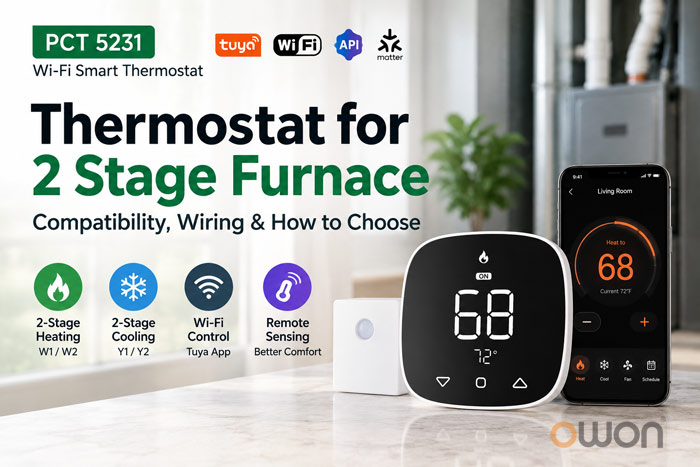
For compatible North American 24VAC conventional HVAC applications, the OWON PCT5231 and PCT533 are two smart thermostat platforms that support 2-stage heating and 2-stage cooling.
The PCT5231 provides W1/W2 and Y1/Y2 control along with WiFi connectivity, scheduling and support for remote room sensors. It is particularly relevant for connected HVAC projects that require remote sensing and flexible thermostat management.
The PCT533 also supports conventional 2H/2C HVAC systems while adding a 4.3-inch touchscreen, occupancy sensing and humidity-related control capabilities.
Both platforms also support more advanced HVAC configurations, but the correct thermostat configuration should always be selected according to the actual equipment and wiring.
For HVAC brands, distributors and system integrators, these platforms can also support OEM/ODM smart thermostat projects where hardware, firmware, connected functions and product branding need to be adapted for a target application.
Two-Stage Furnace vs. Two-Stage Heat Pump: Don’t Confuse Them
These terms describe different HVAC configurations.
A two-stage furnace generally refers to a furnace with two heating output stages, commonly associated with W1 and W2 control.
A heat pump thermostat may need to manage compressor stages, an O/B reversing valve, auxiliary heat and emergency heat.
Therefore, a thermostat advertised as “two-stage” should not automatically be assumed to work with every two-stage furnace or heat pump.
Always check the complete HVAC configuration.
FAQ
What thermostat do I need for a 2-stage furnace?
If your HVAC configuration uses thermostat-controlled two-stage heating, choose a thermostat that supports the required first- and second-stage heating connections, typically W1 and W2. Also verify voltage, cooling stages, C-wire requirements and the furnace manufacturer’s specifications.
Is there a two-stage thermostat?
Yes. Thermostats designed for multi-stage conventional HVAC systems can support first- and second-stage heating. Check the specifications for 2H or W1/W2 support rather than relying only on the product name.
Can I use a WiFi thermostat with a two-stage gas furnace?
Yes, if the WiFi thermostat supports the voltage, wiring and staging requirements of the furnace and overall HVAC system. For many North American systems, this means verifying 24VAC compatibility and W1/W2 support.
Is W2 always required for a two-stage furnace?
Not necessarily. Some furnace control boards can manage staging internally, while other configurations use separate thermostat calls for W1 and W2. Check the furnace wiring and control documentation.
Final Thoughts
Choosing the right thermostat for 2 stage furnace starts with the HVAC system—not the app, display or brand.
First confirm whether the furnace uses thermostat-controlled W1/W2 staging, then check 24VAC power, cooling stages, C-wire availability and the complete HVAC configuration.
Once those requirements are clear, you can decide whether a programmable, WiFi or smart thermostat provides the connected features your home or HVAC project needs.
For North American 24VAC projects requiring two-stage conventional HVAC control, platforms such as the OWON PCT5231 and PCT533 can provide a starting point for both finished-product selection and customized OEM/ODM thermostat development.
Post time: Oct-06-2026


