Every smart home product line has to start somewhere.
If you are a retailer, distributor, or private label brand, you usually don’t enter this space because you love sensors.
You enter it because you want products that actually sell.
And after some time, most people notice something a bit unexpected:
the first product that really behaves well in the market is often the simplest one.
A door sensor.
Not because it is impressive.
But because it is immediately understandable, even for someone who has never touched a smart home device before.
And in retail, that kind of clarity is rare enough to matter.
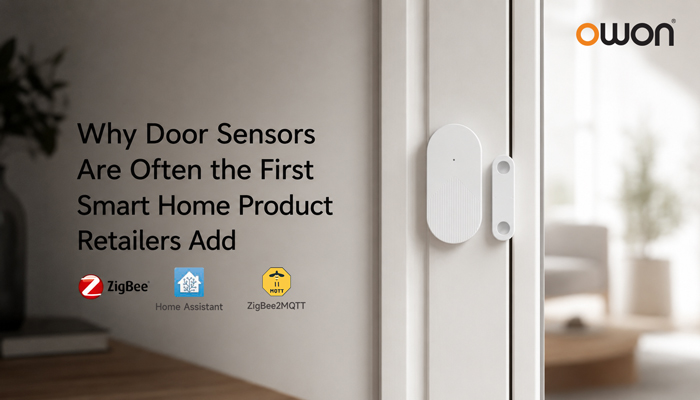
Customers Don’t Buy Smart Devices, They Buy What They Can Understand in Seconds
If you need more than one sentence to explain a product, you are already fighting an uphill battle.
A door sensor avoids that completely.
Open the door → detection → notification.
That’s it.
No system explanation. No architecture talk. No “let me explain Zigbee first”.
Just a clear cause-and-effect logic.
And if we are honest, that simplicity is exactly what makes it feel like a natural first smart home product in many catalogs.
Not the most advanced device.
But often the first one that doesn’t require explanation.
Why Door Sensors Are Safer for Retailers
From your side, the thinking is different.
You are not only asking “what sells”.
You are asking:
- how many support tickets this will create
- how much explanation customers will need
- how fast they understand the product page
- how risky post-sale issues might be
And here, door sensors quietly win again.
Compared with most smart home devices, they behave like a low-friction product category.
No hubs to explain. No complex setup logic.
Just install, pair, and done.
They are not exciting.
But they are predictable.
And in retail, predictability sells.
Why Single Devices Feel Like Parts, Not Products
A common issue with many smart home devices is fragmentation.
A motion sensor does one thing.
A temperature sensor does one thing.
A door sensor does one thing.
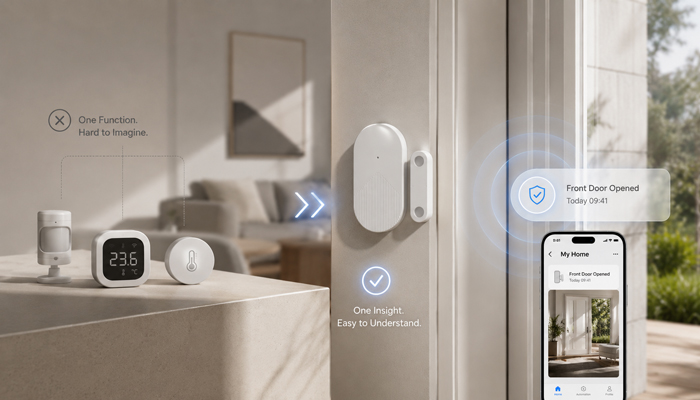
Individually, they feel like components, not systems.
And customers don’t get excited about components.
They get excited when they can imagine a system.
A door sensor, however, sits in a better position mentally.
Even non-technical users can instantly think:
“Okay, this tells me something important is happening in the home.”
That small mental step already moves them closer to purchase.
The Moment Customers Shift from Devices to Systems
At some point, something changes.
Customers stop asking:
“What is this device?”
And start asking:
“What can I build with this?”
This is the real turning point in smart home retail.
Not protocols. Not specs. Not integrations.
Just a shift from device thinking to system thinking.
And once that shift happens, even simple products like door sensors suddenly gain meaning.
They are no longer standalone devices.
They become triggers inside a system the customer is imagining.
Why Ecosystem Compatibility Quietly Matters
Most customers will never say:
“I need Zigbee2MQTT support.”
But they will check it somewhere else before buying.
Usually not on your product page.
More likely in forums, reviews, or setup videos.
So when a Zigbee door sensor works with:
- Home Assistant
- Zigbee2MQTT
- ZHA
It becomes less of a specification.
And more of a trust signal.
Because customers are not only buying hardware.
They are buying confidence that it will work later in their system.
Why Door Sensors Are the First Step in a Bigger Journey
If you sell long enough in smart home, you see a pattern.
Customers rarely stop at one device.
They start small.
Often with something like a door sensor.
Then they slowly expand:
- motion sensors
- smart plugs
- lighting control
- room automation setups
Not immediately. Not dramatically.
But steadily.
And from a retailer perspective, that is where value compounds.
Because the first product is not the end.
It is the beginning.
Where Door Sensors Fit Best in Product Strategy
Door sensors perform best as:
- entry-level smart home products
- e-commerce starter SKUs
- bundle components in kits
- private label launch products
- catalog foundation devices
They are not designed to be the hero product.
They are designed to be the easiest product to understand.
And sometimes, that is exactly what matters most.
Practical Example in Real Product Lines
In many portfolios, a Zigbee door sensor like this Zigbee Door Sensor is often used as the entry point into a broader smart home range.
Not because it carries the system.
But because it is simple enough to be accepted immediately, and flexible enough to sit inside larger ecosystems later.
Once that first step works, expanding into motion sensors, multi sensors, or smart plugs becomes much easier for both brand and customer.
Conclusion
Door sensors are not the most advanced product in a smart home lineup.
But they are often the most reliable starting point.
They are easy to understand, easy to sell, and easy to expand from.
And if you look closely at most successful smart home product lines, you will notice a pattern:
They did not start with complexity.
They started with something simple enough that nobody needed to ask twice.
And that is exactly where a door sensor fits.
Quietly opening the first door.
FAQ
What is a Zigbee door sensor used for?
It detects door or window open/close events and triggers automation or alerts in smart home systems.
Why do retailers prefer door sensors as first smart home products?
Because they are easy to understand, easy to install, and require very low customer support effort.
Are Zigbee door sensors compatible with Home Assistant and Zigbee2MQTT?
Many modern models support ecosystems like Home Assistant, Zigbee2MQTT, and ZHA, which is important for DIY users.
Is a door sensor a good entry-level smart home product?
Yes, it is often used as a starter SKU because it is simple, scalable, and easy to expand into a broader product portfolio.
Related reading:
[How to Choose a Reliable Zigbee Door Sensor Supplier]
Post time: Jun-24-2026