Introduction
Most landlords don’t think about thermostats until tenants start calling.
It usually sounds like this:
- “The apartment is too cold.”
- “The heating feels off.”
- “Can someone adjust the thermostat?”
In rental properties, HVAC complaints are one of the most common maintenance issues.
At the same time, another problem quietly grows in the background — rising energy costs caused by unrestricted thermostat usage.
This is why more property owners are starting to use smart thermostat systems for landlords to control HVAC behavior across multiple rental units.
What Is a Landlord Smart Thermostat System?
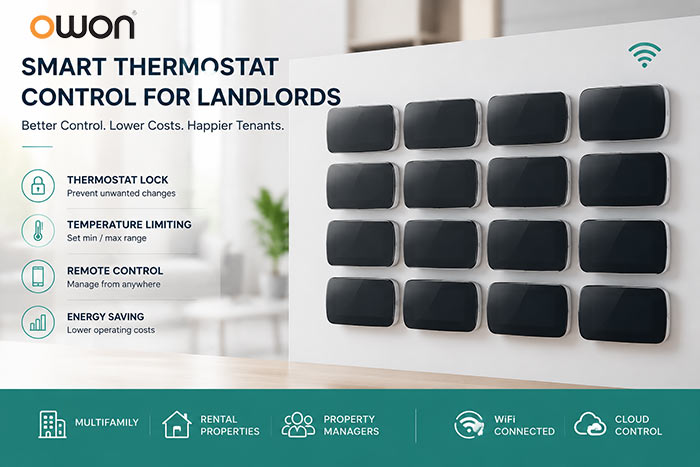
A landlord smart thermostat system allows property owners or managers to control HVAC settings in rental units remotely.
Instead of relying on tenants to manage temperature correctly, landlords can define how the system should operate.
Typical capabilities include:
- Remote temperature control
- Thermostat lock settings
- Temperature range limitation
- Multi-unit HVAC management
This is widely used in apartment buildings, rental portfolios, and student housing.
Why Thermostat Lock Matters in Rental Properties
A thermostat lock is not about limiting comfort.
It is about preventing extreme usage patterns.
In real-world rental operations, tenants may:
- Set cooling too low during summer
- Overheat units during winter
- Leave HVAC systems running unnecessarily
Over time, this leads to higher utility costs and unnecessary system wear.
With a thermostat lock, landlords can prevent extreme adjustments while still maintaining comfortable living conditions.
This is a core function of modern landlord HVAC control systems.
Temperature Limiting for Energy Cost Control
Another important feature is temperature limiting.
Instead of giving full control to tenants, landlords can define a safe operating range such as:
- Minimum cooling temperature
- Maximum heating temperature
This helps stabilize HVAC energy usage across different units and seasons.
It is especially useful in:
- Older apartment buildings
- Poor insulation properties
- High-occupancy rental portfolios
This is where landlord thermostat temperature limiting becomes a practical energy management tool.
Remote HVAC Control for Property Managers
Modern smart thermostat systems allow landlords and property managers to control HVAC settings remotely.
This eliminates the need for on-site adjustments.
With remote control, landlords can:
- Adjust temperature across multiple units
- Respond to tenant issues faster
- Standardize HVAC settings across properties
- Reduce maintenance visits
This is the core idea behind landlord thermostat control systems.
How Smart Thermostats Work in Rental Properties
Most modern systems are cloud-connected WiFi thermostats.
A typical structure looks like this:
Landlord Dashboard → Cloud Platform → Smart Thermostat → HVAC System
This setup allows real-time HVAC control across multiple buildings and units.
Why WiFi Smart Thermostats Are Used in Multifamily Housing
WiFi thermostats are widely adopted in multifamily and rental housing because they eliminate the need for additional gateways or complex infrastructure.
This makes them easier to deploy across large apartment portfolios while still allowing centralized HVAC control and energy management through cloud platforms.
Manufacturers like OWON Technology design smart thermostat solutions specifically for these scenarios, focusing on scalable deployment, HVAC compatibility, and remote management capabilities.
For example, OWON’s smart thermostat portfolio includes models designed for different levels of building automation:
- The PCT5231 WiFi Thermostat is designed for multi-zone residential and apartment applications, supporting remote sensors and centralized HVAC control across multiple units.
- The PCT533 WiFi Thermostat is built for more advanced smart building scenarios, offering occupancy-based control and energy usage monitoring for rental property management systems.
Both solutions are designed for large-scale deployment in multifamily housing, where consistency, remote management, and energy efficiency are critical.
Key Benefits for Landlords and Property Managers
Lower Energy Costs
Prevent unnecessary heating and cooling caused by tenant misuse.
Fewer HVAC Complaints
Reduce temperature-related service calls.
Centralized Control
Manage multiple rental units from one platform.
Better Equipment Protection
Avoid HVAC systems running under extreme conditions.
Landlord Smart Thermostat vs Traditional Thermostat
| Feature | Traditional Thermostat | Smart Landlord Thermostat |
|---|---|---|
| Remote Control | No | Yes |
| Temperature Limits | No | Yes |
| Thermostat Lock | No | Yes |
| Multi-unit Management | No | Yes |
| Energy Monitoring | No | Yes |
FAQ
What is a landlord smart thermostat?
It is a smart HVAC control system that allows landlords to remotely manage and restrict thermostat settings in rental properties.
What is thermostat lock used for?
It prevents tenants from changing HVAC settings beyond limits set by the property owner.
Why do landlords limit thermostat temperature ranges?
To reduce energy waste, stabilize HVAC usage, and avoid extreme heating or cooling behavior.
Can landlords control thermostats remotely?
Yes. With WiFi smart thermostats, property managers can control multiple units from a centralized platform.
Conclusion
Landlord smart thermostat systems are becoming a standard tool in rental property management.
Features such as thermostat lock, temperature limiting, and remote HVAC control help landlords reduce energy costs while improving operational efficiency across multiple units.
For multifamily property operators, these systems are no longer optional — they are part of modern HVAC management strategy.
Related reading
[Best Smart Thermostat for Apartments in North America (2026 Guide for Property Managers)]
Post time: Jun-24-2026