When an Energy Management System fails to deliver reliable insights, the problem is not always the software.
In many projects, the real issue starts at the meter level.
If the energy meter cannot provide stable communication, accurate real-time data, or the right electrical parameters, the EMS platform will only display incomplete or delayed information. For commercial buildings, industrial facilities, solar PV systems, and energy storage projects, choosing the right modbus energy meter is therefore a critical engineering decision.
A good meter should not only measure energy consumption. It should also support practical installation, communicate reliably with controllers or servers, and provide the data needed for energy analysis, automation, reporting, and system optimization.
Why Modbus Still Matters in EMS Projects
Modbus remains widely used in energy management because it is simple, open, and supported by many EMS, BMS, PLC, and SCADA platforms.
For system integrators, this matters because energy data often needs to be collected from different devices across electrical rooms, production areas, solar systems, and mechanical equipment. A meter that supports Modbus can be integrated into existing infrastructure without forcing the project to depend on one closed cloud platform.
In most EMS projects, two Modbus options are commonly considered:
Modbus RTU over RS485 is often used for wired industrial communication. It is suitable for stable local networking, long-distance wiring, and controller-based polling.
Modbus TCP is used over IP networks. It is often easier to connect with servers, gateways, dashboards, and local network-based energy platforms.
For many modern projects, the best solution is not choosing only one. A flexible meter that supports both Modbus TCP and Modbus RTU gives system integrators more options during deployment.
Check the Electrical System First
Before comparing software features, confirm the electrical environment.
An EMS project may involve:
- Single-phase systems
- Split-phase systems
- Three-phase four-wire systems
- Solar PV systems
- Energy storage systems
- Mixed commercial or industrial loads
If the meter supports only one electrical configuration, it may limit future deployment. For distributors, OEM partners, and system integrators, using one meter platform across multiple project types can reduce inventory complexity and make installation planning easier.
This is why a multi-system Modbus meter is often more practical than a meter designed for only one fixed wiring environment.
CT Clamp Installation Is Important for Retrofit Projects
In many existing buildings, shutting down power or rewiring distribution panels is difficult.
This is where a ct clamp energy meter becomes valuable.
Instead of placing the full load current directly through the meter, CT clamp meters measure current through external current transformers. This approach is especially useful for retrofit energy monitoring projects because it can reduce installation disruption and support higher current applications.
For commercial buildings, factories, schools, hotels, and solar retrofit projects, CT-based metering is often more practical than direct-connected metering.
When choosing a CT clamp meter, check:
- Supported CT current ratings
- Number of CT inputs
- Accuracy range
- Cable length
- Installation method
- Whether the meter supports import/export monitoring
For example, a 3-phase project normally requires up to three CT inputs. Solar and energy storage projects may also require bidirectional monitoring to understand both consumption and generation.
Why RS485 Is Still Useful
Although Ethernet and WiFi are common today, RS485 remains important in industrial and energy management systems.
A reliable rs485 energy meter is useful when the project requires wired communication, stable local polling, or integration with controllers and industrial gateways.
RS485 is especially suitable for:
- PLC integration
- Local controller polling
- Industrial automation panels
- Solar inverter communication
- Long-distance wired communication
- Sites where wireless communication is not preferred
For EMS projects, RS485 is not outdated. It is often the most stable and predictable option.
Do Not Only Look at kWh
Basic kWh data is useful, but modern EMS platforms often need more.
A strong Modbus energy meter should provide:
- Voltage
- Current
- Frequency
- Power factor
- Active power
- Reactive power
- Apparent power
- Import/export energy data
Reactive power and apparent power are especially useful for commercial and industrial energy analysis. They help engineers understand not only how much electricity is being used, but also how efficiently electrical loads are operating.
For solar PV and energy storage applications, bidirectional monitoring is also essential. The EMS or inverter platform needs to know whether power is being imported from the grid or exported from the site.
Consider EMS, BMS, SCADA and Private Cloud Integration
A meter used in EMS projects should not be judged only by its mobile app.
For B2B projects, integration flexibility is more important.
Depending on the project, the meter may need to communicate with:
- EMS platforms
- BMS platforms
- SCADA systems
- PLC controllers
- Solar inverters
- Energy storage controllers
- Private cloud servers
- Local dashboards
This is why communication protocols such as Modbus RTU, Modbus TCP, MQTT, and HTTP can be valuable. They allow system integrators to decide whether data should be read locally, sent to a private server, or connected to a larger energy management platform.
Where PC4713 Fits
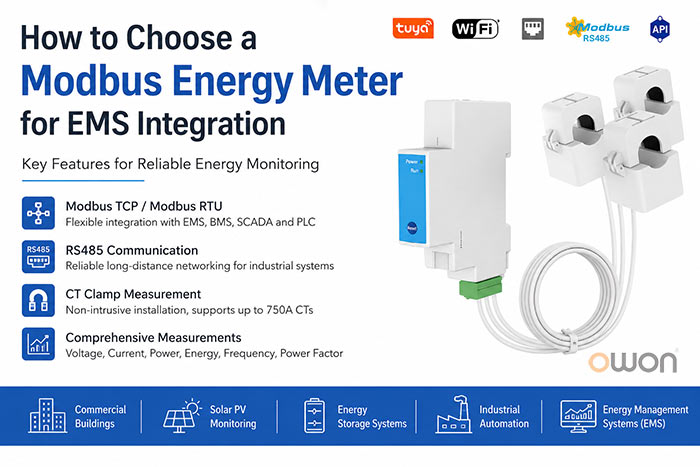
For projects that require Modbus communication, RS485 networking, and CT clamp-based monitoring, products such as the OWON PC4713-W-485 are designed for EMS, BMS, solar PV, and industrial energy monitoring applications.
The PC4713-W-485 supports WiFi and RS485 communication. Its WiFi communication supports HTTP, MQTT, and Modbus TCP, while the RS485 port supports Modbus RTU. It also supports real-time monitoring of voltage, current, power factor, frequency, active power, reactive power, apparent power, and bidirectional energy flow.
This makes it suitable for projects where energy data must be collected by an EMS platform, local server, inverter controller, or industrial automation system.
For system integrators looking for a scalable modbus energy meter, a CT-based platform with RS485 and Modbus TCP support can reduce integration risk and improve long-term deployment flexibility.
Final Thoughts
Choosing a Modbus energy meter for EMS integration is not simply about finding a device that supports Modbus.
The better question is:
Can the meter provide accurate data, reliable communication, flexible installation, and enough electrical parameters for the project?
For commercial buildings, solar PV systems, industrial facilities, and energy storage projects, the best choice is usually a meter that supports Modbus TCP, Modbus RTU, RS485 communication, CT clamp measurement, and bidirectional energy monitoring.
That combination gives EMS integrators the flexibility they need to build reliable, scalable, and future-ready energy monitoring systems.
Post time: Jun-23-2026