Introduction
Many smart automation systems struggle with unreliable motion detection. Traditional PIR sensors often fail to detect occupants who remain still, leading to inefficient HVAC operation, poor lighting control, and unnecessary energy consumption.
A zigbee presence sensor solves this problem by enabling accurate, real-time human detection—even when there is no visible movement. When integrated with Home Assistant, it allows system integrators and developers to build more reliable automation for smart buildings, energy management, and IoT projects.
What Is a Zigbee Presence Sensor in Home Assistant?
A Zigbee presence sensor detects whether a person is present in a space, rather than simply reacting to motion. Unlike PIR-based devices, radar-based sensors can identify micro-movements such as breathing or slight posture changes.
Within Home Assistant, a presence sensor becomes a powerful trigger for automation logic. It enables:
- Continuous occupancy detection for lighting and HVAC
- More accurate automation compared to motion-only triggers
- Real-time room usage monitoring
This makes it a critical component in modern zigbee presence sensor deployments for smart buildings and advanced home automation systems.
How to Integrate Zigbee Presence Sensor with Home Assistant
Home Assistant integrates with Zigbee devices through a coordinator and software layer. The two most common integration methods are:
Zigbee2MQTT
Zigbee2MQTT converts Zigbee device data into MQTT messages, allowing flexible integration with custom dashboards, APIs, and IoT platforms. It is ideal for developers and system integrators who need full control over automation logic.
ZHA (Zigbee Home Automation)
ZHA is Home Assistant’s native Zigbee integration. It is easier to set up and suitable for standard automation projects. For many deployments, ZHA provides a reliable way to connect Zigbee presence sensors without additional complexity.
Both methods enable seamless zigbee presence sensor integration into Home Assistant, allowing real-time occupancy data to drive automation scenarios.
Zigbee Presence Sensor vs PIR Motion Sensor
Zigbee presence sensors and PIR motion sensors are often used for occupancy detection, but they differ significantly in performance:
| Feature | PIR Motion Sensor | Zigbee Presence Sensor (Radar) |
|---|---|---|
| Detection Method | Detects motion only | Detects presence via radar |
| Stationary Detection | ❌ Not supported | ✅ Detects micro-movements |
| Accuracy | Medium | High |
| False Triggers | Higher | Lower |
| Best Use Cases | Basic lighting | HVAC, smart buildings, BMS |
| Automation Reliability | Limited | Continuous and stable |
For modern smart building and HVAC automation, radar-based presence sensors provide far more reliable results.
Use Cases in Smart Buildings & HVAC Systems
Zigbee presence sensors integrated with Home Assistant are widely used in:
HVAC Automation
Control heating and cooling based on real occupancy, reducing energy waste and improving system efficiency.
Smart Offices
Ensure lights and climate systems remain active during meetings or desk work, even when occupants are stationary.
Hotels & Hospitality
Improve guest comfort while minimizing unnecessary energy consumption in rooms and corridors.
Building Management Systems (BMS)
Provide accurate occupancy data for analytics, automation, and space utilization optimization.
Best Zigbee Presence Sensor for Home Assistant
When selecting a presence sensor for Home Assistant, it is important to consider detection technology, coverage, and integration capability.
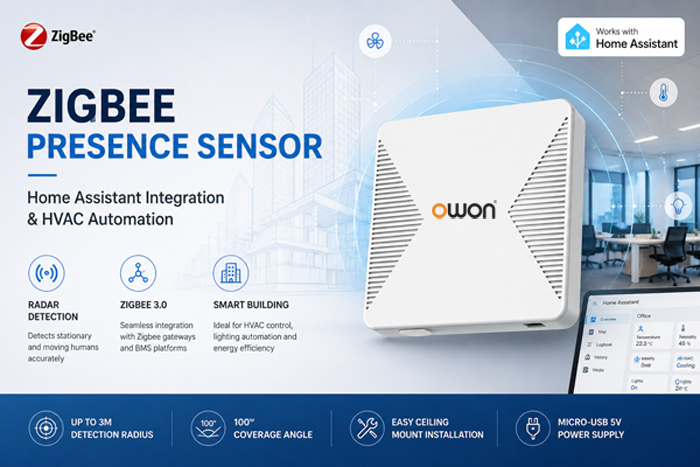
Ceiling-mounted radar-based sensors are often preferred for professional deployments. For example, devices like Owon’s OPS305 zigbee occupancy sensor are designed for scenarios where traditional PIR sensors are not reliable. They provide stable, accurate presence detection for smart building and HVAC automation projects.
FAQs
Q: Does a Zigbee presence sensor work with Home Assistant?
Yes. Most ZigBee 3.0 presence sensors can be integrated with Home Assistant via ZHA or Zigbee2MQTT.
Q: What is the advantage over PIR motion sensors?
Presence sensors detect continuous occupancy, even when people remain still, while PIR sensors only detect motion.
Q: Is Zigbee2MQTT required?
Not necessarily. You can use either Zigbee2MQTT or ZHA depending on your system requirements.
Conclusion
Integrating a Zigbee presence sensor with Home Assistant significantly improves automation accuracy compared to traditional motion-based systems. By using radar-based detection, these sensors enable reliable occupancy awareness, making them ideal for smart building, HVAC, and energy management applications.
For system integrators and developers, combining Zigbee presence sensing with Home Assistant creates a flexible and scalable foundation for advanced IoT automation.
Related reading:
[How to Choose a Zigbee Smart Hotel OEM/ODM Partner for IoT Projects]
Post time: Apr-25-2026