A 3 phase 3 wire energy meter is designed to measure electrical consumption in three-phase systems that use three phase conductors without a neutral conductor in the monitored supply. It is commonly used in industrial equipment, commercial electrical installations, and three-phase distribution systems.
Unlike a standard three-phase four-wire installation, a 3-phase 3-wire system requires a compatible meter and the correct voltage and current measurement connections.
For installers and energy management professionals, understanding the CT connection diagram, phase wiring, and meter compatibility is essential for accurate monitoring.
This guide explains how a three-phase three-wire energy meter works, how CT clamps are connected, and how to select a suitable meter for Delta and other compatible electrical systems.
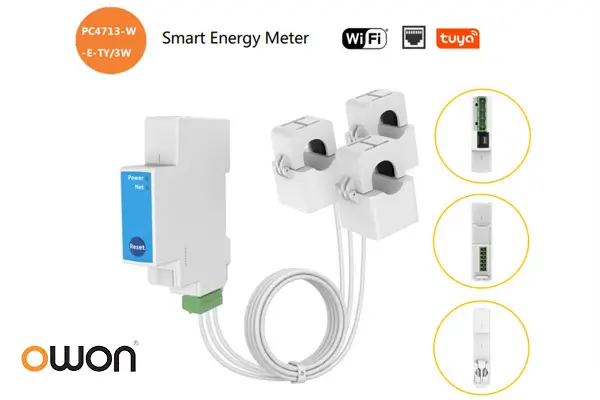
What Is a 3 Phase 3 Wire Energy Meter?
A 3 phase 3 wire energy meter measures electrical parameters in a three-phase electrical system using three phase conductors: L1, L2, and L3.
Unlike a three-phase four-wire system, a three-phase three-wire system does not use a neutral conductor as part of the monitored three-phase supply.
These systems are commonly found in certain industrial and commercial installations, including Delta-connected electrical networks.
A compatible three-phase energy meter can measure:
- Voltage and current
- Active power (W)
- Reactive power (var)
- Apparent power (VA)
- Power factor
- Frequency (Hz)
- Accumulated energy consumption (kWh)
When equipped with external current transformer (CT) clamps, the meter can monitor current without requiring the full load current to pass through the meter itself.
3 Phase 3 Wire vs. 3 Phase 4 Wire Energy Meter
The main difference is the electrical system configuration and the meter’s supported measurement connections.
| Feature | 3 Phase 3 Wire | 3 Phase 4 Wire |
|---|---|---|
| Conductors | L1, L2, L3 | L1, L2, L3, N |
| Neutral conductor | Not used in the monitored supply | Present |
| Typical system | Certain Delta and three-wire systems | Common star (Y) systems |
| Meter requirement | 3-wire compatible meter | 4-wire compatible meter |
| CT monitoring | Depends on meter design | Depends on meter design |
A common mistake is assuming that every three-phase energy meter supports both configurations.
Before purchasing, check whether the manufacturer explicitly specifies 3P3W, 3P4W, and Delta compatibility.
3 Phase 3 Wire Energy Meter Connection Diagram with CT
A CT-based three-phase energy meter uses current transformer clamps to measure current in the electrical conductors.
The following diagram from the OWON PC4713-W-E-TY/3W Quick Start Guide illustrates the manufacturer’s three-phase three-wire connection arrangement.
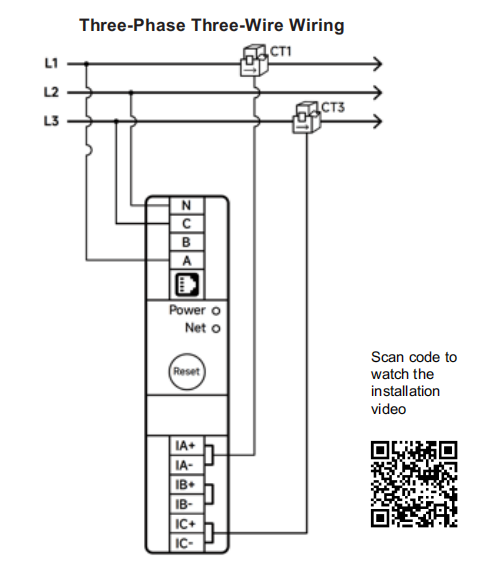
The diagram identifies the three phase conductors and the corresponding meter connections. It also shows the CT placement and terminal connections for this specific meter configuration.
When reviewing a 3 phase 3 wire energy meter connection diagram with CT, pay attention to the following:
- Phase connections: Identify L1, L2, and L3 correctly.
- CT positioning: Install the CT clamps on the conductors indicated in the manufacturer’s three-wire diagram.
- CT polarity: Follow the specified CT orientation and terminal polarity.
- Phase matching: Ensure the current measurement channels correspond to the correct voltage measurement configuration.
Important: The PC4713-W-E-TY/3W three-wire diagram is different from its four-wire diagram. Follow the exact manufacturer diagram rather than assuming that all three CT inputs must be connected in the same way as a three-phase four-wire installation.
How to Connect a 3 Phase 3 Wire Energy Meter
Although wiring arrangements vary between manufacturers and meter models, the general installation process involves the following steps:
- Identify the electrical system. Confirm that the installation is a three-phase three-wire system and check the nominal voltage and frequency.
- Mount the energy meter. Install the meter on the appropriate DIN rail inside the electrical enclosure.
- Connect the voltage measurement wiring. Follow the dedicated 3P3W wiring diagram supplied with the meter.
- Install the CT clamps. Position the current transformers on the specified phase conductors according to the manufacturer’s diagram.
- Connect the CT terminals. Match each CT lead to its designated input and polarity.
- Verify the installation. Check phase correspondence, CT orientation, terminal connections, and the meter configuration before energizing the system.
Electrical installation must be performed by qualified personnel. Isolate the power supply and verify the absence of voltage before working on electrical connections. Follow the product manual and applicable local electrical regulations.
Can a 3 Phase 3 Wire Energy Meter Measure Delta Systems?
Yes, provided the meter explicitly supports three-phase three-wire and Delta configurations.
Delta systems are commonly associated with three-phase three-wire electrical networks. However, not every three-phase energy meter supports this connection method.
For example, the OWON PC4713-W-E-TY/3W supports:
- Three-phase three-wire (3P3W)
- Delta connections
- Three-phase four-wire (3P4W)
- Single-phase
- Split-phase
Its specified three-phase three-wire supply is 3 × 400V AC, 50/60Hz, with a line-to-line voltage measurement range of 156–480V.
This makes it suitable for compatible three-phase monitoring projects that require a dedicated 3P3W energy meter.
OWON PC4713-W-E-TY/3W: Smart Three-Phase Energy Monitoring
For projects requiring both three-phase three-wire measurement and smart energy monitoring, the OWON PC4713-W-E-TY/3W provides a dedicated solution.
Key features include:
- 3P3W and Delta compatibility: Supports three-phase three-wire measurement, as well as compatible three-phase four-wire, single-phase, and split-phase systems.
- External CT sensors: Supports different CT measurement ranges, including 80A, 120A, 200A, 300A, 500A, and 750A.
- WiFi and Ethernet: Provides wireless and wired network connectivity.
- Tuya and Smart Life: Enables compatible energy monitoring and smart home automation.
- Home Assistant integration: Supports smart home energy monitoring projects.
- Bidirectional measurement: Monitors electricity usage and solar energy flow.
- Electrical measurements: Provides voltage, current, active power, reactive power, apparent power, power factor, and frequency readings.
The meter also supports historical energy data, offline data storage, and automatic data reporting after network reconnection.
For system integrators and energy management providers, these features make it suitable for smart building, commercial energy monitoring, and solar-related applications.
Important: The 3P3W capability is specific to the PC4713-W-E-TY/3W variant. Other PC4713 versions do not necessarily support three-phase three-wire or Delta connections. Always confirm the exact model configuration before ordering.
Frequently Asked Questions
What is the difference between a 3 phase 3 wire and 4 wire energy meter?
A three-phase three-wire meter is designed for systems with three phase conductors and no neutral in the monitored supply. A four-wire meter supports three phase conductors plus neutral. The meter must match the electrical system.
How many CT clamps are needed for a 3 phase 3 wire energy meter?
The number of CT clamps depends on the meter’s measurement design and manufacturer wiring diagram. Do not assume that every three-wire meter uses the same CT arrangement. Follow the specific product’s 3P3W connection diagram.
Can a 3 phase 3 wire energy meter work with a Delta system?
Yes. A meter explicitly designed for three-phase three-wire and Delta connections can be used in compatible Delta installations.
Can a three-phase energy meter monitor 480V systems?
Some meters support line-to-line voltage measurements up to 480V. Always check the rated voltage range and supported wiring configuration. The OWON PC4713-W-E-TY/3W specifies a 156–480V line-to-line measurement range.
Can a CT-based three-phase energy meter monitor solar power?
A compatible bidirectional energy meter can measure electricity flowing into and out of a monitored connection. Measuring total solar generation separately may require an additional measurement point.
Conclusion
Choosing the right 3 phase 3 wire energy meter requires more than checking its rated voltage and current range. The meter must support the correct electrical configuration, CT arrangement, and measurement requirements.
For industrial and commercial projects, a dedicated 3P3W-compatible energy meter helps simplify three-phase monitoring and integration.
OWON Technology provides smart energy meters with WiFi, Ethernet, Tuya, and Home Assistant integration options, supporting different electrical systems and energy monitoring applications.
Explore OWON’s smart energy meter solutions or contact our team to discuss a suitable CT-based energy monitoring solution for your project.
OWON Technology – Smart Energy Meter Manufacturer | OEM/ODM Solutions
Post time: Nov-17-2026