A Zigbee underfloor heating controller provides a practical way to integrate water-based floor heating into a smart home or building automation system. By combining temperature sensors, manifold valve actuators, and a Zigbee controller, heating systems can respond to actual temperature conditions and manage different heating circuits.
In Europe, hydronic underfloor heating is widely used in residential buildings, apartments, and some commercial projects. Unlike electric floor heating, it circulates warm water through pipes installed beneath the floor.
This article explains how a Zigbee underfloor heating control system works, what components are required, and how it can be integrated into a wider smart heating solution.
1. How Does a Hydronic Underfloor Heating System Work?
A hydronic underfloor heating system uses warm water circulated through pipes beneath the floor to heat indoor spaces.
A typical installation includes:
- A boiler or heat pump as the heat source.
- A manifold to distribute hot water.
- Underfloor heating pipes installed in different rooms or zones.
- Thermal valve actuators to regulate water flow.
- Temperature sensors and controllers to manage heating demand.
The manifold is particularly important because it distributes water to different heating circuits.
For example, a house may have separate heating circuits for the living room, kitchen, and bedrooms. Each area may require different temperature settings and heating schedules.
A smart controller helps coordinate these components according to the project’s control requirements.
2. What Does a Zigbee Underfloor Heating Controller Do?
A Zigbee underfloor heating controller connects the heating control system with wireless sensors and a smart automation platform.
Instead of relying only on manual adjustment, the system can use temperature information and configured control rules to manage heating operations.
Its typical functions include:
- Receiving temperature information from compatible sensors.
- Controlling manifold valve actuators.
- Managing heating circuits according to configured requirements.
- Supporting integration with a wider smart heating system.
The exact control functions depend on the controller’s hardware, wiring configuration, and system integration.
For homeowners, this can provide more convenient heating management. For installers and system integrators, it offers opportunities to develop connected heating solutions for multiple rooms or properties.
3. Key Components of a Zigbee Underfloor Heating Control Solution
A complete solution generally combines temperature sensing and valve control.
Temperature Sensor with External Probe
A temperature sensor with an external probe can measure temperature at a specific location, such as the floor or another designated measurement point.
For underfloor heating, floor temperature information is useful because the temperature beneath the floor may differ from the room air temperature.
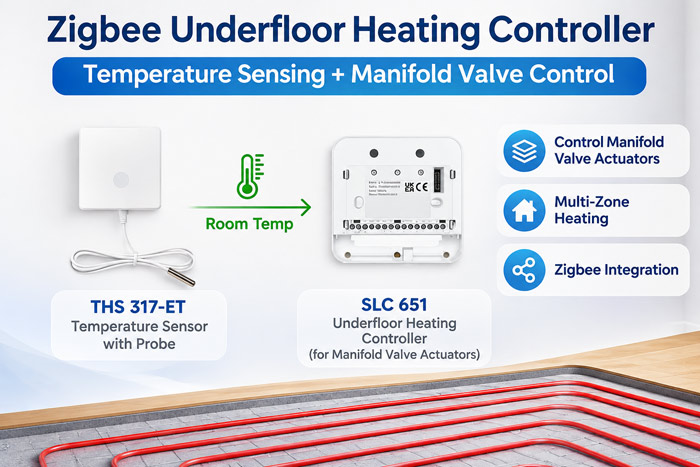
OWON’s THS317-ET Zigbee Temperature Sensor with Probe is designed to monitor floor temperature in hydronic underfloor heating applications.
Underfloor Heating Controller
The controller manages the heating valves according to the configured control logic.
OWON’s SLC651 Zigbee Underfloor Heating Controller is designed to control manifold valve actuators in water-based underfloor heating systems.
By combining THS317-ET and SLC651, system integrators can build a temperature-monitoring and manifold-control solution.
The wider system can also incorporate a Zigbee gateway and a management platform for centralized monitoring and customized automation.
4. How Do the Temperature Sensor and Controller Work Together?
Consider a European apartment with underfloor heating in several rooms.
The basic control process is:
- The THS317-ET measures the temperature at the selected floor measurement location.
- Temperature information is delivered to the system.
- The configured control logic determines whether heating is required.
- The SLC651 controls the corresponding manifold valve actuator.
- Water flow through the heating circuit is adjusted according to the control demand.
This arrangement helps connect temperature sensing with physical heating control.
For multi-room projects, the number of sensors, actuators, control outputs, and heating zones must be planned according to the actual SLC651 configuration and project requirements.
5. Where Are Zigbee Underfloor Heating Controllers Used?
A Zigbee underfloor heating controller can be considered for different European building applications.
Residential Homes: Manage water-based floor heating and support smart temperature monitoring.
Apartments: Integrate heating controls into apartment automation systems.
Hotels and Serviced Apartments: Combine room-level temperature sensing with centralized building management.
Smart Building Projects: Connect heating devices, sensors, and gateways through a unified automation architecture.
For professional projects, the controller should be selected according to the manifold configuration, valve actuator specifications, installation requirements, and integration platform.
6. What Should You Check Before Choosing a Zigbee Underfloor Heating Controller?
Before selecting a controller, consider these important factors:
Heating System Type: Confirm that the product is designed for hydronic underfloor heating rather than assuming it also supports electric heating cables.
Valve Actuator Compatibility: Check the actuator voltage, wiring, control method, and electrical ratings.
Temperature Measurement: Determine whether room temperature, floor temperature, or both are required.
Zigbee Integration: Verify the exact device compatibility and available functions with your intended gateway or automation platform.
System Expansion: Consider the number of heating circuits, rooms, sensors, and actuators required for the project.
Testing the complete configuration before large-scale deployment is recommended.
7. OWON Zigbee Underfloor Heating Control Solution
OWON provides Zigbee-based devices for residential heating and smart building applications.
For hydronic underfloor heating, the THS317-ET Temperature Sensor with Probe and SLC651 Underfloor Heating Controller form a practical product combination.
THS317-ET provides floor temperature measurement, while SLC651 controls manifold valve actuators.
They can also be incorporated into a broader heating management architecture involving Zigbee gateways, boiler or heat pump controllers, radiator valves, and other smart devices.
As an IoT manufacturer offering OEM/ODM services, OWON supports system integrators and solution providers developing customized smart heating and building automation projects.
Conclusion
A Zigbee underfloor heating controller helps connect temperature sensing with manifold valve control, making hydronic heating systems easier to integrate into smart building environments.
For European residential and commercial projects, selecting the right combination of sensors, controllers, valve actuators, and gateways is essential.
OWON’s THS317-ET and SLC651 provide a product combination for developing Zigbee-based water underfloor heating control solutions.
Looking for a Zigbee underfloor heating control solution for your next project? Contact OWON to discuss your device selection, integration, and OEM/ODM requirements.
Post time: Nov-03-2026