An energy saving thermostat can help reduce unnecessary heating and cooling by maintaining comfortable temperatures and adjusting HVAC operation around daily routines.
But saving energy is not simply about buying a smart thermostat. The temperature settings, schedules, HVAC system type, and household habits all matter.
For North American homes with central AC, furnaces, or heat pumps, here are seven practical ways to manage comfort while reducing energy waste.
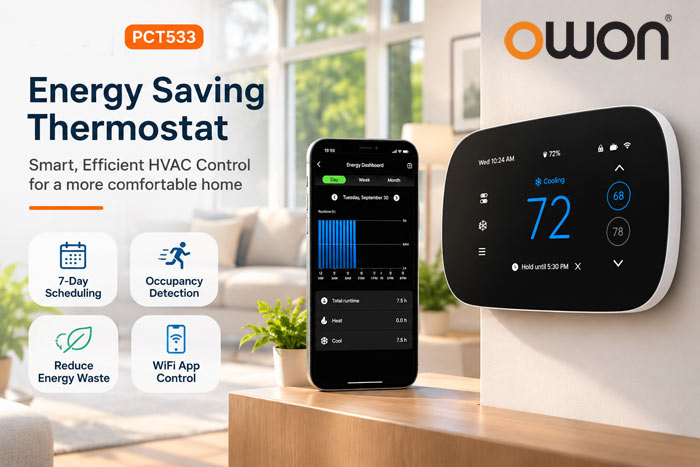
1. What Is an Energy Saving Thermostat?
An energy saving thermostat helps homeowners manage heating and cooling more efficiently through features such as:
• Programmable temperature schedules
• WiFi remote control
• Home, Away, and Sleep modes
• Compatible room temperature sensors
• Occupancy-based adjustments
• Heat pump and multi-stage HVAC control
A basic programmable thermostat can also support energy-saving schedules. Smart models add convenience through connected controls and additional sensing capabilities.
Actual savings depend on the building, HVAC equipment, climate, and how the thermostat is configured.
2. Best Energy Saving Thermostat Settings for Winter
During winter, lowering the heating setpoint when appropriate can reduce heating demand.
For many homes, 68°F (20°C) is a practical starting point when occupants are awake and at home.
| Winter Situation | Suggested Starting Point |
|---|---|
| Home and awake | 68°F (20°C) |
| Sleeping | Slightly lower if comfortable |
| Away | Lower according to household needs |
These are general guidelines, not universal requirements.
Important for heat pumps: Large temperature setbacks may activate auxiliary electric heating during recovery. For some heat pump systems, smaller adjustments or a relatively steady setpoint may be more efficient.
Always consider the equipment’s control strategy before making major schedule changes.
3. Best Thermostat Settings for Summer
During cooling season, a higher indoor temperature generally reduces the workload on central air conditioning.
A common energy-saving reference is 78°F (26°C) when occupants are home and need cooling.
| Summer Situation | Suggested Starting Point |
|---|---|
| Home | 78°F (26°C) |
| Away | A few degrees higher when appropriate |
| Sleeping | Adjust for comfort and humidity |
Avoid setting an extremely low temperature to cool the house faster. Most conventional residential AC systems do not cool faster simply because the thermostat is set much lower.
In humid climates, temperature settings should also account for indoor moisture control.
4. How to Create an Energy Saving Thermostat Schedule
A practical energy saving thermostat schedule should match when people are home, away, or sleeping.
For example:
| Schedule | Time | Heating | Cooling |
|---|---|---|---|
| Home | 7:00 AM | 68°F | 78°F |
| Away | 8:00 AM | 65°F | 82°F |
| Home | 6:00 PM | 68°F | 78°F |
| Sleep | 10:00 PM | 66°F | 80°F |
Illustrative schedule only. Adjust temperatures and times for comfort, humidity, household needs, and HVAC equipment.
For heat pumps with electric auxiliary heat, smaller heating setbacks may be preferable.
WiFi thermostats make these adjustments easier through app-based scheduling. Some models also offer preheating or precooling to reach the desired temperature at a scheduled time.
5. Can Room Sensors and Occupancy Detection Help Save Energy?
The thermostat’s installation location may not represent temperatures throughout the home.
Remote room sensors can provide additional temperature information from bedrooms, living rooms, or other spaces.
Depending on the thermostat’s supported functions, sensor participation settings may help prioritize comfort in selected rooms.
Occupancy detection can also support control strategies based on whether a space is being used.
However, remote sensors do not automatically create independent HVAC zones, and sensing features alone do not guarantee energy savings.
The benefit depends on how the thermostat uses the sensor information.
6. Energy Saving Tips for Heat Pumps and Dual Fuel Systems
Heat pumps require special consideration because their heating efficiency and backup heat operation differ from conventional furnaces.
Before changing thermostat settings, verify:
- Heat pump heating and cooling stages
- Auxiliary and emergency heat configuration
- Dual-fuel heating settings, where applicable
- Temperature recovery behavior
- Compatibility with the installed 24VAC HVAC system
For dual-fuel systems, the thermostat and HVAC controls must be configured to manage the heat pump and secondary heating source correctly.
An incorrect setup may reduce comfort or cause inefficient equipment operation.
Professional installation and commissioning are recommended for complex multi-stage systems.
7. Are Energy Saving Thermostat Rebates Available?
Some utility companies and energy-efficiency programs in the United States and Canada offer incentives for eligible smart thermostats.
However, rebate availability varies by location, utility provider, equipment type, and approved product list.
Before purchasing, check:
- Local utility rebate programs
- Eligible thermostat models
- Installation requirements
- Program terms and application deadlines
A thermostat with WiFi or scheduling features is not automatically eligible for every rebate.
OWON WiFi Thermostats for Smart HVAC Energy Management
OWON Technology develops WiFi thermostats for compatible North American 24VAC HVAC systems, supporting residential upgrades and professional HVAC applications.
OWON PCT5231 – Smart Scheduling and Room Sensors
The PCT5231 offers:
- 7-day programmable scheduling
- WiFi app-based temperature control
- Support for up to 10 compatible remote room sensors
- Preheating and precooling functions
- Up to 2H/2C conventional HVAC control
- Up to 4H/2C heat pump configurations
- Dual-fuel, auxiliary, and emergency heat support
These capabilities help homeowners and HVAC professionals implement more flexible temperature management.
OWON PCT533 – Occupancy-Aware Comfort Control
The PCT533 combines WiFi connectivity with occupancy radar sensing, humidity monitoring, and multi-stage HVAC control.
It is designed for compatible 24VAC HVAC applications where connected comfort management and occupancy information are important.
Neither model should be associated with a specific energy-saving percentage without supporting test data.
Frequently Asked Questions
What is the most energy-efficient thermostat temperature?
There is no single ideal temperature for every home. Common starting points are 68°F for winter heating and 78°F for summer cooling, adjusted for comfort and HVAC requirements.
Does lowering the thermostat at night save energy?
It can reduce heating demand, but heat pumps may require smaller setbacks to avoid inefficient auxiliary heat operation.
Is a programmable thermostat enough to save energy?
Yes. A properly configured programmable thermostat can reduce unnecessary heating and cooling. WiFi models add remote access and other convenient features.
Can smart thermostats reduce electricity bills?
They may help reduce HVAC energy consumption when used effectively, but actual savings depend on equipment efficiency, climate, insulation, schedules, and household behavior.
Are energy saving thermostats compatible with all HVAC systems?
No. Check voltage, wiring, heating and cooling stages, and equipment type before installation. OWON PCT5231 and PCT533 are designed for compatible 24VAC systems, not direct connection to 120V or 240V line-voltage controls.
Final Thoughts
An energy saving thermostat works best when its temperature settings, schedules, and HVAC configuration match the home’s actual needs.
For conventional central HVAC, heat pumps, and dual-fuel systems, choosing a compatible smart thermostat can make temperature management more convenient while helping avoid unnecessary heating and cooling.
OWON Technology provides 24VAC WiFi thermostats and OEM/ODM customization services for HVAC distributors, smart home brands, contractors, and system integrators.
Explore OWON WiFi Thermostat Solutions for product information and professional HVAC applications.
Post time: Nov-14-2026