Introduction
For regional HVAC service providers, home security companies, smart home operators, and managed service organizations, recurring service revenue has become increasingly important. Modern customers expect connected HVAC control, remote monitoring, and mobile access as part of a broader subscription-based service package.
As a result, selecting the right 24VAC WiFi thermostat platform is no longer simply a hardware purchasing decision. It directly impacts installation efficiency, fleet management costs, customer retention, and long-term contract profitability.
This article explores how commercial thermostat platforms with Tuya SaaS integration can help service providers streamline operations, reduce installation costs, and create new recurring revenue opportunities.
1. Streamlining the Subscription Economy Through Tuya SaaS Integration
For large-scale regional home security providers, HVAC service companies, and smart home operators, maximizing subscriber lifetime value influences every operational decision.
A commercial 24VAC WiFi thermostat platform should integrate seamlessly into existing software infrastructure while supporting scalable fleet management. This is where Tuya SaaS integration becomes particularly valuable.
By mapping dedicated Tuya Data Points (DPs) directly into a central monitoring station or proprietary service platform, service providers gain granular control over every deployed thermostat.
This cloud-to-cloud integration enables:
- Centralized fleet management
- Remote configuration and diagnostics
- Automated customer onboarding
- Climate automation workflows
- Energy optimization programs
- HVAC performance monitoring
- Integration with security and smart home services
Rather than managing thermostats through fragmented consumer applications, service providers can operate from a unified backend platform.
This allows operators to bundle HVAC automation, predictive maintenance services, and home security workflows under a single subscription model while improving operational visibility across the entire installed base.
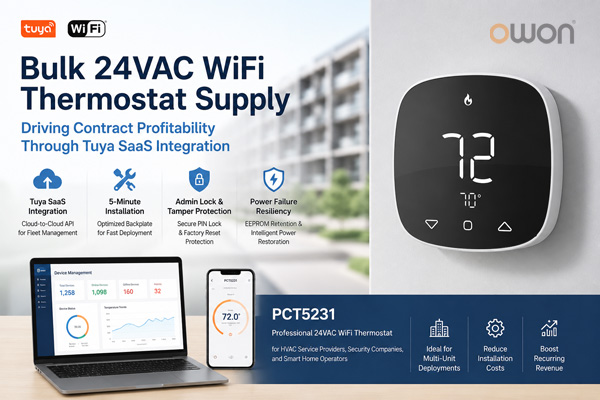
As one example, the OWON PCT5231 24VAC WiFi thermostat supports Tuya cloud connectivity, scheduling, remote sensor integration, and centralized management capabilities suitable for large-scale deployment programs.
2. Optimizing Fleet Operations: The 5-Minute Backplate Protocol
When thermostat hardware is used as part of a customer acquisition strategy or bundled into multi-year service agreements, installation efficiency directly affects profitability.
Every additional minute spent onsite reduces technician productivity and increases deployment costs.
A commercial thermostat platform should therefore be engineered to simplify installation and commissioning.
Standardized North American Terminal Mapping
The thermostat backplate should support the most common North American HVAC configurations, including:
- Conventional forced-air systems
- Multi-stage systems
- Heat pumps
- Dual fuel systems
- Auxiliary heat configurations
Clear terminal layouts reduce wiring errors and shorten installation time.
The 5-Minute Installer Target
The backplate design should support rapid wiring, leveling, mounting, and commissioning.
For field service fleets deploying hundreds or thousands of units annually, reducing installation time by even a few minutes per site can significantly improve profitability.
Faster deployment means more completed installations per technician and lower labor costs per contract.
Eliminating Battery-Stealing Failures
Many retail thermostats rely on power-stealing techniques that can create voltage instability, transformer stress, and HVAC control issues.
Commercial 24VAC C-wire thermostat platforms avoid these problems by utilizing dedicated HVAC power wiring.
This helps reduce service calls, installation failures, warranty claims, and product return rates.
For service providers managing large installed fleets, reliability often matters more than feature count.
3. Why Fleet Reliability Matters: Power Failure and Offline Resiliency
Managed properties frequently experience localized power outages, voltage fluctuations, and network disruptions.
Under these conditions, many consumer smart thermostats lose programming, disconnect from cloud services, or require manual recommissioning.
For service providers, every truck roll generated by a failed thermostat directly impacts profitability.
Commercial thermostat platforms should therefore be designed for operational autonomy.
Non-Volatile Memory Retention
In the event of a complete power loss, schedules, WiFi credentials, HVAC parameters, and user settings should remain securely stored.
This eliminates the need for technicians to manually restore thermostat configurations after outages.
Intelligent Power-Restoration Protection
When power is restored to large apartment communities, managed properties, or commercial facilities, simultaneous HVAC startup can place significant stress on electrical systems and compressors.
Commercial-grade firmware should include staggered startup routines and intelligent restart delays that protect both HVAC equipment and electrical infrastructure.
These protections are particularly valuable in large-scale managed deployments where hundreds of HVAC systems may restart simultaneously.
4. Tenant and User Tampering: The Need for Administrator Controls
A challenge frequently overlooked in consumer thermostat design is unauthorized user intervention.
In rental properties, managed housing, and service-based thermostat deployments, users may:
- Reset devices
- Change WiFi credentials
- Modify HVAC settings
- Disable cloud connectivity
- Remove operational restrictions
Each incident can trigger support requests and technician dispatches.
Advanced Administrator PIN Lock Protection
Commercial thermostat platforms should support administrator-level access control.
Service providers can remotely define permissions and restrict access to critical system settings while still allowing customers to adjust comfort temperatures within approved ranges.
Factory Reset Protection
Preventing unauthorized factory resets reduces unnecessary service visits and helps maintain platform integrity across large deployments.
For subscription-based service providers, centralized device control is often as important as HVAC functionality itself.
5. Engineering Safety: Protecting Heat Pumps and HVAC Assets
The ultimate measure of a commercial thermostat platform is not the mobile application—it is HVAC equipment protection.
Improper thermostat control logic can create short cycling, auxiliary heat conflicts, compressor damage, and premature HVAC equipment failure.
For service providers responsible for long-term customer relationships, equipment protection is essential.
Validated Inductive Load Switching
Commercial thermostat hardware should be designed specifically for North American 24VAC HVAC control systems and their inductive load requirements.
Proper relay design helps improve reliability and reduce control failures.
Built-In Anti-Short-Cycle Protection
Advanced firmware should include compressor delay logic and minimum run-time protections.
These safeguards help prevent equipment wear while extending HVAC system lifespan.
Heat Pump and Dual Fuel Optimization
Many modern installations involve heat pumps, emergency heat, auxiliary heat, or hybrid heating systems.
A professional HVAC thermostat manufacturer should provide control logic specifically engineered for these applications to ensure stable operation and equipment protection.
6. Direct Factory-to-Enterprise Procurement
Large-scale deployment programs require more than a hardware supplier.
Service providers need predictable manufacturing capacity, transparent lead times, consistent quality control, and responsive technical support.
Working directly with a thermostat manufacturer helps eliminate unnecessary distributor layers and improves supply chain visibility.
Benefits include:
- Direct engineering support
- OEM and ODM customization
- Predictable production planning
- Faster technical response
- Volume pricing programs
- Long-term product lifecycle support
For organizations deploying thermostats across multiple regions or customer portfolios, direct manufacturer relationships can significantly improve operational efficiency.
FAQ
Why do HVAC service providers deploy WiFi thermostats?
WiFi thermostats allow service providers to offer remote monitoring, maintenance programs, energy management services, and recurring subscription-based solutions.
What is a 24VAC WiFi thermostat?
A 24VAC WiFi thermostat is designed for North American HVAC systems and uses standard low-voltage control wiring while providing cloud connectivity and remote management capabilities.
Why is Tuya SaaS integration important?
Tuya SaaS integration simplifies fleet management, mobile application support, cloud APIs, and device provisioning while reducing software development requirements.
How do commercial thermostats reduce service costs?
Commercial thermostats help reduce service costs through remote diagnostics, centralized management, reliable hardware design, and reduced onsite maintenance requirements.
What should service providers look for in a thermostat manufacturer?
Key considerations include HVAC compatibility, cloud integration, installation efficiency, reliability, supply chain stability, OEM support, and technical expertise.
Conclusion
For HVAC service providers, security companies, and smart home operators, thermostat hardware should be viewed as a long-term platform rather than a standalone device.
Commercial 24VAC WiFi thermostat platforms with Tuya SaaS integration can help improve fleet visibility, simplify deployment, reduce service costs, and create new recurring revenue opportunities.
By combining centralized management, installation efficiency, HVAC equipment protection, and direct manufacturer support, service providers can improve both operational performance and long-term contract profitability.
Related reading:
[Smart Apartment Thermostat Manufacturer for Multifamily Property Management]
Post time: Jun-07-2026