If you have ever searched for a motion sensor supplier in China, you already know what happens next.
You open Alibaba.
You type “motion sensor”.
And suddenly you are looking at hundreds of factories offering products that seem remarkably similar.
Everyone claims:
- stable quality
- competitive pricing
- fast delivery
- professional OEM service
At some point, all the product listings start blending together.
The challenge is no longer finding a supplier.
The challenge is figuring out which product you can actually sell once it arrives at your warehouse.
Because no customer has ever bought inventory simply because the specifications looked impressive.
Start With the Market, Not the Product
Many buyers make the same mistake.
They start by comparing products.
Detection angle.
Battery life.
Response time.
Wireless range.
Those things matter, of course.
But before comparing specifications, it is worth asking a more important question:
Who is going to buy this?
A surprisingly large number of sourcing decisions fail because buyers focus on features before understanding demand.
After all, you are not importing motion sensors.
You are importing future sales opportunities.
Not All Motion Sensors Target the Same Customer
This is where many sourcing conversations become more interesting.
On paper, two products may look similar.
In reality, they can appeal to completely different markets.
A traditional PIR sensor may fit basic security applications.
A Zigbee motion sensor often attracts smart home users.
A Zigbee multi sensor usually appeals to a different audience altogether: people who actively build and expand home automation systems.
That distinction matters.
Because one customer buys a sensor.
Another customer buys a project.
And project-driven customers tend to spend more over time.
The Question Your Customers Will Actually Ask
Many factories focus heavily on technical specifications.
Your customers often do not.
The average smart home enthusiast is far more likely to ask:
“Will this work with my setup?”
That setup increasingly includes platforms such as:
- Home Assistant
- Zigbee2MQTT
- ZHA
Interestingly, many buyers will never ask this question directly.
They will simply check Reddit, forums, YouTube reviews, and community discussions before purchasing.
This is why ecosystem compatibility has become one of the strongest sales arguments in the smart home market.
Not because it sounds technical.
Because it reduces uncertainty.
Or, as a slightly stubborn European engineer might put it:
The best smart home device is often the one that does not require yet another app.
Why Compatibility Can Be More Valuable Than Features
Imagine two motion sensors.
The first has slightly better specifications.
The second works reliably with Home Assistant and Zigbee2MQTT.
Which one is easier to sell?
For many distributors and private label brands, the answer is obvious.
The smart home market is increasingly driven by communities.
And communities create demand.
When users actively search for compatible products, retailers spend less time convincing customers and more time fulfilling orders.
That is generally a healthier business model than trying to educate an entire market from scratch.
Evaluate the Supplier, Not Just the Sensor
This is where experienced buyers think differently.
New buyers often evaluate products.
Experienced buyers evaluate suppliers.
Because long-term success depends on much more than hardware.
Questions worth asking include:
- How long has this model been available?
- Can the supplier support repeat orders consistently?
- Do they offer OEM branding?
- Can they support future product expansion?
- Do they have experience working with international distributors?
A supplier that can support your business for three years is usually more valuable than one that offers a slightly lower price today.
Think Beyond One SKU
One of the most common sourcing mistakes is treating every product as an isolated purchase.
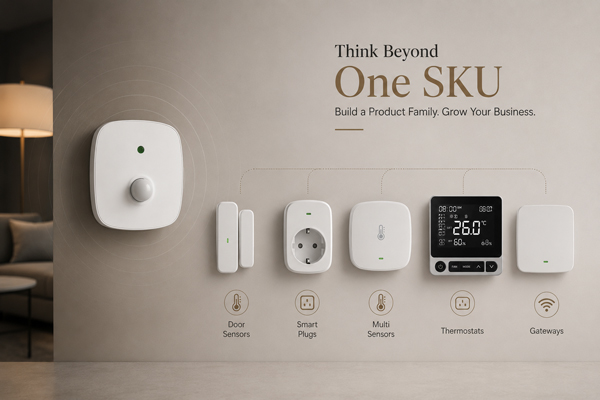
In reality, successful brands often build product families.
You may start with a motion sensor.
But what happens if it sells well?
Your customers may soon ask for:
- door sensors
- smart plugs
- multi sensors
- thermostats
- gateways
Suddenly, your sourcing strategy becomes much bigger than a single product.
This is why many distributors prefer suppliers that can support future expansion rather than just one successful SKU.
A Practical Example: Selling to the DIY Smart Home Market
One of the fastest-growing customer groups today is the DIY smart home community.
These users are actively searching for devices that integrate with existing ecosystems rather than proprietary platforms.
For that reason, many distributors focus on products that support Home Assistant, Zigbee2MQTT, and ZHA.
A good example is a Zigbee Multi Sensor that combines motion detection with environmental monitoring while remaining compatible with popular open smart home ecosystems.
For retailers, the attraction is not simply the number of sensors inside the device.
The attraction is that there is already an active audience looking for products like it.
And that is often a much stronger sales argument than any specification sheet.
Red Flags When Sourcing Motion Sensors From China
A few warning signs are worth watching for:
- Unclear ecosystem compatibility
- Frequent hardware changes
- Weak technical documentation
- Limited product portfolio
- No clear plan for long-term supply
If you plan to build a brand, consistency usually matters more than chasing the absolute lowest price.
Conclusion
Sourcing motion sensors from China is not particularly difficult.
Choosing the right motion sensor is where the real work begins.
The best buyers do not simply compare specifications.
They evaluate demand.
They identify customer groups.
They understand where the market is growing.
And they choose products that already have communities of potential buyers behind them.
Because in the end, the most important question is rarely:
“What features does this sensor have?”
It is:
“Who is already looking to buy it?”
FAQ
How do I choose a reliable motion sensor supplier in China?
Look beyond pricing and specifications. Evaluate long-term supply stability, OEM capabilities, ecosystem compatibility, and the supplier’s ability to support repeat orders.
What should distributors look for when sourcing Zigbee motion sensors?
Distributors should focus on market demand, compatibility with platforms such as Home Assistant and Zigbee2MQTT, and the supplier’s ability to support future product expansion.
Are Home Assistant compatible motion sensors easier to sell?
In many smart home markets, yes. Home Assistant users actively search for compatible products, creating existing demand that retailers can tap into.
What is the difference between a PIR motion sensor and a Zigbee multi sensor?
A PIR motion sensor focuses on motion detection, while a Zigbee multi sensor may combine motion, temperature, humidity, and light sensing in a single device.
Why is ecosystem compatibility important for smart home brands?
Compatibility with Home Assistant, Zigbee2MQTT, and ZHA helps reduce customer concerns, improves user experience, and makes products easier to market to DIY smart home communities.
Post time: Jun-25-2026