Introduction
Selecting the right Modbus energy meter has become increasingly important as energy systems continue to evolve. Modern projects no longer require simple electricity measurement alone—they require reliable communication between energy meters, solar inverters, Energy Management Systems (EMS), Building Management Systems (BMS), PLCs, SCADA platforms, and cloud applications.
For OEM manufacturers, system integrators, and engineering teams, choosing the wrong energy meter can increase software development time, complicate system integration, and limit future expansion. On the other hand, selecting a communication-ready platform can simplify deployment across multiple applications while improving long-term system reliability.
This guide outlines the key factors engineers should evaluate when selecting a Modbus energy meter for solar projects, industrial automation, and intelligent energy management systems.
Why Modbus Remains the Preferred Communication Standard
Modbus has been widely adopted across industrial automation and energy management for decades because it is open, reliable, and supported by equipment from many manufacturers.
Compared with proprietary communication protocols, Modbus enables standardized communication between:
- Energy meters
- Hybrid inverters
- PLCs
- SCADA systems
- EMS platforms
- Industrial gateways
- Cloud-based monitoring software
For system designers, this interoperability reduces engineering complexity while providing greater flexibility when integrating equipment from different vendors.
As renewable energy and industrial digitalization continue to grow, Modbus remains one of the most practical communication standards for modern energy monitoring projects.
Typical Applications
Different industries evaluate energy meters based on different project requirements. Understanding these application scenarios helps engineers select a solution that matches both current needs and future expansion.
Solar Energy Systems
Solar projects require more than measuring electricity consumption. Installers and EPC companies often need real-time monitoring of:
- Solar generation
- Grid import and export
- Building consumption
- Battery charging and discharging
These measurements support system optimization, self-consumption analysis, and export limitation strategies.
Energy Management Systems (EMS)
Modern EMS platforms rely on accurate real-time data to analyze energy usage, optimize operating costs, and improve overall system efficiency.
When selecting an energy meter for EMS projects, engineers typically evaluate:
- Communication protocols
- Data refresh rate
- API availability
- Cloud connectivity
- Long-term communication stability
Industrial Automation
Industrial facilities require reliable communication between electrical equipment and automation systems.
Typical integration targets include:
- PLC controllers
- SCADA software
- Industrial gateways
- Factory energy monitoring platforms
In these environments, stable RS485 communication and Modbus compatibility are often essential for continuous operation.
Key Selection Criteria
Selecting an energy meter should focus on long-term system compatibility rather than only electrical specifications.
The following considerations are commonly used during engineering evaluations.
1. Communication Protocols
A modern energy monitoring project often involves multiple software and hardware platforms.
Before selecting an energy meter, confirm support for communication methods such as:
- Modbus RTU
- Modbus TCP
- MQTT
- HTTP API
- Ethernet
- RS485
Choosing a platform with multiple communication options helps reduce future integration costs while improving deployment flexibility.
2. Electrical System Compatibility
Different projects require different electrical configurations.
A suitable energy meter should support applications including:
- Single-phase systems
- Split-phase systems
- Three-phase four-wire systems
For companies serving international markets, one flexible hardware platform can simplify inventory management while reducing engineering effort.
3. Current Measurement Method: CT Clamp or Direct Connection?
One of the most important decisions when selecting a Modbus energy meter is determining the appropriate current measurement method.
CT Clamp Energy Meters
CT clamp energy meters are widely used in retrofit projects because they can be installed without disconnecting existing power cables. This minimizes downtime and significantly reduces installation costs.
Typical applications include:
- Existing commercial buildings
- Industrial facilities
- Solar PV retrofit projects
- Battery energy storage systems
- Energy auditing and monitoring
A Modbus energy meter with CT clamp also provides greater flexibility by supporting different current ranges through interchangeable CTs, allowing one platform to be used across multiple project sizes.
Direct-Connected Energy Meters
Direct-connected meters are generally selected for lower-current applications where wiring modifications are acceptable and permanent DIN rail installation is preferred.
Typical applications include:
- Electrical distribution panels
- Utility sub-metering
- Building electrical systems
- Machine-level monitoring
The choice depends on installation requirements, current capacity, and future scalability rather than one solution being universally better than the other.
4. Is Bidirectional Energy Monitoring Required?
As solar PV and battery storage become increasingly common, many projects require monitoring of both imported and exported electricity.
Instead of only recording energy consumption, a modern Modbus energy meter should distinguish between:
- Grid import
- Grid export
- Solar generation
- Building consumption
- Battery charging
- Battery discharging
This information enables:
- Solar self-consumption optimization
- Battery charging control
- Export limitation
- Zero-export applications
- Energy performance analysis
For renewable energy projects, bidirectional measurement has become a standard requirement rather than an optional feature.
5. Communication Capability Is Now More Important Than Measurement Accuracy
Ten years ago, engineers primarily compared energy meters based on measurement accuracy.
Today, communication capability often has a greater impact on overall system performance.
When evaluating an energy meter, consider whether it supports:
- RS485 Modbus RTU
- Ethernet Modbus TCP
- MQTT communication
- HTTP API
- Cloud connectivity
- Third-party software integration
A communication-ready platform allows the same hardware to be deployed across different industries while reducing software customization and future upgrade costs.
Example Solution: OWON PC4713
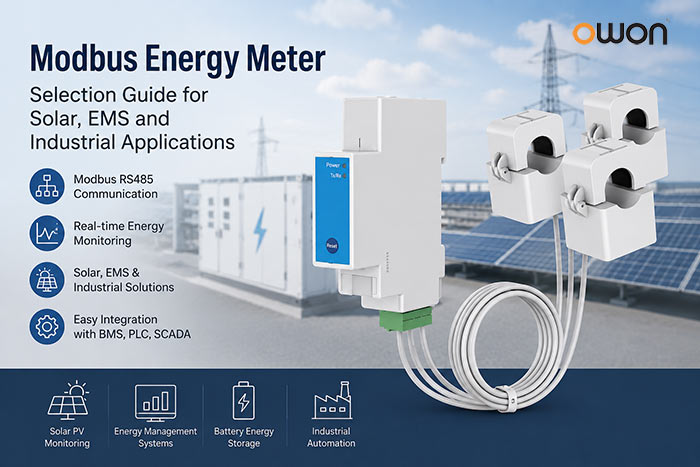
As an example of a modern communication-ready platform, the Modbus energy meter PC4713 has been developed for OEM manufacturers, system integrators, and energy solution providers requiring flexible integration with solar, EMS, and industrial automation projects.
Instead of supporting only a single communication protocol, the PC4713 combines multiple communication options within one hardware platform, making it easier to standardize energy monitoring across different applications.
Key capabilities include:
- Supports Modbus RTU via RS485
- Supports Modbus TCP over Ethernet
- Supports MQTT and HTTP protocols
- Compatible with single-phase, split-phase, and three-phase systems
- Supports external CT clamp inputs from 80A to 750A
- Provides bidirectional energy monitoring
- Optional relay output for advanced control applications
This flexibility allows manufacturers and system integrators to deploy one platform across residential solar systems, commercial energy management projects, industrial automation, and battery energy storage applications without redesigning communication architecture.
Feature Comparison Table
| Selection Factor | Why It Matters |
|---|---|
| Communication Protocols | Ensures compatibility with EMS, PLC, SCADA, and cloud platforms |
| RS485 Communication | Reliable long-distance industrial communication |
| Modbus TCP | Simplifies Ethernet-based system integration |
| CT Clamp Support | Flexible installation and multiple current ranges |
| Three-Phase Compatibility | Supports residential, commercial, and industrial applications |
| Bidirectional Monitoring | Essential for solar PV and battery storage |
| MQTT / HTTP API | Enables cloud-based energy monitoring |
| OEM Scalability | Supports long product life cycles and customized development |
Buyer Selection Checklist
Before making a final decision, engineering teams and purchasing managers should confirm the following:
| Selection Item | Recommendation |
| Communication Protocol | Support Modbus RTU, Modbus TCP, and future expansion options such as MQTT or HTTP API |
| Installation Method | Select CT clamp or direct-connected measurement based on the project requirements |
| Electrical System | Confirm compatibility with single-phase, split-phase, or three-phase systems |
| Bidirectional Measurement | Required for solar PV, battery storage, and export limitation projects |
| Software Integration | Verify compatibility with EMS, BMS, PLC, SCADA, or cloud platforms |
| OEM Support | Choose a manufacturer capable of long-term firmware support and product customization |
Rather than selecting an energy meter solely based on price, evaluating these factors early can reduce engineering effort, simplify deployment, and improve long-term project reliability.
Frequently Asked Questions
What is a Modbus energy meter used for?
A Modbus energy meter measures electrical parameters while transmitting real-time data through the Modbus communication protocol. It is widely used in solar energy systems, Energy Management Systems (EMS), industrial automation, commercial buildings, and battery energy storage projects.
When should I choose an RS485 energy meter?
An RS485 energy meter is recommended when reliable long-distance communication is required, especially for industrial automation, PLC integration, SCADA systems, and large commercial installations where communication stability is essential.
Are CT clamp energy meters suitable for retrofit projects?
Yes. CT clamp energy meters are widely used for retrofit installations because they can often be installed without disconnecting existing power cables, reducing installation time and minimizing downtime.
Can one Modbus energy meter support multiple applications?
Many modern energy meters support single-phase, split-phase, and three-phase systems together with multiple communication protocols. This allows one platform to be deployed across solar monitoring, industrial automation, EMS integration, and commercial energy management projects.
What communication protocols should a modern energy meter support?
For maximum compatibility, many engineering teams look for support for:
- Modbus RTU
- Modbus TCP
- RS485
- Ethernet
- MQTT
- HTTP API
This combination provides greater flexibility for current projects while supporting future software integration.
Conclusion
Selecting the right Modbus energy meter is no longer simply about measuring electrical energy.
For modern solar projects, Energy Management Systems, and industrial automation, communication capability, software compatibility, and future scalability have become equally important selection criteria.
When evaluating different solutions, engineers should consider communication protocols, electrical compatibility, CT options, bidirectional monitoring, and integration requirements rather than focusing solely on measurement specifications.
As an example, communication-ready platforms such as the OWON PC4713 combine RS485 Modbus RTU, Modbus TCP, MQTT, and flexible CT-based measurement within a single hardware platform, enabling OEM manufacturers and system integrators to deploy one solution across multiple energy monitoring applications.
Choosing the right platform at the beginning of a project not only simplifies system integration but also provides greater flexibility for future expansion as energy management technologies continue to evolve.
Related reading:
[Bidirectional Energy Meter for Solar and Grid Monitoring (WiFi-Enabled Solutions)]
Post time: Jun-26-2026