Introduction
As the global population ages, care providers face a growing challenge: how to improve resident safety without compromising privacy.
For many years, video surveillance was considered one of the few practical ways to monitor vulnerable residents. However, cameras are often viewed as intrusive, particularly in bedrooms, bathrooms, and other private living spaces. Families, operators, and regulators are increasingly looking for alternatives that balance safety with dignity.
This shift has accelerated the adoption of privacy-first elder care monitoring systems. Instead of relying on cameras, these solutions use a combination of sensors to detect falls, monitor occupancy, track bed activity, and provide emergency alerts while preserving personal privacy.
Just as importantly, modern sensor-based monitoring systems are far easier to deploy than many people assume. With wireless communication, scalable architectures, and straightforward installation methods, they can be introduced into both new and existing care facilities with minimal disruption.
What Is a Privacy-First Elder Care Monitoring System?
A privacy-first monitoring system uses non-camera technologies to help caregivers understand what is happening inside a care environment.
Rather than recording images or video, these systems rely on sensors that detect activity, presence, environmental conditions, and emergency events.
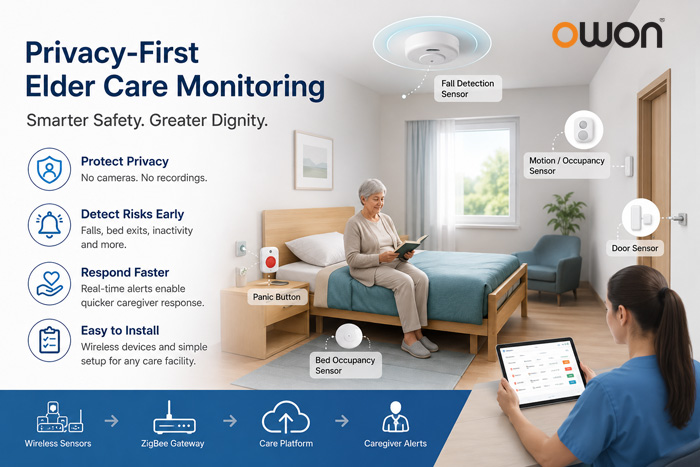
A typical deployment may include:
- Fall detection sensors
- Bed occupancy sensors
- Motion and occupancy sensors
- Door and window sensors
- Emergency panic buttons
- Temperature and environmental sensors
Working together, these devices provide awareness of resident activity without continuous visual surveillance.
Why Privacy Matters in Modern Elderly Care
Privacy has become an important consideration in elderly care environments.
Residents want to feel safe, but they also want to maintain independence and dignity. Families often support monitoring technologies when they improve safety, yet many remain uncomfortable with cameras installed in private rooms.
For operators, privacy concerns are not only about resident acceptance. They also influence regulatory compliance, data management policies, and long-term operational practices.
Sensor-based monitoring offers a practical alternative. Instead of collecting personal images, these systems focus on events and conditions that require attention, such as falls, prolonged inactivity, bed exits, or emergency calls.
Are These Systems Difficult to Install?
In most cases, no.
Modern elderly monitoring devices are designed to simplify deployment across multiple rooms and buildings.
Wireless technologies such as ZigBee eliminate the need for extensive signal wiring, making installation significantly easier than traditional wired monitoring systems.
The installation process typically involves mounting sensors in key locations, connecting them to a gateway, and configuring alert rules through a management platform.
For example, a fall detection sensor is usually mounted on a wall or ceiling to monitor high-risk areas, while a bed occupancy sensor can be placed beneath a mattress without affecting resident comfort.
Most installations can be completed room by room without major renovations or disruption to daily operations.
Building a Practical Monitoring Environment
Effective elderly care monitoring rarely depends on a single device.
A practical deployment usually combines multiple sensor types to create a broader view of resident wellbeing.
Fall Detection
Radar-based fall detection sensors monitor movement patterns and can identify potential fall events without requiring residents to wear devices.
Bed Occupancy Monitoring
Bed sensors help caregivers understand sleep patterns, detect unexpected bed exits, and identify unusual nighttime activity.
Emergency Assistance
Panic buttons allow residents to request immediate help when needed.
Occupancy Awareness
Motion and presence sensors provide additional context about daily activity and room usage.
Entry Monitoring
Door sensors help track room access and can support wandering prevention strategies in memory care environments.
Together, these technologies create a more comprehensive safety framework than any single device could provide alone.
A Real-World Assisted Living Example
Consider a medium-sized assisted living facility with forty private rooms.
Each room includes a fall detection sensor, a bed occupancy sensor, and an emergency call button. Common areas are equipped with occupancy sensors and environmental monitoring devices.
All sensors communicate through ZigBee gateways and report events to a central monitoring platform used by care staff.
If a resident falls, leaves bed unexpectedly during the night, or presses an emergency button, caregivers receive immediate notifications.
No cameras are required, and residents are not asked to wear monitoring devices throughout the day.
This approach allows facilities to improve awareness while maintaining a more comfortable and privacy-respecting environment.
Why ZigBee Is Widely Used in Elderly Care Projects
ZigBee has become a popular communication technology for elderly care applications because it was designed for low-power, reliable device networking.
Several characteristics make it particularly suitable for care environments:
Mesh Networking
Devices can relay messages through neighbouring devices, extending coverage throughout a facility.
Scalability
Additional sensors can be added as monitoring requirements expand.
Low Maintenance
Battery-powered devices can operate for extended periods without frequent servicing.
Multi-Device Integration
Different sensor types can operate within the same monitoring ecosystem.
These advantages make ZigBee well suited for assisted living facilities, nursing homes, senior apartments, and healthcare monitoring projects.
Example of a Sensor-Based Elderly Care Solution
A modern elderly care deployment may combine several different monitoring technologies.
For example, a care room could include a fall detection sensor near the bed area, a bed occupancy sensor beneath the mattress, a panic button within easy reach, and a door sensor to monitor room entry and exit activity.
OWON supports this approach through a portfolio of ZigBee-based elderly care devices, including fall detection sensors, bed occupancy sensors, panic buttons, occupancy sensors, environmental sensors, door sensors, and ZigBee gateways.
Rather than replacing caregivers, these technologies provide earlier awareness when unusual events occur, allowing staff to respond more efficiently and improve resident safety.
Benefits for Care Providers
Organizations adopting privacy-first monitoring systems often report several practical benefits:
- Faster response to incidents
- Improved resident safety
- Reduced caregiver workload
- Better overnight monitoring
- Greater resident acceptance
- Easier deployment compared with camera-based systems
- Scalable expansion as facility needs evolve
Most importantly, these systems help operators balance safety requirements with resident dignity and privacy.
Frequently Asked Questions
What is a privacy-first elder care monitoring system?
It is a monitoring solution that uses sensors instead of cameras to track safety-related events such as falls, bed exits, occupancy changes, and emergency requests.
Do these systems require residents to wear devices?
Not always. Many modern solutions use radar, occupancy, and bed monitoring sensors that operate without wearables.
Are they suitable for existing care facilities?
Yes. Wireless sensor networks are commonly deployed in both new and existing facilities.
Can they detect falls automatically?
Radar-based fall detection sensors can identify potential fall events and automatically generate alerts for caregivers.
Are privacy-first monitoring systems only for nursing homes?
No. They are also widely used in assisted living communities, senior apartments, rehabilitation centres, and home healthcare environments.
Conclusion
Privacy-first monitoring is becoming an increasingly important part of modern elderly care.
By combining fall detection, bed occupancy monitoring, occupancy sensing, emergency assistance, and wireless networking, today’s sensor-based systems provide meaningful safety improvements without relying on cameras or invasive monitoring methods.
For care providers seeking a practical balance between safety, privacy, and operational efficiency, privacy-first elderly monitoring systems offer a scalable and future-ready approach.
As demand for assisted living, nursing home, and home healthcare technologies continues to grow, selecting the right combination of sensors and communication infrastructure becomes increasingly important. A well-designed monitoring solution can help improve resident safety, support caregiver efficiency, and create a more comfortable living environment for older adults.
Organizations evaluating elderly care technologies can explore integrated solutions that combine fall detection, bed occupancy monitoring, panic alerts, and ZigBee-based sensor networks to build a comprehensive and privacy-friendly care ecosystem.
Post time: Jun-27-2026