Choosing the right commercial HVAC thermostat is about much more than controlling temperature. For HVAC contractors, property managers, system integrators, and OEM equipment brands, the thermostat directly affects occupant comfort, energy efficiency, maintenance costs, and long-term system reliability.
Unlike residential installations, commercial HVAC projects often involve multiple rooms, longer operating hours, and more demanding control requirements. Whether you’re upgrading an apartment community, managing a retail space, or developing a new HVAC product, selecting the right thermostat helps improve building performance while reducing operating costs.
This guide explains what a commercial HVAC thermostat is, how it differs from residential models, the features that matter most, and how to choose the right solution for your project.
What Is a Commercial HVAC Thermostat?
A commercial HVAC thermostat is designed to control heating and cooling systems used in commercial and light commercial buildings. Compared with residential thermostats, commercial models are typically expected to support more flexible scheduling, remote management, wider HVAC compatibility, and easier deployment across multiple locations.
For most North American light commercial projects, thermostats operate on standard 24VAC HVAC systems, including:
- Conventional furnace and air conditioner systems
- Heat pump systems
- Multi-stage HVAC systems
- Dual fuel (hybrid heat) systems
- Systems with auxiliary and emergency heat
Commercial thermostats are commonly used in apartment communities, offices, retail stores, hotels, clinics, schools, and other buildings where reliable HVAC control and energy management are essential.
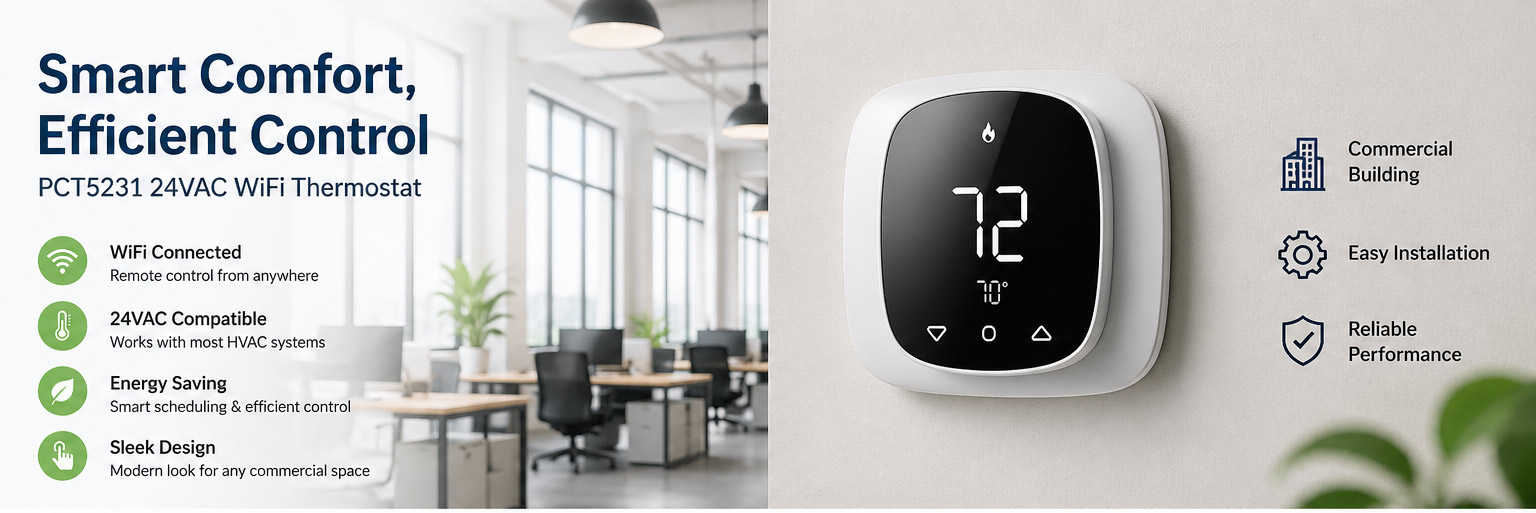
Commercial vs Residential Thermostats
Although both types regulate indoor temperature, commercial projects require additional flexibility and management capabilities.
| Commercial HVAC Thermostat | Residential Thermostat |
|---|---|
| Supports larger or multiple properties | Designed mainly for a single home |
| Advanced scheduling and remote management | Basic daily scheduling |
| Better suited for property management | Individual homeowner use |
| Easier integration with cloud or building platforms | Primarily smart home integration |
| Designed for higher equipment utilization | Lower daily operating demand |
For many apartment communities and small commercial buildings, a commercial smart thermostat offers a practical balance between professional HVAC control and simple installation.
Key Features to Look for in a Commercial HVAC Thermostat
Not every commercial project requires the same functionality. Before selecting a thermostat, consider the features that best fit your building and HVAC equipment.
WiFi Remote Management
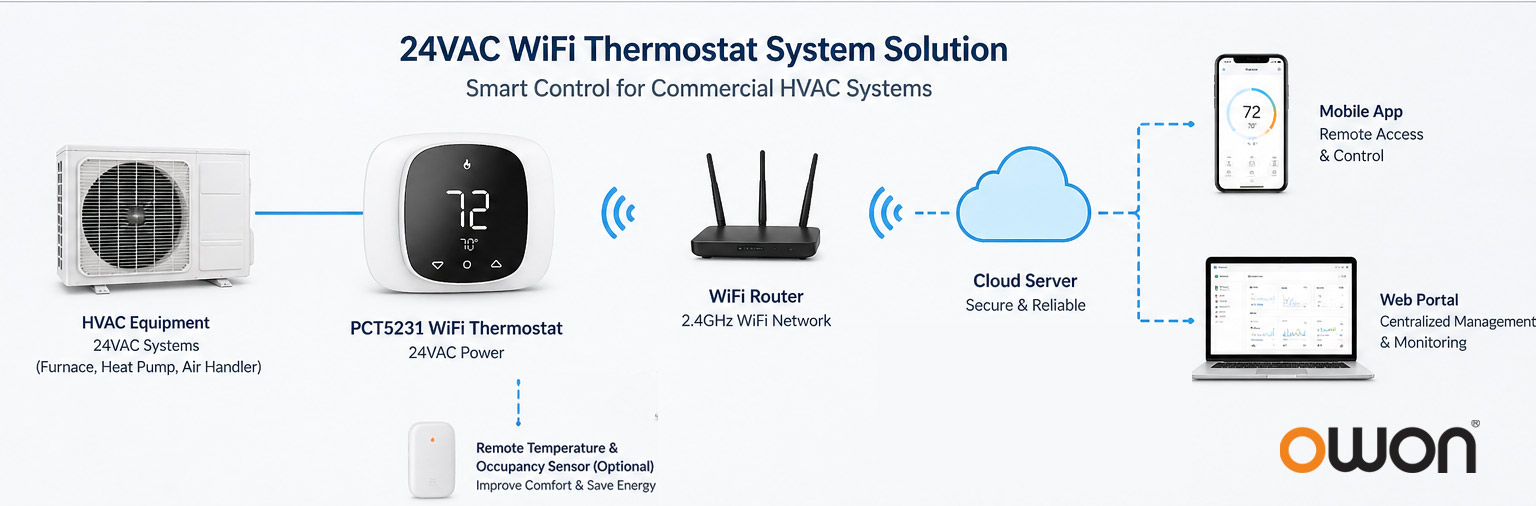
A WiFi-enabled thermostat allows facility managers, contractors, or property owners to monitor and adjust HVAC settings remotely through a mobile app or cloud platform. Remote access reduces unnecessary service visits and simplifies day-to-day management.
Broad HVAC Compatibility
A quality commercial HVAC thermostat should support the HVAC systems commonly used in North America, including conventional heating and cooling equipment, multi-stage heat pumps, auxiliary heat, emergency heat, and dual fuel systems.
Flexible Scheduling
Programmable schedules automatically adjust temperatures based on business hours or occupancy patterns, helping reduce unnecessary HVAC operation while maintaining occupant comfort.
Remote Room Sensors
Buildings often experience uneven temperatures between rooms. Wireless remote sensors allow the thermostat to measure temperatures from multiple locations, improving comfort and reducing hot or cold spots.
Humidity and Occupancy Control
Premium commercial thermostats may include humidity monitoring and occupancy sensing. These features improve comfort while reducing energy consumption by adjusting HVAC operation according to indoor conditions and room usage.
Cloud Integration
Many commercial projects require integration with mobile applications, cloud platforms, or third-party management systems. Choosing a thermostat with API support and OTA firmware updates provides greater flexibility for future expansion.
How to Choose the Right Commercial HVAC Thermostat
Every project has different requirements, but the following checklist can simplify the selection process.
Confirm HVAC Compatibility
Verify whether your HVAC system is conventional, heat pump, multi-stage, or dual fuel. The thermostat should fully support your equipment configuration.
Check Existing Wiring
Most North American commercial HVAC systems use 24VAC wiring. Before replacing an existing thermostat, verify whether a C-wire is available or whether a compatible C-wire adapter may be required.
Consider Building Type
Different commercial environments have different priorities.
- Apartment communities often benefit from remote room sensors and centralized management.
- Small offices typically prioritize scheduling and energy savings.
- Hotels may require occupancy-based HVAC control.
- Retail stores often focus on maintaining consistent indoor comfort during business hours.
Choosing features that match your application helps improve both user experience and operating efficiency.
Plan for Future Expansion
As buildings become smarter, HVAC systems increasingly integrate with cloud services, mobile apps, and energy management platforms. Selecting a thermostat with expandable software capabilities can help reduce future upgrade costs.
Typical Commercial HVAC Applications
Today’s commercial HVAC thermostats are widely used across many light commercial projects.
Apartment Communities
Property managers benefit from consistent HVAC control across multiple units while reducing maintenance costs and improving tenant comfort.
Small Offices
Programmable schedules and remote access help reduce energy consumption outside working hours while maintaining a comfortable workplace.
Retail Stores
Reliable temperature control creates a better customer experience while protecting temperature-sensitive products and equipment.
Hotels and Hospitality
Occupancy-based control can help reduce unnecessary heating and cooling in vacant guest rooms while maintaining a comfortable experience for guests.
Building Retrofit Projects
WiFi commercial thermostats simplify HVAC upgrades by adding smart control without replacing the existing HVAC equipment.
Example Commercial HVAC Thermostat Solutions
Different commercial projects require different thermostat capabilities. Some focus on energy savings, while others prioritize remote management, occupancy sensing, or multi-zone comfort.
For example, OWON Technology develops OEM and ODM commercial HVAC thermostat solutions for North American 24VAC HVAC systems. The PCT5231 supports conventional HVAC systems, multi-stage heat pumps, dual fuel applications, and wireless remote room sensors, making it suitable for apartment communities, property management, and HVAC retrofit projects. For applications requiring enhanced user interaction, the PCT533 adds a 4.3-inch touchscreen, built-in humidity monitoring, and radar occupancy sensing for smarter HVAC control.
Rather than offering a one-size-fits-all product, OWON works with HVAC equipment manufacturers, smart home brands, and system integrators to develop customized thermostat solutions that fit specific project requirements.
Frequently Asked Questions
What is a commercial HVAC thermostat?
A commercial HVAC thermostat controls heating and cooling systems in commercial and light commercial buildings. It typically offers more advanced scheduling, remote management, and HVAC compatibility than residential models.
What is the difference between commercial and residential thermostats?
Commercial thermostats are designed for larger projects, longer operating hours, and centralized management, while residential thermostats primarily focus on individual home comfort.
Can a commercial thermostat control heat pump systems?
Yes. Many commercial HVAC thermostats support single-stage and multi-stage heat pumps, including systems with auxiliary and emergency heat. Always verify compatibility before installation.
Can commercial HVAC thermostats be managed remotely?
Yes. Most modern commercial smart thermostats support WiFi connectivity, allowing users to monitor and adjust HVAC settings through mobile apps or cloud platforms.
Which commercial thermostat is suitable for apartment projects?
Apartment communities often benefit from WiFi thermostats that support remote room sensors, flexible scheduling, centralized management, and compatibility with standard North American 24VAC HVAC systems.
Conclusion
Selecting the right commercial HVAC thermostat is an important decision for any commercial HVAC project. The best solution should provide reliable HVAC compatibility, flexible scheduling, remote management, and room for future expansion while meeting the specific needs of the building.
Whether you’re an HVAC contractor, property manager, system integrator, or OEM equipment manufacturer, investing in a well-designed commercial thermostat platform can improve occupant comfort, reduce energy costs, and simplify long-term HVAC management.
As commercial buildings continue to adopt smarter HVAC technologies, WiFi connectivity, cloud integration, occupancy sensing, and wireless room sensors are becoming standard expectations. Choosing a scalable thermostat solution today helps prepare your projects for tomorrow’s building automation requirements.
Related reading:
[ Choosing the Right Dual Fuel Thermostat: A Compatibility Checklist for HVAC Contractors ]
Post time: Apr-25-2026