Battery life is one of the most important considerations when selecting a smart radiator valve for residential, hospitality, or large-scale heating retrofit projects.
In multi-room heating systems, replacing batteries too frequently can increase maintenance costs and reduce deployment efficiency. For this reason, many EU smart heating projects prefer ZigBee radiator valves over Wi-Fi alternatives due to their lower power consumption and more stable communication.
But how long does a ZigBee smart radiator valve battery actually last in real-world heating systems?
The answer depends on several factors, including wireless protocol efficiency, heating schedules, valve movement frequency, and room temperature management behavior.
Why ZigBee Radiator Valves Typically Offer Better Battery Life
Compared with Wi-Fi devices, ZigBee radiator valves are designed for low-power operation.
ZigBee communication consumes significantly less energy because devices remain in low-power sleep states most of the time and only transmit small amounts of data when necessary.
For smart heating systems involving multiple rooms or apartments, this provides several advantages:
- Longer battery replacement cycles
- Lower maintenance workload
- More stable multi-device deployments
- Better suitability for large heating projects
This is one reason why ZigBee-based heating automation is widely used in apartments, hotels, and boiler retrofit projects across Europe.
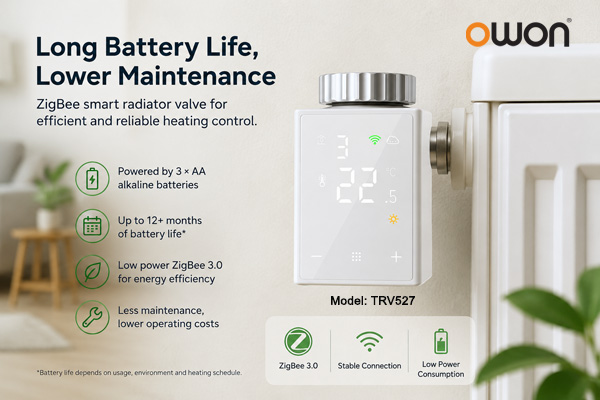
Typical Battery Life of a ZigBee Radiator Valve
Most ZigBee smart radiator valves are designed for ultra-low power consumption and commonly use standard AA alkaline batteries.
For example, the OWON TRV527 ZigBee smart radiator valve uses 3 × AA alkaline batteries and supports low-power wireless heating control for radiator-based HVAC systems.
In typical residential heating environments, battery life can often last for several months depending on heating schedules, room temperature changes, and communication frequency.
Actual battery life depends on:
- Frequency of valve adjustments
- Heating schedule complexity
- Ambient temperature conditions
- Network communication frequency
- BOOST mode usage frequency
In well-configured smart heating systems, battery maintenance intervals are usually significantly longer than comparable Wi-Fi heating devices.
What Affects Radiator Valve Battery Consumption?
Frequent Temperature Changes
If heating schedules constantly change room temperatures throughout the day, the valve motor operates more frequently, increasing battery consumption.
Stable schedules usually improve battery efficiency.
BOOST Heating Mode Usage
Many smart radiator valves include BOOST mode for rapid heating.
The TRV527 supports BOOST mode with configurable running times.
Frequent use of fast-heating functions can increase motor activity and reduce battery life over time.
Wireless Communication Stability
Poor wireless signal quality may cause repeated network communication attempts.
This is one reason why ZigBee mesh networking performs well in apartment and hotel heating systems, where multiple ZigBee devices help improve communication stability.
Open Window Detection
Energy-saving features such as open window detection can actually help reduce unnecessary heating cycles.
The TRV527 includes configurable open window detection settings designed to improve heating efficiency.
Why Battery Life Matters in Large Heating Projects
For single-room smart home deployments, battery replacement may not be a major concern.
However, in larger projects such as:
- Apartments
- Hotels
- Student housing
- Office buildings
battery maintenance becomes a significant operational consideration.
If hundreds of radiator valves require frequent maintenance, long-term operating costs increase quickly.
For this reason, many system integrators prefer low-power ZigBee radiator valves for large-scale heating automation systems.
ZigBee vs Wi-Fi Battery Performance
| Feature | ZigBee Radiator Valve | Wi-Fi Radiator Valve |
|---|---|---|
| Power Consumption | Low | Higher |
| Battery Life | Longer | Shorter |
| Multi-room Stability | High | Medium |
| Suitable for Large Projects | Yes | Less ideal |
In most EU heating retrofit projects, ZigBee is generally considered the more practical option for long-term deployment.
Tips to Improve Smart Radiator Valve Battery Life
To maximize battery performance in heating systems:
- Use stable heating schedules
- Avoid excessive BOOST mode activation
- Maintain reliable ZigBee network coverage
- Use high-quality alkaline batteries
- Configure appropriate temperature ranges
Proper network planning and heating automation settings can significantly improve long-term device performance.
Smart Heating Trends in Europe
As energy costs continue rising across Europe, building owners are increasingly focusing on energy-efficient heating control systems.
Instead of replacing existing boiler infrastructure, many retrofit projects now prioritize:
- Smart radiator automation
- Room-level heating control
- Heating schedule optimization
- Energy-saving management systems
Low-power ZigBee radiator valves play an important role in these modern heating upgrade strategies.
Conclusion
Battery life is a critical factor when deploying smart radiator valves in residential and commercial heating systems.
Thanks to low-power ZigBee communication and efficient room-level heating automation, ZigBee radiator valves typically provide longer operational life and lower maintenance requirements compared with Wi-Fi alternatives.
For apartments, hotels, and EU heating retrofit projects, ZigBee-based smart heating systems continue to offer a practical balance between energy efficiency, scalability, and long-term operational reliability.
Related reading:
[ZigBee Radiator Valve Installation Guide for EU Heating Systems]
Post time: May-27-2026