Modern hotels are under increasing pressure to improve guest experience while reducing operational costs and energy consumption. Traditional wired automation systems are often difficult to scale, expensive to retrofit, and complex to maintain across large hospitality properties.
This is why many hotels and system integrators are now moving toward the smart hotel automation system approach powered by Zigbee IoT technology.
Unlike conventional building automation systems, Zigbee-based wireless automation offers flexible deployment, lower installation costs, simplified expansion, and more efficient room-level control for modern hospitality environments.
Why Smart Hotel Automation Systems Are Becoming Essential
A modern smart hotel automation system is no longer limited to simple lighting or temperature control. Hotels today require intelligent infrastructure capable of managing guest comfort, operational efficiency, and centralized automation simultaneously.
A typical hotel automation deployment may include:
- HVAC automation
- Occupancy detection
- Lighting control
- Curtain automation
- Energy monitoring
- Door and window status detection
- Centralized room management
For hotel operators, the goal is clear:
Reduce operational costs while improving the guest experience.
For system integrators, the focus is equally important:
Deploy scalable, reliable, and easy-to-maintain automation systems.
In many hospitality projects, integrated smart hotel IoT solution architectures are becoming increasingly attractive because they simplify deployment and reduce long-term infrastructure complexity.
Why Zigbee IoT Is Well-Suited for Hotel Automation
Unlike WiFi-based architectures that may struggle with device density and network congestion, Zigbee technology is specifically designed for large-scale IoT deployments.
A Zigbee mesh network allows devices to communicate reliably across multiple hotel rooms and floors while maintaining low power consumption and stable connectivity.
This makes Zigbee particularly suitable for:
- Hotel retrofit projects
- Guest room automation
- Occupancy-based control
- Hotel energy management
- Multi-room device communication
In practical deployments, Zigbee-based systems also reduce dependence on cloud latency because many automation functions can operate locally through the gateway.
For hospitality environments where stable room control is critical, local communication reliability is a major advantage.
Key Components of a Smart Hotel Automation System
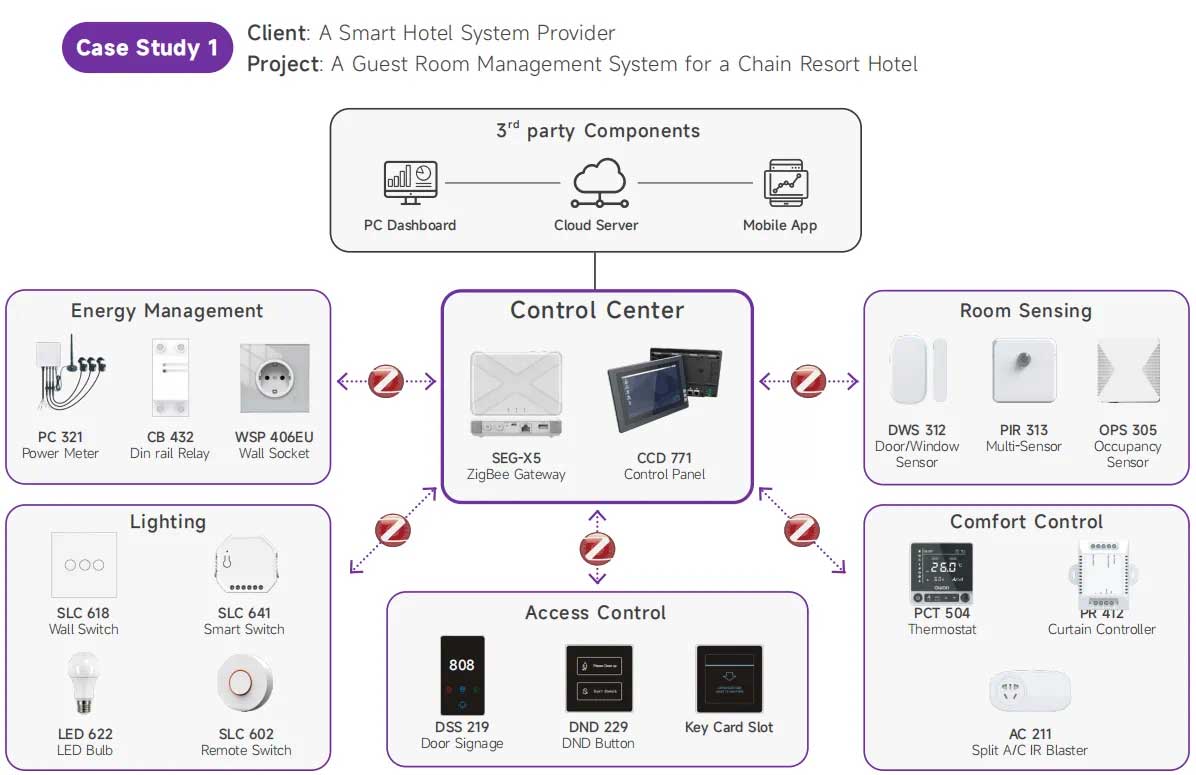
A complete smart hotel automation system typically consists of several integrated layers working together.
| System Layer | Main Function |
|---|---|
| Zigbee Devices | Sensors, thermostats, switches, relays |
| Gateway Layer | Local automation logic and device communication |
| Platform Layer | Centralized monitoring and management |
| Integration Layer | API, MQTT, PMS/BMS integration |
Together, these components enable real-time automation, centralized monitoring, and scalable hotel operations.
Occupancy-Based Hotel Room Automation Improves Efficiency
Occupancy automation has become one of the most valuable functions in modern hotel environments.
By using Zigbee occupancy sensors and door/window detection devices, hotels can automatically determine room usage status and adjust systems accordingly.
For example:
- HVAC switches to energy-saving mode when guests leave
- Lighting automatically turns off in vacant rooms
- Temperature settings adjust dynamically based on occupancy
This significantly reduces unnecessary energy consumption while maintaining guest comfort.
Modern Zigbee occupancy sensors can also monitor temperature, humidity, vibration, and motion simultaneously, making them highly suitable for intelligent hospitality automation scenarios.
Smart HVAC Control Helps Reduce Hotel Energy Costs
HVAC systems are typically among the largest contributors to hotel electricity consumption.
A Zigbee-enabled smart hotel automation system allows hotels to automate fan coil units, thermostats, and HVAC scheduling more efficiently.
Instead of operating continuously, room temperature can automatically adjust according to occupancy, schedules, or hotel operational policies.
This helps hotels:
- Reduce energy waste
- Improve sustainability
- Maintain guest comfort
- Simplify centralized HVAC management
For large hotel deployments, occupancy-based HVAC automation can generate substantial long-term operational savings.
For example, smart thermostat systems are increasingly used in hotel retrofit projects because they support room-level temperature automation without requiring extensive wiring modifications.
Why Local Gateway Control Matters in Hotel Automation
One of the biggest differences between professional hotel automation systems and basic smart home deployments is local control capability.
A reliable Zigbee gateway does more than connect devices to the cloud.
It also:
- Executes automation logic locally
- Maintains communication during network interruptions
- Supports real-time room automation
- Reduces latency in HVAC and lighting control
In large hospitality deployments, scalability and local control are becoming increasingly important requirements for long-term operational stability.
Modern Zigbee gateways also support MQTT and API integration, allowing communication with property management systems, cloud platforms, and third-party building management systems.
For system integrators, gateway architecture directly impacts deployment reliability, maintenance complexity, and future scalability.
Hotel Energy Management Is Becoming a Core Requirement
Energy efficiency is no longer optional for hospitality projects.
Today, many hotels are actively deploying hotel energy management system strategies to reduce electricity costs while supporting sustainability goals.
A Zigbee-based energy management architecture can help operators monitor and optimize:
- HVAC energy usage
- Guest room electricity consumption
- Lighting power usage
- Public area energy consumption
Smart meters and energy monitoring devices provide real-time visibility into hotel operations, helping management teams identify inefficiencies and improve energy performance.
Smart Hotel Automation Systems Are Ideal for Retrofit Projects
Many hotels still rely on older wired infrastructure that is difficult to expand and expensive to maintain.
Wireless Zigbee automation provides a more flexible alternative.
Because Zigbee devices communicate wirelessly, hotels can gradually upgrade room automation systems without major structural renovation.
In many hotel retrofit projects, one of the biggest challenges is minimizing disruption to daily operations.
Unlike traditional wired systems that often require wall reconstruction and extensive cabling, Zigbee-based wireless automation allows hotels to modernize guest room control systems while rooms remain operational.
This makes wireless deployment especially attractive for hospitality projects where installation speed, scalability, and maintenance flexibility are critical.
The Future of Smart Hotel Automation
As hospitality technology continues to evolve, smart hotel automation systems are becoming increasingly data-driven, energy-focused, and integration-oriented.
Future hospitality projects are expected to combine:
- Occupancy intelligence
- Predictive HVAC optimization
- Unified energy management
- Cloud and local hybrid control
- Cross-platform IoT integration
For system integrators, selecting the right automation architecture is not only about device compatibility.
It also affects deployment efficiency, long-term maintenance, scalability, and future integration capability.
This is why many hospitality automation projects are increasingly moving toward Zigbee-based IoT architectures that combine local gateway control, occupancy automation, and centralized energy management.
Conclusion
A modern smart hotel automation system is no longer just a convenience feature—it has become a critical infrastructure layer for hospitality operations.
By combining Zigbee IoT devices, local gateway control, occupancy automation, HVAC optimization, and energy management, hotels can improve operational efficiency while delivering a better guest experience.
As hospitality automation projects continue to expand globally, scalable wireless architectures will play an increasingly important role in the future of hotel technology.
Post time: May-13-2026