Why Hotel Energy Management Has Become a Priority
Hotel energy management used to be a “nice-to-have” topic.
Today, it is more like a survival skill.
Energy prices across Europe have made even the most charming boutique hotels quietly reconsider their HVAC habits. Keeping every room perfectly comfortable 24/7 sounds nice… until the electricity bill arrives.
At the same time, many hotels are still operating buildings that were designed in a pre-“smart everything” era. Full renovation is expensive. And let’s be honest—nobody enjoys tearing open walls in a running hotel unless absolutely necessary.
This is where system integrators come in.
And increasingly, they are turning to Zigbee-based room control systems to modernize hotels without rebuilding them from scratch.
What Is Occupancy-Based Energy Management?
Let’s keep this simple.
Occupancy-based energy management is a strategy that adjusts energy usage in a hotel room based on a very human question:
“Is anyone actually here right now?”
If the answer is no, the room politely stops pretending it’s still in peak hospitality mode.
In practical terms:
When the room is vacant:
- HVAC shifts to energy-saving mode
- Non-essential loads are turned off
- The room enters “let’s not waste money” mode
When a guest returns:
- Temperature returns to comfort levels
- Devices resume normal operation
- Hospitality mode is restored instantly (without complaint)
No magic. Just logic.
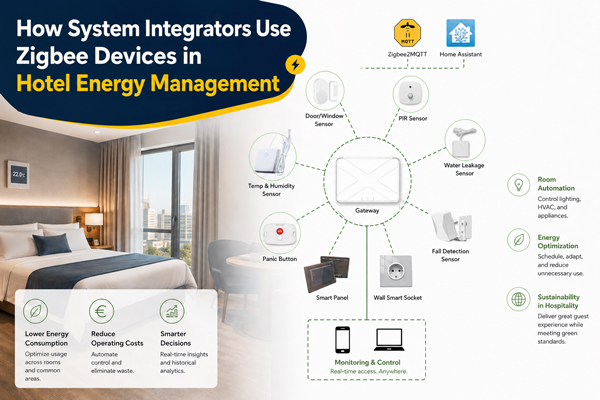
How Zigbee Devices Enable Room-Level Energy Control
A Zigbee-based hotel room system is not about individual devices.
It is about cooperation.
Think of it as a small, well-trained team:
- A door sensor notices movement at the entrance
- A PIR sensor quietly confirms whether someone is still around
- A thermostat adjusts HVAC behavior
- Smart plugs handle everything that does not need to run 24/7
None of these devices are impressive alone.
Together, they form a system that quietly prevents hotels from heating empty rooms like they are hosting invisible guests.
Why System Integrators Prefer Zigbee in Hotel Retrofit Projects
System integrators are not looking for “cool technology.”
They are looking for things that:
- Do not require breaking half the building
- Scale across hundreds of rooms
- Do not collapse under real-world deployment conditions
Zigbee fits surprisingly well here.
Easy Retrofit Deployment
No new wiring. No architectural drama. Just deployment.
Multi-Room Scalability
One room is easy. Two hundred rooms should not become a life philosophy crisis.
Centralized Control via Gateway
Everything flows through a gateway, instead of ten different apps and silent confusion.
Open Integration Architecture
Modern projects often require integration with:
- MQTT systems
- Local APIs
- Third-party building platforms
Because no one really enjoys being locked into a black box anymore.
Real-World Case Study: European Hotel Retrofit Project
Now, theory is nice.
But system integrators usually trust only one thing:
“Show me where this actually worked.”
So let’s talk about a real deployment.
Challenge
A European hotel system integrator faced a familiar situation:
- High energy consumption per room
- Aging HVAC infrastructure
- Strict requirement: avoid major rewiring
- Deployment needed across multiple hotel properties
In other words: modernize everything, but please don’t touch the walls too much.
Solution Architecture
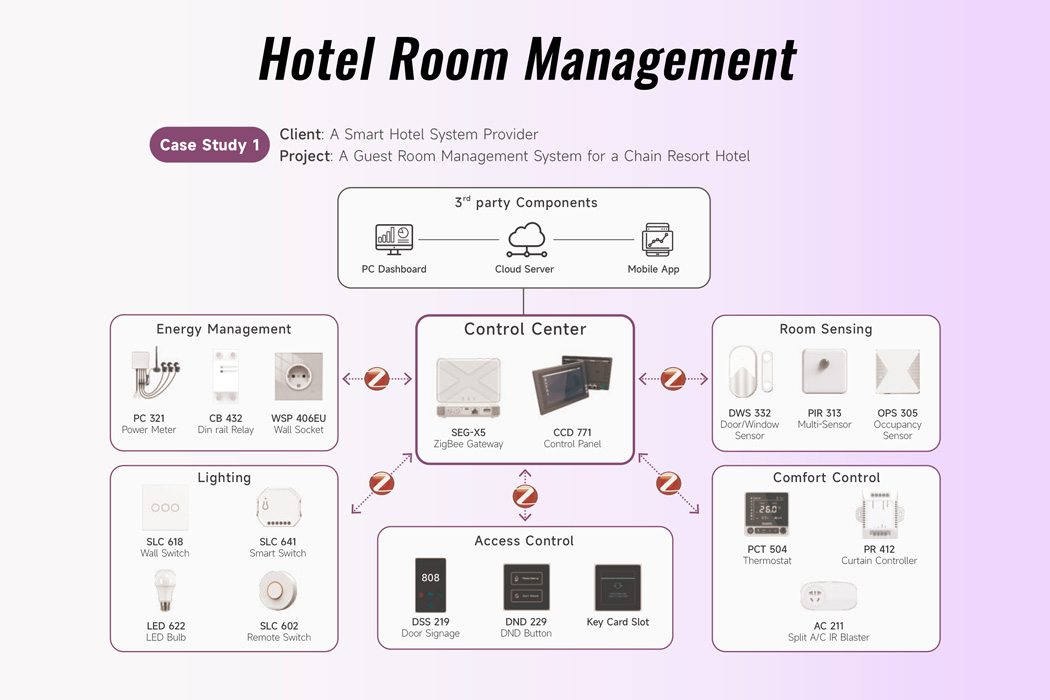
Instead of replacing the entire system, the integrator deployed a Zigbee-based room control architecture using:
- Zigbee thermostats for HVAC control
- Door/window sensors for occupancy triggering
- PIR sensors for motion validation
- Smart plugs and relays for auxiliary load control
- Zigbee gateways for system aggregation
No single device was the hero.
The system was the hero.
Integration Layer
Here is where things become interesting.
These devices were integrated into the integrator’s own platform using:
- MQTT for cloud communication
- Local API for offline operation
- Gateway-based architecture for multi-mode control
This allowed the system to continue functioning even when the internet connection decided to take a coffee break.
At the hardware layer, an OWON Zigbee gateway and device ecosystem provided the foundation for this deployment, serving as the interoperable layer between field devices and the integrator’s software platform.
Nothing flashy. Just reliable infrastructure doing its job.
Result
The outcome was not a “revolutionary transformation.”
It was something more valuable:
- Stable occupancy-based room automation
- Scalable rollout across multiple hotel properties
- Reduced retrofit complexity
- Unified control of distributed devices
In hotel projects, “it works reliably at scale” is usually the highest compliment you can give.
What System Integrators Should Look for in Hotel Energy Devices
When system integrators evaluate devices for hotel energy projects, they rarely ask about marketing claims.
They ask practical questions:
- Can this integrate with our platform?
- Will the gateway survive real-world deployment?
- Is there a proper API, or just a PDF with good intentions?
- Can we combine multiple device types into one ecosystem?
- Will this product still exist in two years when we expand the project?
It is not glamorous, but it is how real decisions are made.
Building Open and Integration-Ready Zigbee Systems
Modern hotel automation is no longer about standalone devices.
It is about how easily different devices can be integrated into a system that already exists.
For system integrators, the challenge is not finding a “complete platform”, but finding hardware that does not fight against their existing architecture.
Zigbee fits naturally into this environment because it allows multiple devices to communicate through a gateway, without forcing changes to the upper-level system.
In this context, OWON operates as a device-focused Zigbee supplier for integration projects, providing:
- Sensors for occupancy and environmental detection
- Thermostats for HVAC control
- Relays for load switching
- Gateways for protocol bridging
All devices are designed to be integrated into third-party systems via:
- MQTT
- Local API
- Zigbee2MQTT / Home Assistant compatibility
- OEM/ODM customization for project-specific requirements
Rather than offering a proprietary software platform, OWON focuses on ensuring its hardware can be reliably embedded into the system integrator’s own software, cloud, or building management infrastructure.
In other words, OWON does not replace your system—it simply makes sure your system has better hardware to work with.
Conclusion
Hotel energy management is no longer about installing smarter devices.
It is about coordinating existing systems more intelligently.
Zigbee enables that coordination through occupancy-driven logic, distributed control, and scalable deployment architecture.
And for system integrators, the real value is not in any single device.
It is in whether the entire system behaves like it understands the hotel is supposed to serve guests—not empty rooms.
Post time: Jun-05-2026