Introduction: The Real Decision Behind Building Automation Projects
System integrators do not choose wireless technologies based on popularity or consumer trends.
They select technologies based on deployment reliability, system scalability, and integration efficiency.
In real-world building projects such as hotels, apartments, and energy management systems, the choice is not simply Zigbee vs WiFi.
It is a system architecture decision.
System integrators prioritize technologies that reduce integration complexity and support long-term maintainability in multi-device environments.
Zigbee vs WiFi: It Is Not a Protocol Comparison, It Is a System Design Choice
Many discussions incorrectly frame Zigbee and WiFi as competing technologies.
In reality:
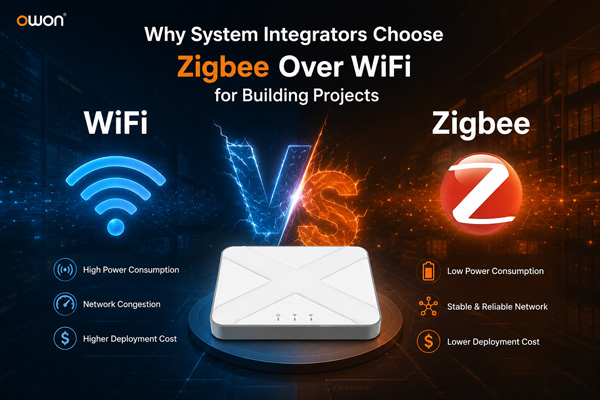
- WiFi is designed for high-bandwidth user devices
- Zigbee is designed for low-power distributed control systems
WiFi-based architecture (device-centric model):
- Each device connects directly to the router
- Communication depends on WiFi network stability
- Scaling increases router load and network congestion
Zigbee-based architecture (system-centric model):
- Devices form a mesh network
- All devices communicate via a Zigbee gateway
- System operates independently of WiFi load
Zigbee functions as a dedicated control layer for building automation, while WiFi serves as a general-purpose communication network.
Why WiFi Becomes a Limitation in Building Projects
In large-scale deployments such as hotels or multi-room buildings, WiFi-based devices introduce structural challenges.
Network Congestion
Each WiFi device consumes network resources, leading to congestion when deployed at scale.
Maintenance Complexity
WiFi devices require individual pairing, configuration, and firmware management.
Scalability Constraints
Expanding a WiFi-based system often requires additional routers and network redesign.
WiFi systems scale linearly in complexity, while building automation systems require non-linear scalability.
Why Zigbee Is More Suitable for System Integration Projects
Zigbee is widely adopted in building automation because it is designed for distributed device environments.
Mesh Network Architecture
Zigbee devices relay signals through neighboring nodes, improving coverage and reliability.
Low Power Consumption
Battery-powered devices such as door sensors, PIR sensors, and leak detectors can operate for years without replacement.
Scalable Deployment Model
A single Zigbee gateway can manage hundreds of devices within one system.
Zigbee is optimized for multi-device coordination rather than individual device connectivity.
Integration Capability: The Real Reason System Integrators Choose Zigbee
For system integrators, protocol selection is not the final decision factor.
The key requirement is integration capability with existing platforms and backend systems.
MQTT Integration
MQTT enables real-time communication between Zigbee gateways and cloud platforms, making it suitable for energy management and hotel systems.
Local API Control
Local APIs allow devices to operate without internet dependency, enabling offline-first building automation systems.
Zigbee2MQTT and Home Assistant Compatibility
Open-source ecosystems reduce integration time and allow faster deployment for SI teams.
In system integration projects, compatibility and openness matter more than hardware specifications.
System Architecture of a Zigbee-Based Building Automation System
A typical Zigbee building automation system follows a layered architecture:
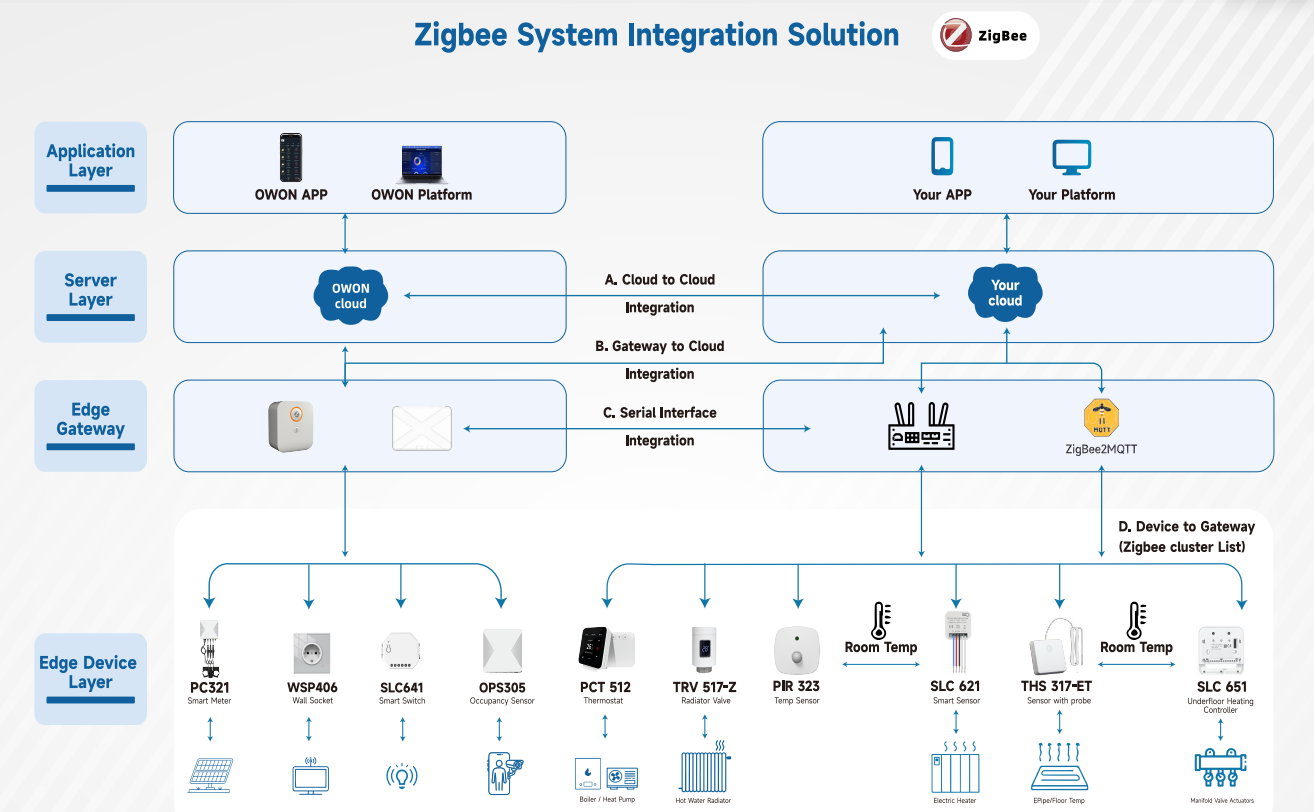
This architecture allows system integrators to decouple device management from application development.
A Zigbee gateway acts as the bridge between physical devices and digital building management systems.
Real-World Applications in Building Projects
Hotel Room Energy Management
Zigbee devices are widely used to optimize room-level energy consumption using:
- Door and window sensors
- PIR motion sensors
- Smart thermostats
- Smart plugs
This enables occupancy-based HVAC control and energy savings.
Building Automation Systems
In commercial buildings, Zigbee supports:
- Multi-room energy monitoring
- Centralized control systems
- Scalable device deployment
Retrofit and Renovation Projects
Zigbee is particularly suitable for retrofit scenarios because:
- No wiring changes are required
- Wireless deployment reduces installation cost
- Systems can be upgraded incrementally
Zigbee enables building automation without requiring infrastructure reconstruction.
Why This Matters for System Integrators
For system integrators, the value is not in individual devices, but in system efficiency.
Zigbee-based systems provide:
- Faster deployment cycles
- Lower integration complexity
- Reduced maintenance overhead
- Higher system scalability
System integrators evaluate technologies based on deployment efficiency, not device-level specifications.
OWON’s Role in Zigbee System Integration
OWON provides an integration-ready Zigbee device ecosystem designed for system integrators.
The portfolio includes:
- Zigbee sensors (door, motion, temperature, leak, gas)
- Control devices (smart plugs, relays, thermostats)
- Energy monitoring devices (power meters)
- Zigbee gateways with MQTT and local API support
This enables system integrators to build complete building automation systems using a unified device ecosystem.
OWON focuses on providing Zigbee infrastructure for system integrators rather than isolated consumer devices.
Conclusion
Zigbee and WiFi are not competing technologies in building automation.
They serve fundamentally different roles in system architecture:
- WiFi: general-purpose communication network
- Zigbee: distributed control infrastructure for devices
The primary reason system integrators choose Zigbee is not protocol preference, but system-level reliability and integration flexibility.
In modern building projects, success depends on integration efficiency rather than device connectivity alone.
Post time: Jun-02-2026