You Are Not Buying a Sensor Anymore
If you are reading this, you are probably already past the “what is mmWave” stage.
You already know what a fall detection sensor is.
You already understand the idea of non-contact monitoring.
So let’s be honest about what you are actually doing now.
You are not comparing technologies.
You are choosing a supplier that will sit inside your project for the next 3–5 years.
And in elderly care projects, that is not a small decision.
Because when something goes wrong here, it is rarely a technical issue.
It becomes an operational one.
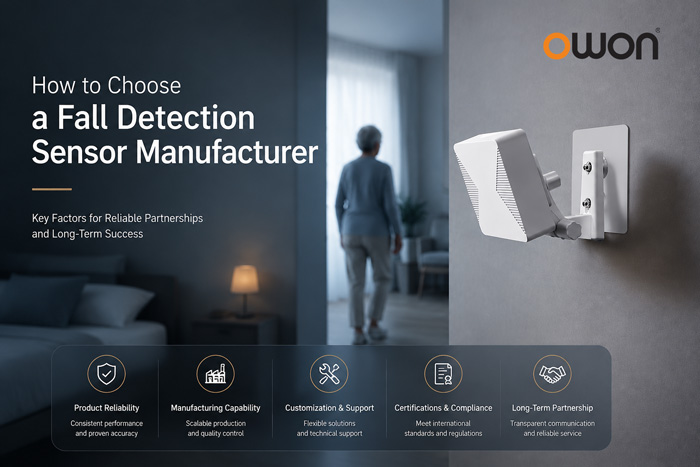
Not All Fall Detection Sensor Manufacturers Are Equal
On paper, most fall detection sensor manufacturers look very similar.
They all say things like:
- mmWave radar
- AI detection
- privacy protection
- non-contact sensing
Very clean. Very convincing. Very identical.
But in reality, they usually fall into three categories:
Hardware OEM Type
They can produce devices, but detection logic is basic or externally dependent.
Algorithm-first Type
They talk a lot about AI, but hardware consistency and deployment stability can be weak.
Deployment-ready Type
They understand that real value is not the sensor itself, but how it behaves in a real system over time.
If you are building anything beyond a pilot project, you already know which category matters.
What Is the Sensor Actually Detecting?
Let’s simplify something that is often overcomplicated.
A proper fall detection sensor is not just detecting motion.
It should understand patterns such as:
- presence detection
- posture changes
- sudden vertical movement
- inactivity after movement
If a supplier cannot clearly explain how these signals are interpreted, you are basically being asked to trust a black box.
And black boxes are fine for magic tricks, not for care environments.
Accuracy Is Not the Real Problem. Stability Is.
Most suppliers will lead with numbers:
- 99% accuracy
- wide detection range
- high sensitivity
- AI optimization
It sounds reassuring.
Until you actually deploy it.
Then you start seeing the real issues:
- different firmware behaves differently
- batch-to-batch inconsistency
- unexpected false alarms
- changes after “minor upgrades”
And here is the part people usually only learn the hard way:
In elderly care environments, false alarms are not “annoying”.
They are operational cost.
And sometimes emotional cost too.
Integration Is Where Most Projects Become Difficult
A fall detection sensor is almost never used alone.
It usually sits inside a larger ecosystem:
- gateway systems
- alarm platforms
- care dashboards
- building monitoring systems
So the real question is not:
Can it detect a fall?
The real question is:
System Integration Capability
You should be looking for:
- stable Zigbee / IP / API support
- event-based data output
- predictable real-time reporting
- easy third-party integration
If every project requires custom engineering, scaling becomes very expensive very quickly.
And nobody enjoys scaling expensive problems.
Supply Chain Reality: Can This Still Exist in 3 Years?
This is one of the most underestimated parts of sourcing.
A lot of buyers focus on samples.
But projects live in time.
So you should be asking:
Long-term Supply Stability
- Will this model still exist next year?
- Will firmware stay consistent?
- Can I reorder the same version?
- Will I need to re-certify everything later?
Because in real deployments, changing hardware is not “an update”.
It is a migration project.
And nobody likes migration projects.
What mmWave Fall Detection Actually Does
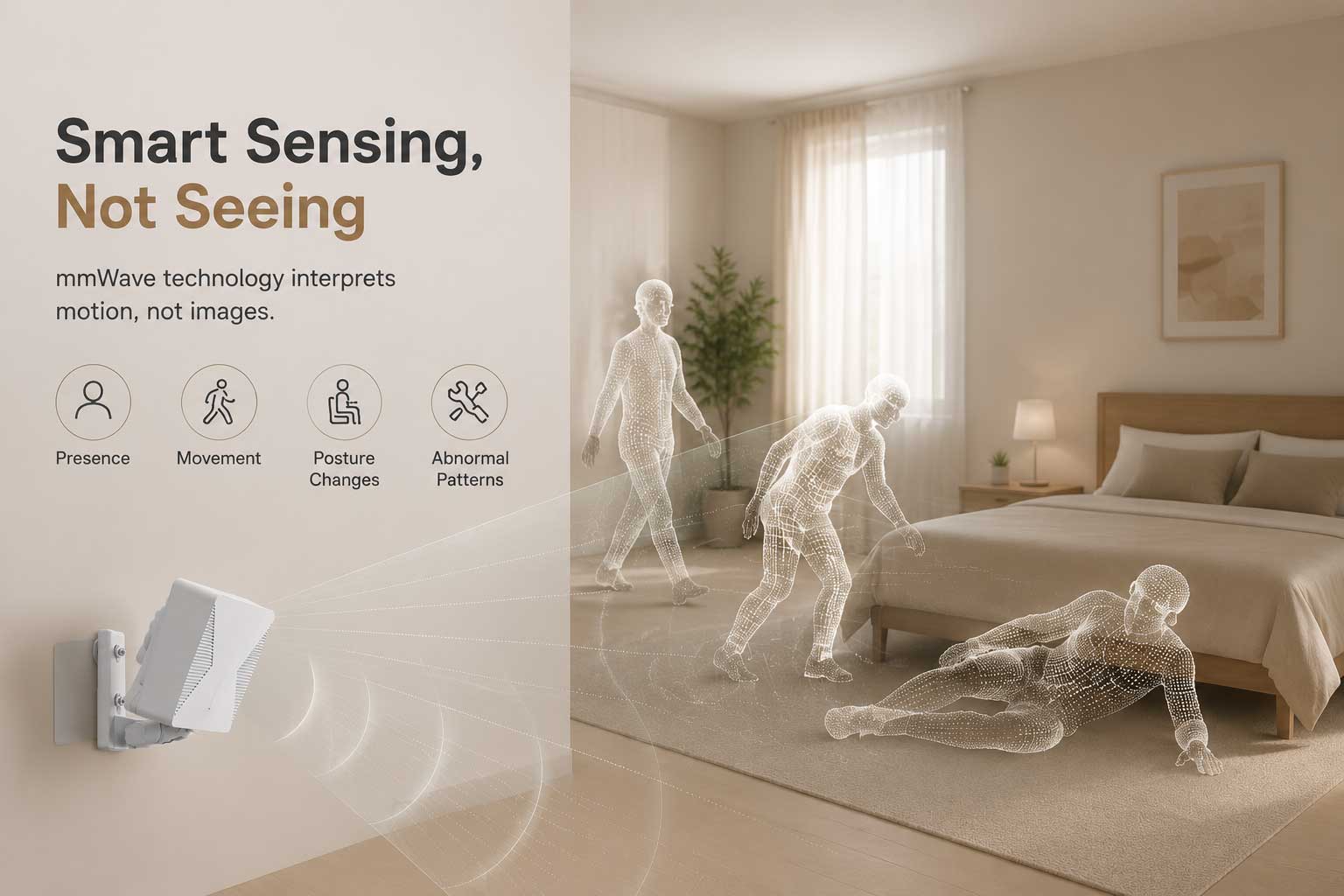
At its core, mmWave fall detection technology is not imaging.
It does not “see” people.
It interprets signal reflections to understand:
- presence
- movement
- posture changes
- abnormal motion patterns
So instead of recording what happens, it interprets how the body moves in space.
Which is why it can work without cameras.
And without requiring users to wear anything.
A Real Deployment Example
Devices like the FDS315 mmWave fall detection sensor are typically used in:
- nursing homes
- assisted living facilities
- elderly home monitoring systems
From a technical point of view, it is a non-contact radar-based detection device.
But from a procurement point of view, that is not the interesting part.
The real questions are:
- Can it be deployed at scale?
- Can it be integrated into existing systems?
- Will behavior remain consistent across batches?
- Can I rely on supply continuity?
Because in real projects, the sensor itself is rarely the risk.
The system around it is.
Red Flags You Should Not Ignore
If you encounter suppliers who:
- only say “AI detection” without explanation
- change hardware versions frequently
- cannot clearly describe integration methods
- lack long-term product roadmap
- show sample performance that differs from production
You should probably slow down.
Not because they are necessarily bad suppliers.
But because your project will depend on things they have not fully defined yet.
Conclusion: You Are Not Selecting a Sensor, You Are Selecting Predictability
At this stage, sourcing is no longer about features.
It is about predictability under real-world conditions.
A good fall detection sensor manufacturer is not the one with the most advanced specification sheet.
It is the one that quietly avoids surprises.
Because in elderly care projects, surprises are rarely welcome.
And when they do appear, they are never cheap.
So the real question is not:
“What can this sensor do?”
It is:
“How confidently can I deploy it at scale and forget about it working exactly as expected?”
FAQ
What should I look for in a fall detection sensor manufacturer?
You should evaluate integration capability, long-term supply stability, firmware consistency, and real deployment experience, not just specifications.
What is mmWave fall detection technology?
It is a non-contact sensing method that uses radar signal reflection to detect presence, movement, and posture changes for fall detection purposes.
Why is system integration important for fall detection devices?
Because these devices are usually part of larger monitoring systems and must reliably communicate with gateways and care platforms.
Are all fall detection sensors the same?
No. They differ significantly in detection logic, hardware stability, integration capability, and long-term consistency.
Is fall detection technology suitable for elderly care environments?
Yes. It is widely used in nursing homes, assisted living facilities, and home monitoring scenarios where non-intrusive safety monitoring is required.
Post time: Jul-03-2026