Introduction
Modern hotel guest room management has evolved far beyond traditional door signs and manual room inspections. As hotels continue investing in digital transformation, Hotel DND (Do Not Disturb) Systems have become an important part of smart guest room operations.
A modern hotel DND system helps staff understand room status in real time, reduces unnecessary guest interruptions, and improves housekeeping efficiency. More importantly, today’s systems can integrate with smart hotel platforms, occupancy sensors, thermostats, and room automation devices to create a better guest experience while reducing operational costs.
For hotel owners, operators, and system integrators, understanding how modern DND systems work is becoming increasingly important when planning new hotel projects or upgrading existing properties.
What Is a Hotel DND System?
A Hotel DND System is a room status management solution that allows guests to communicate their room preferences to hotel staff through electronic room indicators and control panels.
Typical functions include:
| Function | Purpose |
|---|---|
| DND (Do Not Disturb) | Prevent housekeeping or staff interruptions |
| MUR (Make Up Room) | Request housekeeping service |
| Doorbell | Notify guests of visitors or staff presence |
| Room Status Indicator | Display room status outside the guest room |
Unlike traditional door signs, modern hotel DND systems provide real-time status updates and can be integrated into centralized hotel management platforms.
Why Hotels Are Replacing Traditional Door Signs
Traditional door signs have several operational limitations.
Limited Visibility
Staff members must physically approach rooms to check guest status, increasing labor costs and reducing efficiency.
Delayed Housekeeping Response
Housekeeping teams often experience delays when room service requests are not communicated instantly.
Guest Disturbance
Without accurate room status information, staff may unintentionally disturb guests.
Lack of Integration
Traditional signs cannot communicate with hotel management systems, occupancy sensors, or energy management platforms.
As a result, many hotels are transitioning to connected room status solutions that provide real-time visibility and centralized control.
Key Benefits of Modern Hotel DND Systems
Improved Guest Privacy
Guests can easily activate DND status, reducing unwanted interruptions and improving overall satisfaction.
Faster Housekeeping Operations
MUR requests are delivered immediately to hotel staff, improving response times and room turnover efficiency.
Better Operational Visibility
Front desk personnel, housekeeping teams, and supervisors can monitor room status centrally, enabling more efficient workflow management.
Energy Savings Opportunities
When integrated with occupancy detection and HVAC control systems, room status information can help optimize energy usage during vacant periods.
How Hotel DND Systems Integrate with Smart Hotel Platforms
Modern hotel DND systems are no longer standalone devices. They are increasingly integrated into broader smart hotel ecosystems that connect room status controls, guest service workflows, and building automation platforms.
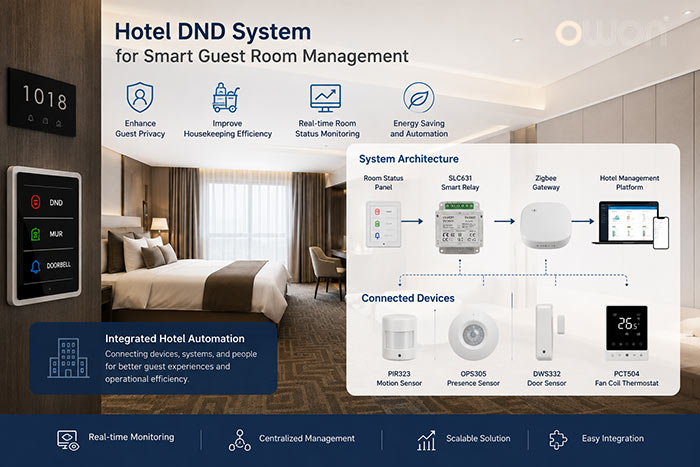
A typical architecture includes:
Guest Room Panel
↓
Smart Relay
↓
Zigbee Gateway
↓
Hotel Management Platform
In this architecture, the relay module serves as the interface between the physical room signage panel and the hotel’s automation network.
When a guest presses the Do Not Disturb (DND) or Make Up Room (MUR) button, the relay module detects the status change and controls the corresponding room signage indicators. It can also monitor doorbell events and report room status information to the automation platform.
For example, the OWON SLC631 Smart Relay is designed specifically for hotel room status applications. It provides three relay outputs for controlling room signage functions such as DND, MUR, and service indicators, while also supporting doorbell status detection through a Zigbee 3.0 network.
The relay communicates with a Zigbee gateway, allowing room status information to be synchronized with hotel management platforms, guest room management systems (GRMS), and building management systems (BMS). This enables hotel staff to view room status in real time and respond more efficiently to guest requests.
Building a Complete Smart Guest Room Solution
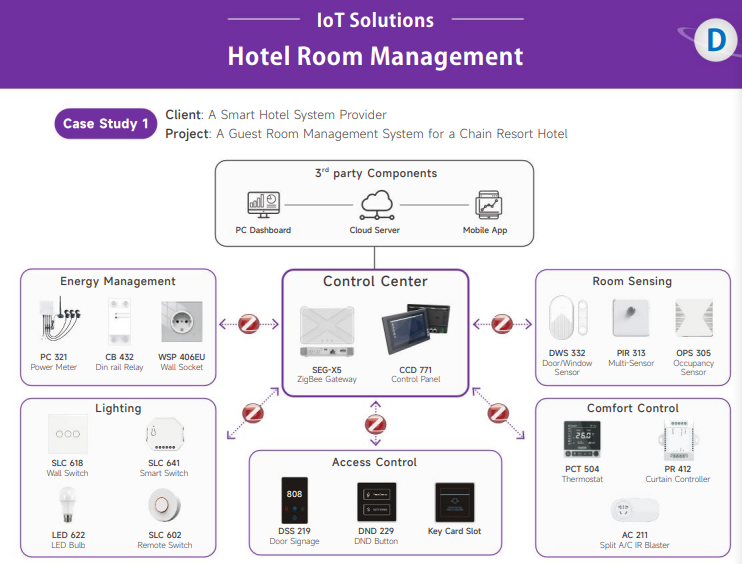
A modern hotel DND system often serves as the foundation for a broader smart guest room solution.
Room Status Control
The OWON SLC631 Smart Relay enables centralized management of:
- Do Not Disturb (DND)
- Make Up Room (MUR)
- Doorbell notifications
- Room status indicators
Occupancy Detection
Occupancy sensors can determine whether a room is actively occupied, allowing hotel systems to automate lighting and HVAC operation.
Examples include:
- PIR323 Zigbee Motion Sensor
- OPS305 Presence Sensor
Door Monitoring
Door sensors can provide room entry and exit information, supporting both security and energy-saving applications.
Example:
HVAC Control
Room status information can also be linked to HVAC control systems.
For example, when a guest leaves the room, the thermostat can automatically switch to an energy-saving mode.
Example:
Centralized Connectivity
A Zigbee gateway acts as the central communication hub for the entire room automation system.
Example:
Deployment Considerations for Hotel Projects
When selecting a hotel DND system, several factors should be evaluated.
Scalability
The solution should support deployment across hundreds or thousands of guest rooms.
Local Operation
Critical room functions should continue operating even if the internet connection becomes unavailable.
Integration Capability
The system should support integration with:
- Hotel PMS platforms
- Building Management Systems (BMS)
- Guest Room Management Systems (GRMS)
- Energy Management Systems (EMS)
Maintenance Efficiency
Remote monitoring and centralized device management can significantly reduce maintenance costs.
Why Zigbee Is Well Suited for Hotel Room Automation
Many hotel automation projects choose Zigbee technology because of its reliability and scalability.
Key advantages include:
Mesh Networking
Devices automatically extend network coverage throughout the property.
Reliable Communication
Zigbee is designed for building-scale deployments and provides stable communication across multiple rooms and floors.
Low Power Consumption
Wireless devices can operate efficiently while minimizing maintenance requirements.
Centralized Management
Multiple devices can be controlled and monitored through a single gateway and management platform.
These characteristics make Zigbee an excellent choice for guest room automation and room status management applications.
Conclusion
Modern hotel DND systems have evolved far beyond simple door signs. Today, they play a critical role in guest room management, housekeeping coordination, and smart hotel automation.
By combining room status indication, occupancy sensing, door monitoring, and HVAC control, hotels can improve guest satisfaction while increasing operational efficiency.
Solutions built around technologies such as the OWON SLC631 Smart Relay, Zigbee gateways, occupancy sensors, door sensors, and thermostats provide a scalable foundation for modern smart hotel projects.
For hotels planning digital transformation initiatives, implementing an integrated hotel DND system is an effective step toward delivering better guest experiences and more efficient property operations.
Post time: Jul-02-2026