As the global population ages, elderly care providers face increasing challenges related to nighttime supervision, fall prevention, and caregiver efficiency. Falls remain one of the leading causes of injury among older adults, particularly in nursing homes, assisted living facilities, rehabilitation centers, and long-term care environments.
To address these challenges, healthcare providers are increasingly adopting bed presence sensors as part of their safety monitoring strategy. These devices provide real-time visibility into whether a resident is in bed or has left the bed, allowing caregivers to respond more quickly and reduce the risk of accidents.
Today, bed presence monitoring is becoming an essential component of modern elderly care systems and smart healthcare environments.
Why Fall Prevention Matters in Elderly Care
Many falls occur when elderly residents attempt to get out of bed without assistance, especially during nighttime hours. In traditional care environments, staff often rely on routine room checks, which can be labor-intensive and may not provide immediate awareness when a resident leaves the bed.
A delayed response can lead to:
- Fall-related injuries
- Extended recovery periods
- Increased hospitalization rates
- Reduced resident confidence
- Higher operational costs
As care facilities seek more proactive safety solutions, occupancy monitoring technologies are becoming increasingly valuable.
What Is a Bed Presence Sensor?
A bed presence sensor is a monitoring device designed to detect whether a person is currently in bed or has left the bed.
Installed beneath or within the mattress, the sensor continuously monitors occupancy status without requiring the resident to wear any device or interact with the system.
Typical functions include:
- In-bed detection
- Out-of-bed detection
- Occupancy monitoring
- Real-time notifications
- Event logging and reporting
Because monitoring is completely passive, the technology is particularly suitable for elderly residents, patients with limited mobility, and individuals requiring continuous supervision.
How Bed Presence Monitoring Works
A bed presence monitoring system typically consists of a sensing pad, a wireless communication module, and a monitoring platform.
When a resident gets into or out of bed, the sensor detects the occupancy change and immediately sends status information to a connected system.
Notifications can be delivered to:
- Caregiver mobile applications
- Nurse stations
- Elderly care management platforms
- Healthcare monitoring dashboards
- Smart building systems
This enables caregivers to receive timely alerts without disturbing residents during normal sleep.
Benefits of Smart Bed Presence Sensors
Modern facilities increasingly prefer a smart bed presence sensor because it provides more than simple occupancy detection.
Key benefits include:
Improved Resident Safety
Real-time occupancy monitoring helps caregivers react faster when assistance is needed.
Reduced Fall Risks
Immediate awareness of out-of-bed events can help prevent unattended movement and potential falls.
Better Caregiver Efficiency
Staff no longer need to perform frequent manual checks, allowing them to focus on residents who require attention.
Non-Intrusive Monitoring
Residents are not required to wear pendants, wristbands, or other devices.
Scalable Deployment
Wireless monitoring solutions can be deployed across multiple rooms and facilities with minimal disruption.
Bed Presence Sensor vs Bed Occupancy Sensor
Healthcare professionals often use the terms bed presence sensor and bed occupancy sensor interchangeably.
In practical applications, both technologies are designed to determine whether a resident is occupying a bed.
A bed occupancy sensor is particularly valuable in:
- Nursing homes
- Assisted living facilities
- Hospitals
- Rehabilitation centers
- Memory care facilities
Regardless of the terminology used, the primary goal remains the same: improving resident safety and providing caregivers with real-time occupancy information.
Applications in Modern Elderly Care
A bed sensor for elderly monitoring can support a wide range of healthcare and care facility applications.
Common deployment scenarios include:
Nursing Homes
Monitor residents who may require assistance when getting out of bed.
Assisted Living Facilities
Improve resident independence while maintaining caregiver visibility.
Rehabilitation Centers
Track patient movement during recovery periods.
Hospitals
Support patient monitoring and fall prevention programs.
Home-Based Elderly Care
Enable family members and caregivers to receive alerts when occupancy status changes.
As healthcare becomes increasingly connected, occupancy monitoring is also being integrated into larger IoT-based care platforms.
Why Zigbee-Based Solutions Are Becoming Popular
For large-scale deployments, wireless communication reliability is critical.
A bed presence sensor Zigbee solution offers several advantages:
- Low power consumption
- Stable wireless communication
- Scalable device networking
- Integration with healthcare IoT systems
- Support for centralized monitoring platforms
Zigbee technology is particularly suitable for nursing homes and assisted living facilities where multiple monitoring devices must communicate reliably within the same environment.
Example Solution: OWON SPM915 Bed Presence Sensor
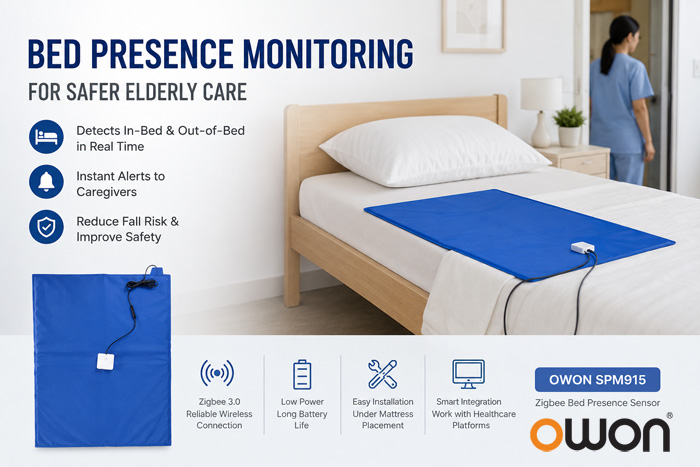
The OWON SPM915 is a Zigbee-based bed presence monitoring solution designed specifically for elderly care and healthcare applications. It provides real-time in-bed and out-of-bed detection and can be integrated into smart healthcare platforms through Zigbee gateways. The device is positioned as an occupancy monitoring solution rather than a vital signs monitor, making it ideal for fall prevention and caregiver notification scenarios. OWON lists the SPM915 within its personal care portfolio as a sleep monitoring pad focused on on-bed/off-bed detection.
Key benefits include:
- Zigbee 3.0 communication
- Real-time occupancy detection
- Low power consumption
- Easy under-mattress installation
- Integration with healthcare monitoring systems
- Suitable for nursing homes and assisted living projects
Choosing the Right Bed Presence Monitoring Solution
When evaluating occupancy monitoring technologies, healthcare providers should consider:
- Detection accuracy
- Wireless communication reliability
- Ease of installation
- Platform integration capabilities
- Long-term product availability
- Technical support
- OEM and ODM services
The right solution should not only improve resident safety but also integrate smoothly into existing healthcare workflows.
Bed Presence Monitoring Solutions for Healthcare and OEM Partners
As healthcare providers continue to modernize elderly care services, occupancy monitoring is becoming a standard requirement for many projects.
OWON supports healthcare providers, system integrators, and OEM partners with Zigbee-based monitoring technologies that can be integrated into broader healthcare ecosystems. In addition to occupancy monitoring solutions such as the SPM915, OWON provides a wide range of IoT devices, gateways, sensors, and integration APIs for healthcare and smart building projects.
If your project requires a reliable bed occupancy sensor for elderly care, rehabilitation, or healthcare monitoring applications, OEM customization and system integration capabilities should be key selection criteria.
FAQ
What does a bed presence sensor detect?
A bed presence sensor detects whether a person is currently in bed or has left the bed, providing real-time occupancy status information.
Is a bed occupancy sensor the same as a bed presence sensor?
In most healthcare applications, the terms are used interchangeably because both technologies monitor bed occupancy status.
Does a bed presence sensor monitor heart rate or respiration?
No. Occupancy monitoring devices focus on in-bed and out-of-bed detection. If heart rate and respiration monitoring are required, solutions such as OWON’s SPM912 or SPM913 are more suitable.
Why is Zigbee suitable for bed presence monitoring?
Zigbee offers low power consumption, reliable wireless communication, and easy integration into larger healthcare monitoring networks.
Who typically uses bed presence monitoring systems?
Nursing homes, assisted living facilities, hospitals, rehabilitation centers, healthcare platform providers, and system integrators commonly deploy these solutions.
Conclusion
Bed presence monitoring is becoming an essential part of modern elderly care systems. By providing real-time occupancy awareness, a bed presence sensor helps reduce fall risks, improve caregiver response times, and enhance overall resident safety.
As nursing homes, hospitals, and assisted living facilities continue to adopt smart healthcare technologies, solutions such as Zigbee-based occupancy monitoring systems will play an increasingly important role in delivering safer, more efficient care environments.
Related reading:
[Why Vital Signs Monitoring Devices Are Transforming Elderly Healthcare Systems]
Post time: Jul-01-2026