Introduction
As multifamily housing operators continue upgrading aging HVAC infrastructure, smart thermostat deployment has become a critical part of apartment energy management and tenant comfort strategies.
However, deploying thermostats across dozens or hundreds of apartment units is very different from installing a single residential thermostat. Multifamily projects require scalable installation workflows, broad HVAC compatibility, centralized management, and simplified maintenance.
For property technology providers, HVAC contractors, and apartment automation integrators, deployment efficiency often matters more than consumer-oriented smart home features.
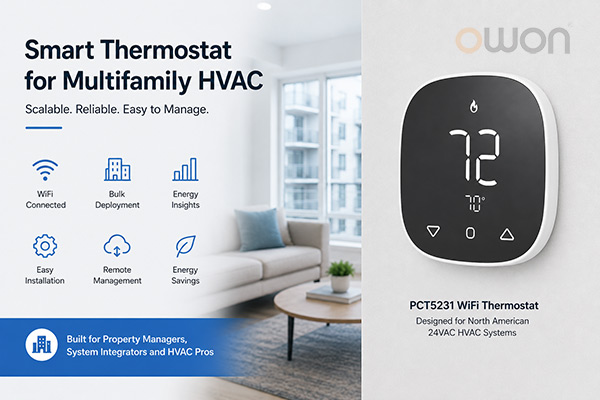
This article explores the practical considerations behind thermostat bulk deployment projects and how the OWON PCT5231 WiFi thermostat helps simplify apartment HVAC automation in North American multifamily buildings.
Why Multifamily Buildings Are Investing in Smart HVAC Automation
In North America, HVAC systems account for a major portion of apartment operating costs.
As energy prices continue rising, property operators are increasingly adopting smart HVAC automation to:
- Reduce heating and cooling waste
- Improve tenant comfort consistency
- Enable remote HVAC management
- Simplify maintenance operations
- Support apartment retrofit projects
- Reduce onsite service visits
Unlike single-family smart home installations, multifamily deployments prioritize operational scalability and long-term maintenance efficiency.
This creates different requirements for thermostat selection and deployment planning.
Operational Benefits of Smart Thermostat Deployment in Multifamily Buildings
Estimated Improvement
30
20
10
0
Savings
Efficiency
Reduction
Improvement
Efficiency
Key Challenges in Thermostat Bulk Deployment
HVAC Compatibility Across Apartment Buildings
Many apartment properties contain a mix of HVAC systems installed over different periods.
Deployment teams often encounter:
- Conventional furnace systems
- Heat pump systems
- Dual fuel systems
- Multi-stage HVAC systems
- Older thermostat wiring
- Limited C-wire availability
A multifamily thermostat platform must support broad HVAC compatibility to reduce installation complexity and deployment delays.
The OWON PCT5231 supports:
- Conventional HVAC systems
- Up to 4H/2C heat pump systems
- Dual fuel / hybrid heat systems
- Emergency heat
- Optional C-wire adapter installation
This flexibility is especially valuable during apartment retrofit projects where HVAC system variations are common.
Reducing Installation Time Across Multiple Units
In large apartment projects, installation speed directly affects labor costs and deployment schedules.
HVAC contractors typically prioritize:
- Simplified wiring
- Fast setup procedures
- Consistent installation workflows
- Minimal wall modifications
- Reduced troubleshooting time
The PCT5231 is designed for deployment-friendly installation with:
- Standard 24VAC compatibility
- Optional C-wire adapter support
- Touch-sensitive controls
- Guided setup workflow
- Broad HVAC system support
These features help reduce installation friction across large multifamily deployments.
Managing HVAC Systems Across Multiple Apartments
Property operators increasingly expect centralized visibility across multiple apartment units.
Typical management goals include:
- Remote temperature adjustment
- HVAC schedule management
- Energy usage monitoring
- Maintenance reminders
- Occupancy-based HVAC control
- Reduced tenant complaints
WiFi-connected thermostats simplify apartment HVAC automation by enabling remote access without requiring additional gateway infrastructure.
This approach is especially suitable for retrofit-friendly multifamily projects where deployment simplicity is important.
Why WiFi Thermostats Work Well for Apartment Retrofit Projects
Compared with traditional building automation systems, WiFi thermostats are often easier to deploy in existing apartment buildings.
Advantages include:
| Feature | Benefits for Multifamily Deployment |
|---|---|
| WiFi connectivity | No dedicated gateway hardware required |
| Remote management | Simplified maintenance operations |
| OTA firmware updates | Easier long-term device management |
| Broad HVAC compatibility | Suitable for retrofit projects |
| Occupancy sensing | Reduce HVAC waste in vacant units |
| Remote sensor support | Better room-level comfort balancing |
| C-wire adapter support | Easier installation in older apartments |
| Energy usage tracking | Better operational visibility |
Why the PCT5231 Fits Multifamily Thermostat Deployment
The OWON PCT5231 is designed for North American 24VAC HVAC systems commonly found in apartments and multifamily buildings.
Key deployment advantages include:
| Feature | Why It Matters for Multifamily Projects |
| 4H/2C HVAC support | Handles complex apartment HVAC systems |
| Dual fuel compatibility | Supports mixed retrofit environments |
| Remote sensors | Improve room-level comfort |
| Occupancy sensing | Reduce unnecessary HVAC runtime |
| Energy tracking | Improve operational efficiency |
| OTA firmware updates | Simplify large-scale maintenance |
| WiFi architecture | No gateway dependency |
| Optional C-wire adapter | Simplifies old-building installation |
The thermostat also supports remote room sensors for balancing temperature differences between rooms, helping improve tenant comfort in larger apartment units.
Typical Deployment Workflow for Multifamily Thermostat Projects
Step 1 — Evaluate Existing HVAC Infrastructure
Before deployment, identify:
- HVAC system types
- Heat pump compatibility
- Existing thermostat wiring
- C-wire availability
- Multi-stage HVAC requirements
This helps standardize installation procedures across units.
Step 2 — Standardize Installation Procedures
Large apartment deployments benefit from repeatable installation workflows.
Best practices often include:
- Wiring documentation templates
- Installer checklists
- HVAC configuration standards
- Unit naming structures
- Consistent onboarding procedures
Reducing installation variation improves deployment efficiency.
Step 3 — Configure Centralized Management
Remote HVAC management allows property operators to:
- Adjust temperatures remotely
- Monitor vacant units
- Reduce HVAC waste
- Improve maintenance response times
- Standardize scheduling policies
Centralized management becomes increasingly important as apartment portfolios scale.
Step 4 — Plan Long-Term Maintenance Operations
Long-term maintenance considerations are often overlooked during initial deployment planning.
Important operational considerations include:
- Firmware update management
- Remote diagnostics
- Sensor replacement procedures
- HVAC alert handling
- Tenant usability
Thermostats designed for remote lifecycle management can significantly reduce long-term support costs.
FAQ
What is the best thermostat type for multifamily apartment deployment?
WiFi smart thermostats with broad HVAC compatibility and remote management capabilities are commonly preferred for multifamily retrofit projects.
Why is thermostat bulk deployment challenging in apartment buildings?
Apartment buildings often contain mixed HVAC systems, older wiring configurations, and varying installation conditions, making deployment standardization important.
Can WiFi thermostats work in older apartment buildings?
Yes. Thermostats with optional C-wire adapter support can often be installed in older buildings without requiring major rewiring.
Why do multifamily projects prefer WiFi thermostats?
WiFi thermostats simplify deployment because they do not require separate gateway infrastructure and can support centralized remote management.
What thermostat features matter most for apartment HVAC automation?
Key features include:
- Heat pump compatibility
- Fast installation
- Remote management
- OTA firmware updates
- Occupancy sensing
- Energy tracking
- Remote sensor support
Conclusion
Deploying smart thermostats across multifamily buildings requires more than basic smart home functionality. Successful apartment HVAC automation projects depend on deployment scalability, HVAC compatibility, installation efficiency, and long-term maintenance simplicity.
For North American apartment retrofit projects, the OWON PCT5231 provides a deployment-friendly WiFi thermostat solution designed to support modern multifamily HVAC management strategies.
Post time: May-28-2026