Introduction
As smart building automation continues to evolve, more system integrators and IoT solution providers are adopting Zigbee2MQTT door sensors for reliable local control and real-time automation.
Unlike cloud-dependent smart home systems, Zigbee2MQTT enables direct local communication between Zigbee devices and automation platforms through MQTT, making it highly suitable for commercial environments where stability, privacy, and flexible integration are essential.
In hotels, offices, apartments, and energy management systems, Zigbee door sensors are widely used to detect door and window open/close status and trigger automated actions such as HVAC shutdown, lighting control, occupancy monitoring, and security alerts.
Why Zigbee2MQTT Matters in Commercial Projects
For commercial IoT deployments, local automation is often more important than mobile app convenience.
Zigbee2MQTT allows door sensors to communicate directly with local servers or building automation platforms without relying on external cloud services. This architecture improves reliability, reduces latency, and ensures automation continues working even during internet outages.
For system integrators, Zigbee2MQTT also provides:
• Open MQTT-based integration
• Compatibility with Home Assistant and BMS platforms
• Flexible automation logic
• Easier large-scale deployment management
• Better long-term device interoperability
These advantages make Zigbee2MQTT especially popular in smart hotels, office buildings, and energy optimization projects.
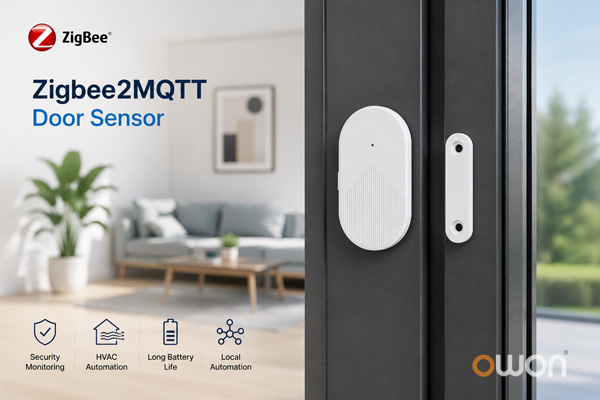
How Zigbee2MQTT Door Sensors Work
A Zigbee2MQTT door sensor detects whether a door or window is opened or closed using a magnetic reed switch.
When the sensor status changes, the Zigbee gateway immediately forwards the event to the MQTT broker, allowing automation platforms to trigger predefined actions in real time.
Typical automation examples include:
• Turning off air conditioning when a window is opened
• Triggering intrusion alarms after business hours
• Activating lighting when a room door is opened
• Recording occupancy activity in hotel rooms
• Sending real-time notifications to facility managers
Because Zigbee uses mesh networking, multiple devices can extend communication range throughout large commercial buildings.
Typical Applications of Zigbee2MQTT Door Sensors
Smart Hotel Automation
In smart hotel projects, Zigbee door sensors are commonly integrated with HVAC and lighting systems.
When guests open balcony doors or windows, the building management system can automatically pause air conditioning to reduce energy waste.
Door status can also be linked with room occupancy logic to optimize guest comfort and operational efficiency.
Commercial Security Monitoring
Office buildings, retail stores, and warehouses often use Zigbee2MQTT door sensors for real-time security monitoring.
Local MQTT-based automation ensures alarm triggers continue functioning even if internet connectivity becomes unstable.
Smart Apartment & Rental Management
Property managers can use Zigbee2MQTT door sensors to monitor access activity, automate lighting schedules, and reduce unnecessary HVAC operation in vacant units.
Why Zigbee 3.0 Matters for Large Deployments
For large-scale commercial installations, Zigbee 3.0 interoperability is critical.
Professional Zigbee door sensors such as the OWON DWS332 support Zigbee 3.0 and provide stable mesh communication, tamper alerts, and long battery life for demanding smart building environments.
The DWS332 also features secure screw installation and optional spacers for uneven mounting surfaces, making it suitable for hotels, apartments, and building automation projects.
Choosing a Zigbee Door Sensor Manufacturer
For OEM partners and system integrators, selecting a reliable zigbee door sensor manufacturer is just as important as choosing the right communication protocol.
Key factors to evaluate include:
• Zigbee 3.0 compatibility
• Stable Zigbee2MQTT integration
• Battery life and low-power optimization
• Tamper protection features
• Installation flexibility
• OEM/ODM customization capability
Professional manufacturers with commercial IoT experience can help ensure long-term deployment stability and easier system integration.
Conclusion
Zigbee2MQTT door sensors are becoming an essential component in modern smart building and commercial automation projects.
By combining local MQTT-based control with reliable Zigbee mesh networking, these sensors enable scalable security monitoring, HVAC optimization, and real-time automation without cloud dependency.
For system integrators, hotels, and IoT solution providers, choosing a professional Zigbee 3.0 door sensor can significantly improve deployment reliability and long-term operational efficiency.
FAQ
Q1: What is a Zigbee2MQTT door sensor?
A Zigbee2MQTT door sensor is a Zigbee-based door or window sensor that communicates with automation systems through the Zigbee2MQTT platform using MQTT protocol.
Q2: Can Zigbee2MQTT door sensors work without internet?
Yes. Zigbee2MQTT supports fully local automation, allowing door sensors to continue functioning even when internet access is unavailable.
Q3: What are Zigbee2MQTT door sensors used for?
They are commonly used for smart building security, HVAC automation, occupancy monitoring, and energy management.
Q4: Does the OWON DWS332 support Zigbee2MQTT?
Yes. The OWON DWS332 Zigbee door sensor supports Zigbee 3.0 and can be integrated into Zigbee2MQTT-based automation systems.
Post time: May-27-2026