Introduction
Most landlords don’t think about thermostats until tenants start calling.
It usually sounds like this:
- “The apartment is too cold.”
- “The heating feels off.”
- “Can someone adjust the thermostat?”
In rental properties, HVAC complaints are among the most common maintenance requests.
At the same time, another problem quietly grows in the background—rising energy costs caused by unrestricted thermostat usage.
A landlord thermostat is a smart HVAC control solution that helps property owners and managers remotely manage temperature settings, define operating limits, and improve HVAC efficiency across rental properties.
This is why more landlords, apartment operators, and property management companies are adopting smart thermostat systems to improve tenant comfort while reducing unnecessary HVAC costs.
What Is a Landlord Smart Thermostat System?
A landlord smart thermostat system allows property owners or managers to control HVAC settings in rental units remotely.
Instead of relying entirely on tenants to manage indoor temperatures, landlords can define how the HVAC system should operate while maintaining comfortable living conditions.
Typical capabilities include:
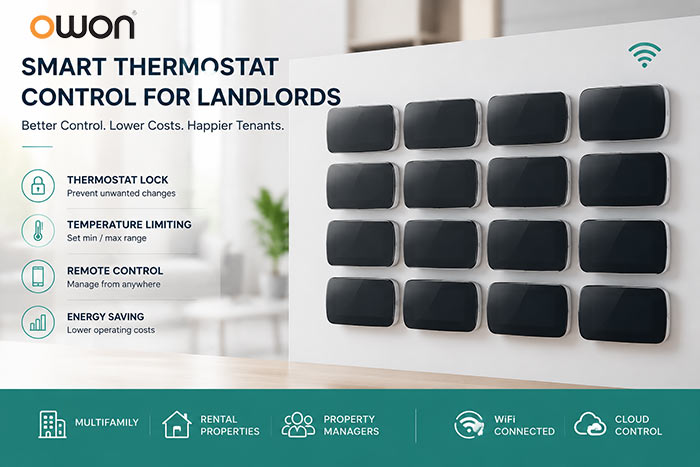
- Remote temperature control
- Thermostat lock settings
- Temperature range limitation
- WiFi remote management
- Multi-unit HVAC management
These systems are widely used in rental homes, apartment communities, student housing, and multifamily residential buildings where centralized HVAC management improves operational efficiency.
Why Thermostat Lock Matters in Rental Properties
A thermostat lock is not about limiting tenant comfort.
Instead, it helps prevent unnecessary HVAC operation caused by extreme temperature settings or unauthorized changes.
In real-world rental properties, tenants may:
- Set cooling temperatures excessively low during summer
- Increase heating temperatures unnecessarily during winter
- Leave HVAC systems running continuously
- Accidentally change advanced thermostat settings
Over time, these behaviors increase utility costs, accelerate HVAC equipment wear, and generate avoidable maintenance requests.
With a thermostat lock, landlords can protect thermostat settings while still allowing tenants to adjust temperatures within a reasonable range.
This has become one of the most practical features of modern landlord thermostat systems.
Temperature Limiting for Better Energy Management
Another important feature is temperature limiting.
Instead of giving tenants unrestricted control, landlords can define a comfortable operating range, such as:
- Minimum cooling temperature
- Maximum heating temperature
This approach helps stabilize HVAC energy usage across different seasons while reducing unnecessary equipment runtime.
Temperature limiting is especially valuable for:
- Apartment buildings
- Student housing
- Older rental properties
- Multifamily housing
- Rental portfolios with centralized energy management
For many landlords, allowing tenants to adjust temperatures within a predefined range provides a better balance between occupant comfort and operating costs than completely locking the thermostat.
When choosing a smart thermostat for rental property applications, temperature limiting is often considered one of the most valuable functions because it improves energy efficiency without negatively affecting the tenant experience.
Remote HVAC Control for Property Managers
Modern smart thermostat systems allow landlords and property managers to monitor and adjust HVAC settings remotely.
Instead of sending maintenance personnel to individual units, authorized users can access thermostat settings through a cloud platform or mobile application.
With remote HVAC control, landlords can:
- Adjust temperatures across multiple units
- Respond to tenant requests more quickly
- Standardize HVAC settings across rental properties
- Reduce unnecessary maintenance visits
For property managers responsible for dozens or even hundreds of rental units, centralized thermostat management significantly improves daily operations.
It also helps HVAC contractors and system integrators simplify deployment, maintenance, and long-term HVAC management for multifamily projects.
This is one of the biggest advantages of modern landlord thermostat control systems compared with traditional programmable thermostats.
How Smart Thermostats Work in Rental Properties
Most modern landlord thermostat systems are cloud-connected WiFi thermostats.
A typical deployment looks like this:
Property Manager Dashboard → Cloud Platform → Smart Thermostat → HVAC System
This architecture allows authorized users to monitor and manage HVAC systems across multiple rental units from a single interface.
Instead of visiting each property, landlords and property managers can adjust temperature settings, apply schedules, and respond to tenant requests remotely, improving operational efficiency while reducing unnecessary service visits.
Why WiFi Smart Thermostats Are Used in Multifamily Housing
WiFi thermostats are increasingly adopted in apartment communities and rental properties because they simplify deployment while providing centralized HVAC management.
Compared with conventional programmable thermostats, connected WiFi thermostats offer several advantages:
- Remote HVAC management
- Temperature scheduling
- Centralized control across multiple properties
- Faster response to maintenance requests
- Better visibility of HVAC operation
- Improved energy management
For apartment operators, property management companies, HVAC contractors, and system integrators, these capabilities help reduce operating costs while delivering a more consistent tenant experience.
Smart Thermostat Solutions for Rental Property Projects
Different rental property projects often require different thermostat capabilities.
For example, apartment communities with larger floor plans may benefit from wireless room sensors that improve temperature consistency across living spaces, while modern multifamily buildings may require occupancy-based HVAC optimization to reduce energy use in vacant units.
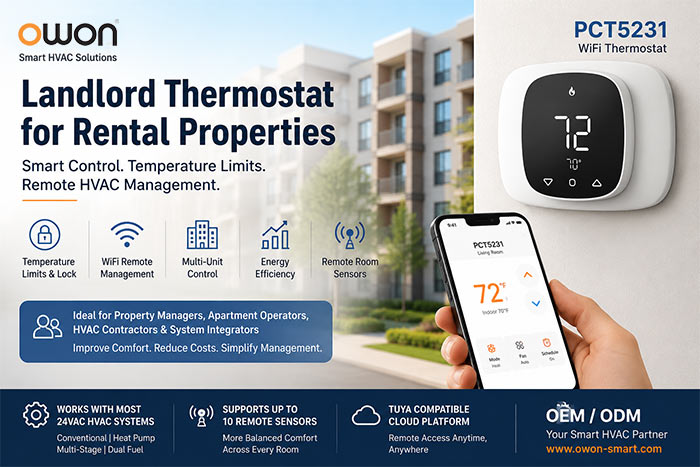
For example, OWON’s PCT5231 WiFi Thermostat supports most North American 24VAC HVAC systems, including conventional and heat pump configurations. It also supports up to 10 wireless remote room sensors, making it well suited for apartment and rental housing projects where more balanced temperature control is required.
For projects that require more advanced HVAC automation, such as multifamily housing or light commercial buildings, the OWON PCT533 WiFi Thermostat adds radar occupancy sensing and humidity monitoring to help optimize HVAC operation based on actual room usage.
Rather than focusing on a single feature, these solutions are designed to help property managers, HVAC professionals, and system integrators deploy scalable HVAC control systems for modern rental properties.
Key Benefits for Landlords and Property Managers
Lower Energy Costs
Reduce unnecessary heating and cooling caused by extreme thermostat settings while improving overall HVAC efficiency.
Fewer HVAC Complaints
Maintain more consistent indoor temperatures and respond to tenant requests more quickly through remote management.
Centralized Property Management
Monitor and manage multiple rental units through a single cloud-based platform, reducing manual adjustments and on-site service visits.
Better HVAC Equipment Protection
Prevent excessive HVAC runtime and reduce unnecessary wear by limiting extreme temperature settings.
Scalable Deployment
Support growing apartment portfolios with thermostat solutions designed for centralized management and long-term maintenance.
Landlord Smart Thermostat vs Traditional Thermostat
| Feature | Traditional Thermostat | Smart Landlord Thermostat |
|---|---|---|
| Remote Control | No | Yes |
| Temperature Limits | No | Yes |
| Thermostat Lock | No | Yes |
| WiFi Management | No | Yes |
| Multi-unit Management | No | Yes |
| Energy Monitoring | No | Yes |
FAQ
What is a landlord thermostat?
A landlord thermostat is a smart HVAC control solution that allows property owners or managers to remotely manage thermostat settings, define temperature limits, and improve HVAC efficiency across rental properties.
How does a landlord thermostat work?
Most landlord thermostat systems connect to a cloud platform through WiFi, allowing authorized users to remotely monitor HVAC status, adjust temperatures, apply schedules, and manage multiple rental units from a centralized dashboard.
Why do landlords use thermostat temperature limiting?
Temperature limiting helps prevent excessive heating and cooling while still allowing tenants to make reasonable adjustments. This improves HVAC efficiency, reduces energy waste, and helps protect HVAC equipment from unnecessary operation.
Can landlords control thermostats remotely?
Yes. Modern WiFi smart thermostats allow landlords and property managers to remotely adjust thermostat settings, monitor HVAC operation, and manage multiple rental units through cloud-based platforms.
What features should a landlord thermostat have?
A good landlord thermostat should provide:
- Remote WiFi management
- Temperature range limiting
- Thermostat lock functions
- Compatibility with common 24VAC HVAC systems
- Reliable cloud connectivity
- Scalable management for multiple rental properties
For larger apartment projects, features such as wireless room sensors, occupancy-based control, and platform integration can further improve HVAC management efficiency.
Conclusion
As rental property management becomes increasingly data-driven, thermostats are evolving from simple temperature controllers into important tools for HVAC management and energy optimization.
Features such as thermostat lock, temperature limiting, remote WiFi control, and centralized management help landlords reduce operating costs while maintaining a comfortable living environment for tenants.
For apartment operators, property management companies, HVAC contractors, and system integrators, selecting a scalable thermostat platform is equally important. Beyond individual device features, long-term factors such as HVAC compatibility, remote management, deployment efficiency, and future system expansion should also be considered.
For example, OWON provides WiFi thermostat solutions for North American 24VAC HVAC systems, supporting applications ranging from individual rental homes to multifamily housing and light commercial projects. OEM and ODM customization is also available for customers developing their own smart HVAC solutions.
Related reading
[Best Smart Thermostat for Apartments in North America (2026 Guide for Property Managers)]
Post time: Jun-24-2026