As elderly care facilities continue adopting smart monitoring technologies, choosing the right sensing technology has become increasingly important. While traditional PIR motion sensors have been widely used for occupancy and security applications, radar-based sensing is rapidly gaining attention in healthcare and elderly monitoring projects.
For nursing homes, assisted living facilities, and smart care providers, understanding the difference between these technologies can help improve safety, reduce false alarms, and provide more reliable monitoring.
This article compares radar fall detection sensors and PIR motion sensors and explains why radar technology is becoming the preferred choice for modern elderly care systems.
What Is a PIR Motion Sensor?
A Passive Infrared (PIR) sensor detects changes in infrared radiation emitted by people and objects.
When a person moves within the detection zone, the sensor identifies the change in heat patterns and triggers an event.
PIR sensors are commonly used for:
- Lighting automation
- Security systems
- Occupancy detection
- Basic room monitoring
They are inexpensive, low-power, and effective for detecting movement.
However, PIR technology has limitations when used in healthcare monitoring environments.
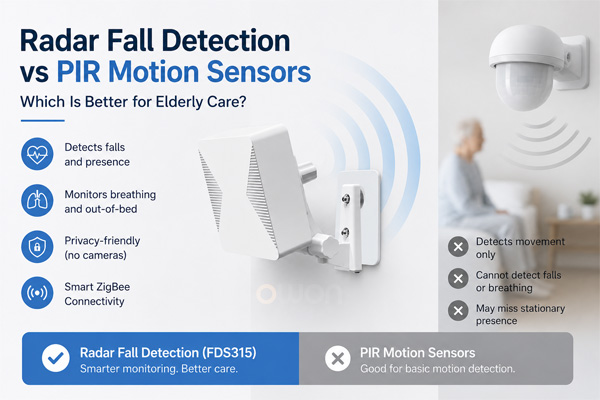
What Is a Radar Fall Detection Sensor?
Radar-based sensors use millimeter-wave technology to continuously monitor human presence, movement, posture changes, and activity patterns.
Unlike PIR sensors, radar sensors do not rely solely on motion.
They can detect:
- Presence while sitting still
- Presence during sleep
- Breathing activity
- Out-of-bed events
- Fall incidents
This capability makes radar sensing particularly suitable for elderly monitoring applications where residents may remain motionless for extended periods.
Radar vs PIR: Key Differences
| Feature | PIR Motion Sensor | Radar Fall Detection Sensor |
|---|---|---|
| Detects Movement | Yes | Yes |
| Detects Stationary Presence | No | Yes |
| Fall Detection | No | Yes |
| Breathing Monitoring | No | Yes |
| Out-of-Bed Detection | No | Yes |
| Works in Darkness | Yes | Yes |
| Privacy Friendly | Yes | Yes |
| Suitable for Elderly Monitoring | Limited | Excellent |
For elderly care environments, the ability to detect presence even when a person remains still is often critical.
A resident sleeping, resting in a chair, or lying on the floor after a fall may not generate enough movement for a PIR sensor to recognize occupancy.
Radar sensors overcome this limitation by detecting micro-movements and posture changes.
Why PIR Sensors Are Not Enough for Elderly Care
PIR sensors perform well in basic automation scenarios.
For example:
- Turning lights on when someone enters a room
- Triggering security alerts
- Detecting movement in corridors
However, elderly care requires more than movement detection.
Consider the following scenario:
An elderly resident falls beside the bed and becomes unconscious.
A PIR sensor may stop reporting activity because the individual is no longer moving.
As a result, caregivers may not receive timely notifications.
In contrast, a radar-based fall detection sensor can identify the fall event and continue monitoring occupancy status, helping caregivers respond more quickly.
Why Radar Technology Is Becoming the Preferred Choice
Modern elderly care systems increasingly rely on radar sensing because it provides more comprehensive monitoring.
Key advantages include:
Continuous Presence Detection
Radar sensors can identify a person even when they remain stationary.
Privacy Protection
Unlike cameras, radar sensors do not capture images or videos, making them suitable for bedrooms and private care environments.
Fall Detection Capability
Advanced radar algorithms can distinguish fall events from normal daily activities.
Health Monitoring Functions
Some radar-based solutions can detect breathing patterns and out-of-bed events, providing additional safety information for caregivers.
Typical Applications in Elderly Care Facilities
Radar fall detection technology is increasingly deployed in:
- Nursing homes
- Assisted living facilities
- Senior apartments
- Rehabilitation centers
- Home healthcare environments
As part of a comprehensive elderly care solution, radar sensors can communicate with gateways and monitoring platforms to provide real-time alerts, centralized management, and improved resident safety across healthcare environments.
For example, Owon’s FDS315 ZigBee Fall Detection Sensor combines 60GHz radar technology with ZigBee 3.0 connectivity, enabling fall detection, presence monitoring, breathing detection, and out-of-bed monitoring in a privacy-friendly solution. The device is designed for nursing homes, assisted living facilities, and smart healthcare projects.
Choosing the Right Technology for Your Project
The best sensing technology depends on the application.
If the goal is simple occupancy detection or lighting control, a PIR sensor may be sufficient.
However, for elderly care projects where safety, health monitoring, and rapid response are critical, radar-based sensing offers significant advantages.
As smart healthcare and assisted living systems continue to evolve, radar fall detection technology is expected to play an increasingly important role in protecting vulnerable residents while supporting caregivers with more reliable information.
Conclusion
Both PIR motion sensors and radar sensors have their place in modern smart buildings. However, when it comes to elderly care, radar technology provides capabilities that traditional PIR sensors cannot offer.
The ability to detect stationary presence, monitor breathing, identify out-of-bed events, and recognize falls makes radar-based solutions a stronger choice for nursing homes, assisted living facilities, and elderly monitoring projects.
Organizations planning future elderly care deployments should carefully evaluate monitoring requirements and consider whether advanced radar sensing can provide a safer and more effective solution.
Related reading:
[Battery-Powered Zigbee PIR Sensors: Why They Matter in Smart Buildings]
Post time: Jun-05-2026