Introduction
As smart homes, apartment projects, and commercial buildings continue adopting connected devices, smart plugs have evolved from simple remote-control accessories into valuable energy management tools.
Today, many users are no longer satisfied with simply turning appliances on and off from a mobile app. They want to understand how much electricity devices consume, identify unnecessary energy waste, and build smarter automation based on actual usage patterns.
This is where energy-monitoring smart plugs come into play.
However, choosing the right solution is not always straightforward. One of the most common questions asked by homeowners, installers, and system integrators is:
Should I choose a Zigbee smart plug or a WiFi smart plug for energy monitoring?
While both technologies offer remote control and power monitoring capabilities, they behave very differently when deployments begin to scale.
What Makes a Smart Plug Useful for Energy Monitoring?
A smart plug with energy monitoring provides more than simple remote switching.
In addition to controlling connected appliances, it can track:
- Real-time power consumption
- Voltage and current
- Accumulated energy usage (kWh)
- Historical consumption patterns
- Appliance runtime
This information helps users identify inefficient devices, reduce standby power waste, and make more informed decisions about energy usage.
For example:
- Property managers can monitor electricity consumption in rental units.
- Hospitality operators can reduce energy waste in guest rooms.
- Homeowners can identify appliances that consume excessive standby power.
- Integrators can build automated energy-saving strategies based on actual consumption data.
The value comes not from the plug itself, but from the visibility it provides.
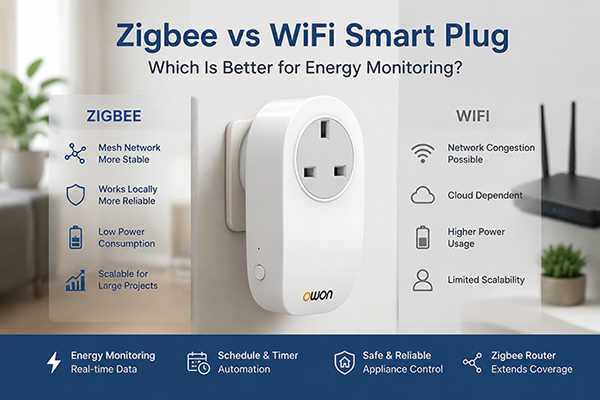
Zigbee vs WiFi Smart Plug: The Key Differences
Although Zigbee and WiFi smart plugs may appear similar from the user’s perspective, their underlying network architectures are very different.
| Feature | WiFi Smart Plug | Zigbee Smart Plug |
|---|---|---|
| Network Type | Router-based | Mesh Network |
| Internet Dependency | Typically cloud-dependent | Supports local control |
| Scalability | Limited as device count grows | Excellent for large deployments |
| Response Time | Depends on cloud and router | Typically faster local response |
| Network Congestion | Can increase WiFi traffic | Uses dedicated Zigbee network |
| Reliability | Router dependent | Self-healing mesh network |
| Best For | Small residential setups | Smart homes, hotels, apartments, IoT projects |
For a home with only a few connected devices, WiFi may work perfectly well.
However, when dozens of sensors, thermostats, plugs, and controllers are deployed together, many installers begin to encounter WiFi limitations.
This is where Zigbee often becomes the preferred option.
Why Many Integrators Choose Zigbee
The biggest advantage of Zigbee is not power monitoring.
It is scalability.
Unlike WiFi devices that all compete for bandwidth through a single router, Zigbee devices communicate through a mesh network. As more powered Zigbee devices are added, the network can actually become stronger and more reliable.
This characteristic makes Zigbee particularly attractive for:
- Multi-family housing
- Hotels
- Student accommodation
- Senior living facilities
- Smart building projects
- Home Energy Management Systems (HEMS)
For these environments, reliability is often more important than app features.
A network outage affecting dozens of rooms or apartments can quickly become an operational problem.
Why a Zigbee Plug Can Also Work as a Network Repeater
One often-overlooked advantage of Zigbee smart plugs is that they can strengthen the Zigbee network itself.
Unlike battery-powered sensors, mains-powered Zigbee devices typically function as routing devices.
This means a Zigbee plug can help forward messages between devices and extend communication coverage throughout a property.
Many users searching for a zigbee plug repeater are actually looking for this functionality.
In larger homes or commercial buildings, strategically placing Zigbee plugs can improve network stability and reduce communication dead zones without installing additional infrastructure.
This makes Zigbee smart plugs useful not only for energy monitoring, but also for improving overall network performance.
Home Assistant and Local Energy Monitoring
Another growing trend is the move toward local automation platforms such as Home Assistant.
Many advanced users prefer local control because it reduces cloud dependency and provides greater flexibility when integrating devices from different manufacturers.
A zigbee smart plug home assistant setup can be used alongside:
- Smart thermostats
- Occupancy sensors
- Smart lighting
- HVAC systems
- Solar monitoring systems
- Energy meters
By combining appliance-level monitoring with broader automation logic, users can create energy-saving routines that respond to real-world conditions.
For example:
- Turn off a heater when a room becomes unoccupied.
- Disable standby devices overnight.
- Activate appliances when solar production is highest.
- Monitor HVAC runtime and energy consumption.
This level of automation is difficult to achieve with standalone smart plugs alone.
OWON WSP403: A Practical Zigbee Plug for Energy Monitoring
For projects that require both energy monitoring and reliable Zigbee connectivity, the OWON WSP403 Zigbee smart plug provides a practical solution.
The WSP403 combines:
- Remote appliance control
- Real-time energy monitoring
- Scheduling functions
- Zigbee mesh routing capability
- Support for multiple international socket standards
Because it functions as a Zigbee routing device, the WSP403 not only monitors energy usage but also helps strengthen overall Zigbee network communication.
This makes it suitable for:
- Smart homes
- Apartments
- Hotels
- Property management projects
- OEM energy monitoring systems
For installers deploying multiple Zigbee devices, the networking benefits can be just as valuable as the energy data itself.
When Should You Choose Zigbee Instead of WiFi?
A Zigbee solution is often the better choice when:
- More than a few smart devices will be deployed
- Long-term reliability is important
- Local automation is preferred
- Home Assistant integration is planned
- Energy monitoring is part of a larger IoT system
- The project may expand in the future
WiFi smart plugs remain a good option for simple consumer applications.
However, for scalable energy monitoring projects, many professionals find Zigbee provides a stronger foundation.
FAQ
Is Zigbee better than WiFi for smart plugs?
For larger smart home and building deployments, Zigbee is often preferred because mesh networking improves reliability and reduces WiFi congestion.
Can a Zigbee smart plug measure energy consumption?
Yes. Many Zigbee smart plugs include power monitoring features that measure real-time power usage and accumulated energy consumption.
Does a Zigbee plug work as a repeater?
Most mains-powered Zigbee plugs act as routing devices, helping extend and strengthen the Zigbee network.
Can Zigbee smart plugs work with Home Assistant?
Yes. Many Zigbee smart plugs can be integrated with Home Assistant through compatible Zigbee gateways or Zigbee2MQTT environments.
Is Zigbee suitable for hotels and apartment projects?
Yes. Zigbee is widely used in multi-room deployments because it provides better scalability and network reliability than large WiFi-based installations.
Conclusion
When comparing Zigbee vs WiFi smart plugs, the decision goes beyond simple remote control.
For small deployments, WiFi may be sufficient. But for users who value scalability, local automation, network stability, and long-term energy monitoring, Zigbee often delivers significant advantages.
As energy visibility becomes increasingly important in homes, apartments, hospitality projects, and IoT systems, Zigbee-based smart plugs are evolving from simple accessories into critical components of modern energy management infrastructure.
Related reading:
[Zigbee Wall Socket with Power Metering: A Practical Guide to Smart Energy Monitoring]
Post time: Nov-11-2025