Ah, hotels. You check in, toss your luggage on the bed, and the air conditioning greets you like an overenthusiastic uncle. Meanwhile, the hotel manager is silently weeping over skyrocketing energy bills. Enter you, the clever system integrator, armed with Zigbee devices and a penchant for efficiency.
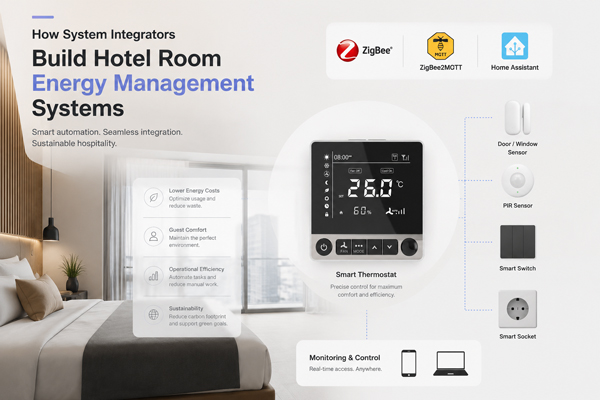
Let’s talk about how you can save energy in hotel rooms while keeping guests blissfully unaware. And yes, I promise this isn’t a snooze-fest—it’s more like chatting over a pint in Copenhagen while solving energy problems.
What Exactly Is a Hotel Room Energy Management System?
Think of it as an invisible butler for energy. When a room is empty, the system nudges the HVAC into energy-saving mode, quietly powers down non-essential devices, and waits patiently for the guest’s return. When someone walks in, comfort settings return instantly. It’s polite, silent, and doesn’t judge.
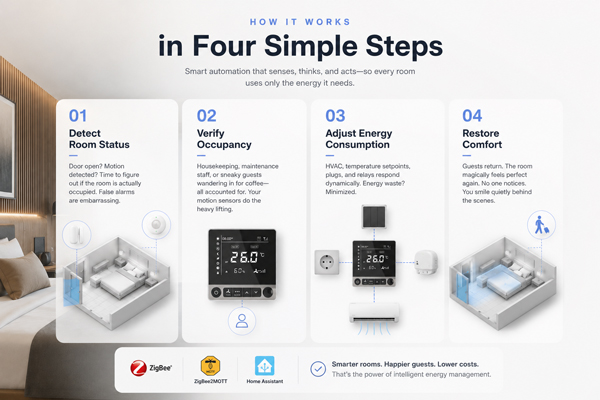
How It Works in Four Simple Steps
-
Detect Room Status
Door open? Motion detected? Time to figure out if the room is actually occupied. False alarms are embarrassing.
-
Verify Occupancy
Housekeeping, maintenance staff, or sneaky guests wandering in for coffee—all accounted for. Your motion sensors do the heavy lifting.
-
Adjust Energy Consumption
HVAC, temperature setpoints, plugs, and relays respond dynamically. Energy waste? Minimized.
-
Restore Comfort
Guests return. The room magically feels perfect again. No one notices. You smile quietly behind the scenes.
Key Zigbee Devices in Hotel Rooms
Here’s your toolbox, minus the hammer:
-
Door and Window Sensors
– Know if the room is entered or if someone’s fiddling with the windows.
-
PIR Motion Sensors
– Confirm actual presence. Guests like privacy; systems like certainty.
-
Zigbee Thermostats
– Switch between comfort and economy modes like a pro.
-
Smart Plugs and Relays
– Control the little things that eat energy silently.
-
Gateway
– The conductor of this orchestra, making sure every device plays in harmony.
Why Zigbee Wins in Hotels
Hotels love Zigbee for several reasons: it installs easily in existing rooms, scales up to hundreds of rooms, sips battery gently, and plays nicely with MQTT, Local APIs, Zigbee2MQTT, and Home Assistant.
Zigbee vs WiFi: The Straight Talk
| Feature | Zigbee | WiFi | Notes |
|---|---|---|---|
| Retrofit Installation | Easy | Often requires rewiring | Hotels prefer minimal disturbance |
| Power Consumption | Low | High | Sensors like long battery life |
| Network Scalability | Hundreds of rooms | Limited by AP count | Big hotels need lots of devices |
| Integration Flexibility | MQTT, Local API, Z2M, HA | Often platform-locked | Must work with existing systems |
| Reliability | Stable mesh | Prone to interference | Guests don’t like surprise AC shutdowns |
“For large-scale hotel automation projects, Zigbee’s mesh architecture and low power consumption make it far superior to WiFi, especially when retrofitting old buildings,” – Dr. Lars Møller, European Energy Systems Consultant, 2023
What to Look for When Choosing Devices
-
Integration Flexibility
– Will it talk nicely to your existing platform?
-
Gateway Reliability
– Crashes are not funny.
-
Open APIs
– MQTT, Local APIs, and other magic spells for integration.
-
Device Ecosystem
– All the sensors and controls you need.
-
Long-Term Availability
– Devices shouldn’t disappear mid-project.
Conclusion
Hotel room energy management isn’t about single devices—it’s about coordination, intelligence, and a touch of magic. Zigbee devices quietly do the heavy lifting behind the scenes. If you deploy them wisely, guests stay comfortable, hotels save money, and you get to sip your coffee knowing the system works perfectly.
Related reading:
[Zigbee vs WiFi Fan Coil Thermostats: Which Is Better for HVAC and Building Automation Projects?]
Post time: Jun-10-2026