Introduction
Hybrid inverter systems have become a critical component of modern solar and battery storage projects. As residential and commercial energy storage adoption continues to grow, inverter manufacturers are expected to deliver increasingly sophisticated energy management capabilities, including self-consumption optimization, export limitation, battery dispatch, and intelligent energy flow control.
To perform these functions effectively, hybrid inverters rely on accurate real-time energy measurements. This is why energy meter integration has become a key part of inverter system architecture.
For manufacturers, selecting an energy meter is no longer simply about measuring electricity consumption. The meter must provide reliable communication, accurate bidirectional measurements, and seamless integration with inverter control platforms.
This article explores the key considerations when selecting and integrating a Modbus energy meter for hybrid inverter applications.
Why Hybrid Inverters Need External Energy Meters
A hybrid inverter manages multiple energy sources simultaneously:
- Solar generation
- Utility grid
- Battery storage
- Building loads
To optimize energy flow between these sources, the inverter requires accurate and continuous measurements.
An external energy meter enables the inverter to:
- Monitor grid import
- Monitor grid export
- Track household consumption
- Detect surplus solar generation
- Control battery charging and discharging
- Support export limitation strategies
- Improve self-consumption performance
Without reliable metering data, many advanced inverter functions cannot operate as intended.
Key Requirements for Hybrid Inverter Energy Meter Integration
Bidirectional Energy Measurement
Bidirectional monitoring is essential for hybrid inverter applications.
The energy meter must accurately distinguish between:
- Imported energy
- Exported energy
- Solar production
- Load consumption
This information allows the inverter to make intelligent decisions regarding battery charging, energy storage optimization, and export control.
In modern PV and battery storage projects, a bidirectional energy meter provides the real-time energy flow data needed to improve system efficiency and maximize solar self-consumption.
Modbus Communication Support
Modbus remains one of the most widely adopted communication protocols in the inverter industry.
Most hybrid inverter manufacturers require support for:
- Modbus RTU
- Modbus TCP
to exchange real-time operating data between the inverter and energy meter.
When evaluating a Modbus energy meter, manufacturers should consider:
- Register mapping flexibility
- Communication stability
- Polling speed
- Integration complexity
RS485 Communication Reliability
RS485 continues to be a preferred communication interface for inverter applications due to its stability and long-distance communication capability.
Benefits include:
- Reliable communication performance
- Strong noise immunity
- Low deployment cost
- Industry-wide compatibility
As a result, RS485 energy meters remain widely adopted across solar and battery storage projects.
Flexible CT Clamp Configuration
Hybrid inverter projects range from small residential installations to large commercial energy storage systems.
Manufacturers often prefer a metering platform that supports a wide range of CT options. Flexible CT support enables one meter platform to be deployed across multiple project types while reducing product complexity and inventory requirements.
Multi-System Compatibility
Many inverter manufacturers serve multiple global markets.
An ideal energy meter should support:
- Single-phase systems
- Split-phase systems
- Three-phase systems
This flexibility simplifies product standardization and reduces engineering effort when expanding into new regions.
Common Challenges in Meter Integration Projects
Communication Compatibility
One of the most common integration challenges is ensuring compatibility between inverter firmware and energy meter communication protocols.
Manufacturers should verify:
- Modbus register mapping
- Address configuration
- Data refresh intervals
- Error handling mechanisms
before large-scale deployment.
Export Limitation Requirements
Many countries now require export limitation or zero-export functionality.
To support these requirements, the inverter must continuously monitor power flow at the grid connection point and respond rapidly when export thresholds are reached.
Accurate bidirectional metering is therefore essential.
For projects requiring zero-export or anti-backflow operation, an anti export energy meter provides the real-time power flow data needed for inverter control and grid compliance.
Future Energy Management Expansion
Many inverter platforms are evolving beyond traditional solar applications.
Future integration requirements may include:
- Home Energy Management Systems (HEMS)
- Battery Energy Storage Systems (BESS)
- EV Chargers
- Virtual Power Plants (VPP)
- Smart Building Platforms
Selecting a scalable meter platform today can significantly reduce future development costs.
Example Energy Meter for Hybrid Inverter Integration
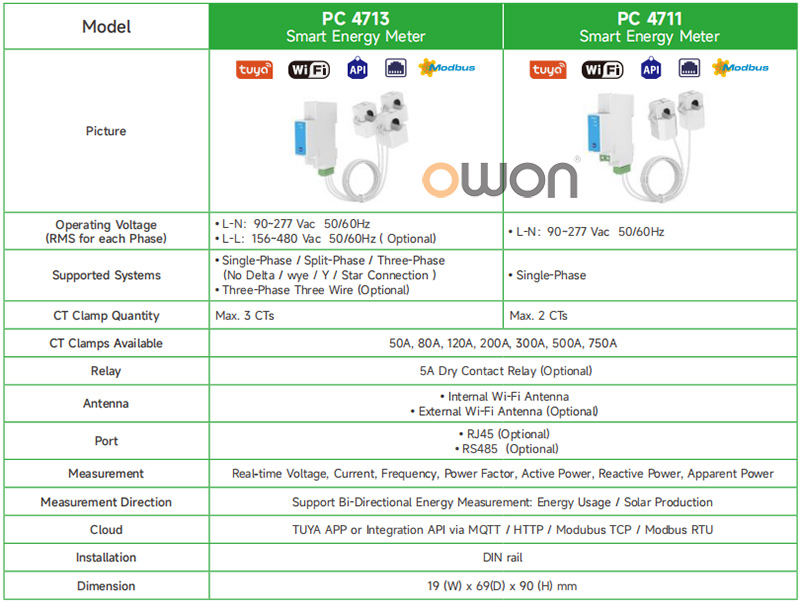
One example is the OWON PC4713 Energy Meter, developed for solar energy storage, energy management, and hybrid inverter integration applications.
Unlike traditional utility billing meters, the PC4713 is designed to provide real-time energy monitoring data that supports system control and optimization.
Key capabilities include:
- Single-phase, split-phase, and three-phase support
- Bidirectional energy measurement
- Modbus RTU communication
- Modbus TCP communication
- RS485 interface
- RJ45 Ethernet connectivity
- MQTT support
- HTTP API support
- CT options from 50A to 750A
- Optional dry-contact relay output
These capabilities allow inverter manufacturers to deploy a common metering platform across residential, commercial, and battery storage projects while maintaining communication flexibility and future scalability.
Feature Comparison Table
| Feature | Why It Matters |
|---|---|
| Bidirectional Measurement | Supports battery charging, discharging, and export control |
| Modbus RTU | Industry-standard inverter communication |
| Modbus TCP | Ethernet-based integration |
| RS485 Interface | Reliable long-distance communication |
| Flexible CT Options | Supports multiple project sizes |
| Single / Three-Phase Support | Global deployment flexibility |
| MQTT Support | EMS and cloud integration |
| API Support | Third-party platform connectivity |
| Relay Output | Export limitation applications |
Market Trends Driving Demand for Advanced Energy Meters
Several industry developments are accelerating demand for advanced inverter energy meters.
The rapid growth of residential battery storage is increasing the need for accurate bidirectional monitoring. At the same time, export limitation regulations in many countries require inverters to monitor grid interaction more precisely. The emergence of virtual power plants, smart energy management platforms, and intelligent load control systems is also creating demand for energy meters with richer communication capabilities and real-time data access.
As hybrid inverter systems become more sophisticated, energy meters are evolving from optional accessories into essential components of modern energy ecosystems.
FAQ
What is an energy meter for a hybrid inverter?
An energy meter provides real-time information about grid import, export, and energy consumption, allowing the inverter to optimize energy flows and battery operation.
Why do hybrid inverters require bidirectional energy meters?
Bidirectional measurement allows the inverter to track imported and exported electricity, which is critical for battery optimization and export limitation.
What communication protocols should a hybrid inverter energy meter support?
Most manufacturers require Modbus RTU and Modbus TCP. Additional support for RS485, MQTT, and APIs can improve flexibility and future integration capabilities.
Is RS485 still important for inverter integration?
Yes. RS485 remains one of the most widely adopted communication interfaces in solar and battery storage systems due to its reliability and long-distance communication capability.
How does an energy meter support export limitation?
The meter continuously measures power flow at the grid connection point and provides data to the inverter, allowing it to reduce output when export thresholds are reached.
Conclusion
As hybrid inverter systems become increasingly sophisticated, energy meters play a critical role in system intelligence, battery optimization, and grid interaction management.
For inverter manufacturers, selecting the right metering platform requires more than simply measuring power. Bidirectional measurement, Modbus compatibility, RS485 communication, CT flexibility, and future integration capabilities are all essential considerations.
By choosing a scalable and communication-ready energy meter platform, manufacturers can simplify inverter integration, improve system performance, and prepare for future energy management requirements.
Post time: Jun-11-2026