What Is Occupancy-Based Energy Management in Smart Hotels?
Energy bills creeping up again? Older hotels that haven’t seen a renovation since the ’90s?
If you’re a system integrator or hotel operator, you know that reducing energy costs without sacrificing guest comfort is one of the biggest challenges in hospitality.
This is where Occupancy-Based Energy Management (OBEM) is making a difference.
Instead of replacing existing HVAC systems or rewiring entire properties, OBEM allows hotels to automatically adjust room energy consumption based on actual occupancy status. The result is lower operating costs, improved sustainability, and a better guest experience.
As smart hotel automation continues to evolve, occupancy-based control is becoming a core component of modern hotel energy management strategies across Europe and other regions.
How Occupancy-Based Energy Management Works
At its core, Occupancy-Based Energy Management means that hotel rooms only consume energy when necessary.
Occupied Room
- HVAC operates in comfort mode
- Lighting functions normally
- Guest amenities remain active
Vacant Room
- HVAC switches to energy-saving mode
- Non-essential loads are reduced
- Lighting and standby devices can be automatically controlled
The concept is simple:
Use occupancy status to determine how energy should be consumed.
For hotels, this translates into lower operating costs without compromising guest comfort.
For system integrators, it creates a practical path to implement hotel energy optimization without replacing existing infrastructure.
Why Occupancy-Based Energy Management Is Growing in Smart Hotels
Hotel operators today face two major pressures:
- Rising energy costs
- Increasing sustainability requirements
At the same time, guest expectations for comfort continue to rise.
Occupancy-Based Energy Management helps balance these competing priorities by ensuring that hotel rooms operate efficiently when unoccupied while remaining comfortable when guests return.
This is one reason why occupancy-based automation has become an important part of modern smart hotel automation and hotel energy management systems.
How It Works in Practice
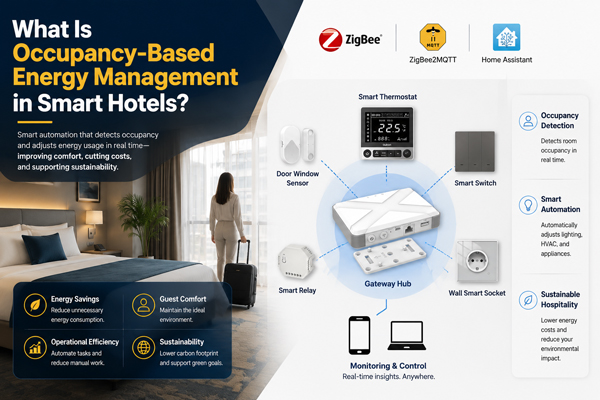
Occupancy-based control relies on a combination of smart devices that communicate seamlessly through a Zigbee-based automation architecture.
| Device Type | Role in OBEM |
|---|---|
| Door & Window Sensors | Detect room entry/exit and window status |
| PIR Motion Sensors | Confirm ongoing occupancy to avoid false triggers |
| Zigbee Thermostats | Switch between comfort and energy-saving HVAC modes |
| Smart Plugs & Relays | Control non-essential loads and reduce standby energy |
Together, these devices form a lightweight automation framework without requiring replacement of the hotel’s existing management systems.
Many modern hotel automation projects rely on Zigbee-based ecosystems that combine thermostats, occupancy sensors, door sensors, smart plugs, relays, and gateways into one coordinated platform.
As a Zigbee device manufacturer and IoT solution provider, OWON supports this architecture with a complete portfolio of hotel automation devices that can be integrated through MQTT, local APIs, and third-party management platforms.
Why Zigbee Works Well for Occupancy-Based Energy Management
Not all wireless technologies are equally suitable for hotel automation.
Occupancy-Based Energy Management often involves hundreds or even thousands of devices distributed across multiple rooms and floors.
This is where Zigbee offers significant advantages.
Zigbee Benefits for Hotel Automation
- Low power consumption
- Reliable mesh networking
- Stable communication across multiple floors
- Local automation capability
- Scalability for large deployments
- Reduced installation complexity
Unlike standalone smart home devices, Zigbee systems can support large-scale hotel automation projects while maintaining reliable communication between sensors, thermostats, gateways, and management platforms.
This makes Zigbee especially attractive for hotel retrofit projects where flexibility and scalability are critical.
Benefits for Hotels and System Integrators
Significant Energy Savings
Reduce HVAC and standby energy consumption without impacting guest comfort.
Retrofit-Friendly Deployment
Wireless Zigbee devices minimize installation effort and reduce disruption to hotel operations.
Scalability
Suitable for single hotels, hotel chains, serviced apartments, and multi-building hospitality projects.
Open Integration
Support for MQTT APIs, local automation logic, third-party platforms, and hotel management systems.
Better Guest Experience
Guests enjoy comfortable room conditions while hotels benefit from improved operational efficiency.
What System Integrators Should Consider
When evaluating Occupancy-Based Energy Management solutions, system integrators should focus on five key areas:
Integration Flexibility
Can the devices integrate with PMS, EMS, BMS, or custom software platforms?
Reliable Devices and Gateways
Sensors and gateways must operate consistently across large deployments.
Scalability
Can the architecture support hundreds or thousands of rooms?
Complete Device Ecosystem
Can a single supplier provide:
- Zigbee thermostats
- Door and window sensors
- Motion sensors
- Smart plugs
- Relays
- Gateways
Ease of Deployment
Retrofit-friendly installation reduces project complexity and deployment time.
How OWON Supports Occupancy-Based Hotel Automation
OWON provides a complete Zigbee device ecosystem for Occupancy-Based Energy Management projects, including:
- Zigbee thermostats
- Door & window sensors
- PIR occupancy sensors
- Smart plugs and relays
- Zigbee gateways
- MQTT/API integration support
This enables system integrators to source compatible devices from a single supplier while maintaining flexibility to integrate with existing hotel management platforms.
Rather than replacing existing hotel systems, OWON devices can be deployed as an enhancement layer that adds occupancy intelligence and energy optimization capabilities.
Real-Life Example: European Hotel Retrofit Project
A hotel renovation project in Europe required energy-saving upgrades without replacing the existing HVAC infrastructure.
The system integrator selected Zigbee thermostats, door/window sensors, PIR sensors, smart plugs, and a Zigbee gateway from OWON.
By connecting the devices to the existing management platform through MQTT APIs, occupancy-based control was implemented across guest rooms.
When guests left a room, HVAC automatically switched to setback mode and non-essential loads were disconnected.
When occupancy was detected again, room comfort settings were restored automatically.
This approach reduced installation complexity while enabling scalable deployment across multiple hotel floors.
The project demonstrated how integration-ready Zigbee devices can help hotels reduce energy costs without requiring a complete technology overhaul.
Conclusion
Occupancy-Based Energy Management is not about a single device.
It is about how sensors, thermostats, smart plugs, relays, and gateways work together to create a smarter and more energy-efficient hotel environment.
For system integrators, the key is choosing a device ecosystem that is reliable, scalable, and integration-ready.
With Zigbee-based automation and occupancy intelligence, hotels can reduce operating costs, improve sustainability, and enhance guest comfort while keeping retrofit projects simple and cost-effective.
Related reading:
[How System Integrators Use Zigbee Devices in Hotel Energy Management]
Post time: Jun-08-2026