Introduction
As security requirements continue to evolve, standalone alarms and isolated sensors are no longer sufficient for modern residential and commercial buildings. Property owners and system integrators are increasingly looking for connected security solutions that provide centralized monitoring, automated responses, and reliable wireless communication across multiple devices.
A Zigbee home security system addresses these needs by connecting sensors, gateways, alarm devices, and management platforms into a unified network. Compared with traditional wired systems, Zigbee offers greater installation flexibility while maintaining stable communication through its self-healing mesh architecture. It also allows different security devices to work together, creating automated responses that improve both safety and operational efficiency.
For commercial projects such as apartment complexes, hotels, office buildings, retail stores, and healthcare facilities, system design is just as important as the devices themselves. A well-planned Zigbee network improves coverage, simplifies maintenance, and supports future expansion without major infrastructure changes.
This guide explains the key elements of designing a reliable Zigbee-based home security system, from selecting the right network architecture to planning deployment strategies for residential and commercial applications.
Why Zigbee Is the Preferred Choice for Security Systems
Wireless technologies have transformed modern security systems, but not every wireless protocol is equally suitable for large-scale deployments. While Wi-Fi provides high bandwidth for cameras and internet-connected devices, Zigbee was specifically designed for low-power, highly reliable communication between sensors and control devices.
For security applications, reliability is often more important than bandwidth. Devices such as Zigbee door sensors, motion sensors, smoke detectors, and alarm sirens transmit only small amounts of data, but those messages must be delivered quickly and consistently to ensure timely event detection and response. Zigbee’s mesh networking allows powered devices to relay signals for one another, extending coverage while reducing the risk of communication failure.
Zigbee vs. Wi-Fi for Security Projects
| Feature | Zigbee | Wi-Fi |
| Network topology | Self-healing mesh | Star network |
| Power consumption | Very low | Higher |
| Coverage | Expands through mesh routing | Limited by router coverage |
| Device capacity | Suitable for large sensor networks | Performance depends on router capability |
| Typical applications | Security, building automation, energy management | Cameras, multimedia, internet access |
Another advantage is scalability. A commercial security project may include dozens or even hundreds of connected devices distributed throughout multiple floors or buildings. Zigbee networks are designed to accommodate this type of deployment while maintaining stable communication between gateways, sensors, and alarm devices.
Although Wi-Fi remains an excellent choice for bandwidth-intensive applications, Zigbee is often preferred for professional security systems because it combines low power consumption, reliable communication, and flexible network expansion.
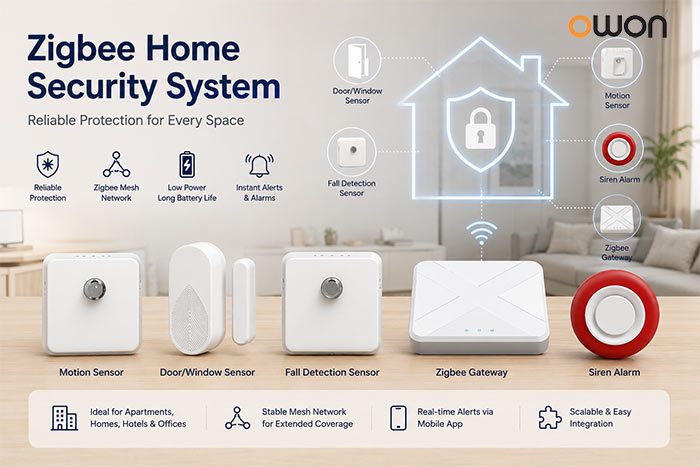
Essential Components of a Zigbee Home Security System
A reliable security solution is built on multiple devices working together rather than relying on a single sensor or alarm. Each component has a specific role within the overall system architecture.
Zigbee Gateway
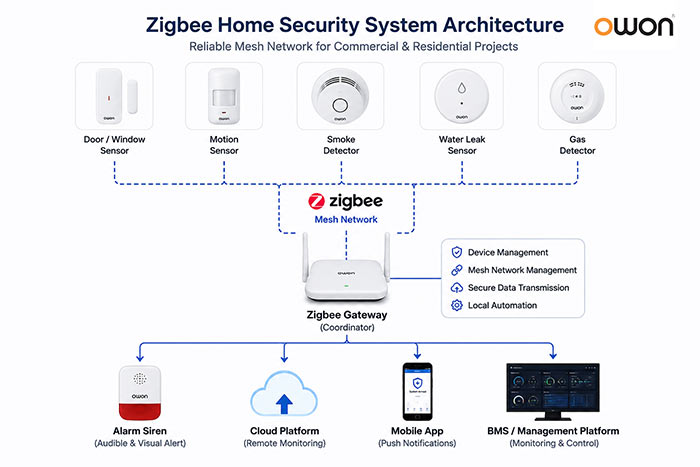
The gateway acts as the central coordinator of the Zigbee network. It manages communication between connected devices and can forward data to cloud platforms, mobile applications, or building management systems (BMS). Selecting the appropriate gateway and installing it in a suitable location are critical steps in ensuring stable network performance.
Door & Window Sensors
Door and window sensors provide perimeter protection by detecting unauthorized entry. They are typically installed at entrances, emergency exits, and other access points to trigger immediate alerts when unexpected openings occur.
Motion Sensors
Motion sensors monitor interior spaces after perimeter security has been bypassed. They are commonly used in offices, hotel corridors, warehouses, and residential areas to detect unauthorized movement and activate predefined automation rules.
Safety Sensors
A comprehensive Zigbee security system often extends beyond intrusion detection. Smoke detectors, gas detectors, and water leak sensors help protect occupants and property from environmental hazards, enabling early warning and faster emergency response.
Alarm Sirens
When a security event is confirmed, an Zigbee alarm siren serves as the system’s primary notification device by generating audible and visual alerts. Besides warning occupants, alarm sirens can help deter intruders and draw immediate attention to abnormal events. In integrated security systems, sirens are typically triggered automatically based on predefined rules involving multiple sensors rather than a single device.
Five Design Principles for Reliable Zigbee Security Systems
A successful Zigbee home security system is not determined by the number of devices installed, but by how well those devices work together. Whether the project involves a residential community, hotel, office building, or retail chain, careful planning during the design stage can significantly improve reliability, simplify maintenance, and reduce long-term operating costs.
The following principles are commonly considered when designing professional Zigbee security deployments.
1. Start with Proper Gateway Placement
Every Zigbee network begins with a gateway. Its location directly affects communication quality across the entire system.
Ideally, the gateway should be installed near the center of the protected area rather than at one end of a building. This helps shorten communication paths and reduces the number of hops required for messages to travel between devices.
For larger projects, multiple gateways may be used to divide the building into manageable network zones. This approach improves scalability while preventing excessive device density within a single network.
When planning gateway placement, system designers should also consider wall materials, elevator shafts, electrical rooms, and other potential sources of wireless interference.
2. Build a Stable Mesh Network
One of Zigbee’s greatest advantages is its self-healing mesh architecture.
Unlike point-to-point wireless systems, Zigbee allows powered devices to relay messages for neighboring devices. If one communication path becomes unavailable, data can automatically be rerouted through another available route, helping maintain reliable communication.
A stable mesh network should include enough powered routing devices throughout the building to eliminate communication blind spots.
For example, routers may include:
- Alarm sirens
- Smart plugs
- Smart switches
- Wall-powered controllers
- Dedicated Zigbee repeaters
Battery-powered sensors generally operate as end devices to maximize battery life, while powered devices strengthen the overall network.
When properly planned, the mesh network becomes more resilient as additional powered devices are added.
3. Divide the Building into Logical Security Zones
Professional security systems rarely treat an entire building as a single protection area.
Instead, they divide the property into logical security zones that can be monitored and managed independently.
Typical examples include:
- Main entrances
- Office areas
- Hotel guest rooms
- Warehouses
- Equipment rooms
- Emergency exits
- Public corridors
Each zone can have its own alarm rules, notification priorities, and operating schedules.
For example, a warehouse may remain armed overnight while office areas follow business hours. Hotel public areas may operate continuously, whereas guest rooms are managed individually according to occupancy.
This zoning strategy improves operational flexibility while reducing unnecessary alarms.
4. Define Intelligent Alarm Strategies
An effective security system should respond differently depending on the type of event being detected.
Rather than activating every device simultaneously, modern Zigbee systems allow multiple sensors to participate in intelligent automation.
Examples include:
| Event | Recommended Response |
|---|---|
| Door opens after business hours | Activate alarm siren and send mobile notification |
| Motion detected in restricted area | Trigger siren, notify security personnel, record event |
| Smoke detected | Activate siren immediately and notify emergency contacts |
| Water leak detected | Send maintenance alert and activate local warning |
| Gas leak detected | Trigger audible alarm and initiate emergency response procedure |
This event-based approach reduces false alarms while ensuring that critical incidents receive immediate attention.
For commercial deployments, different notification priorities can also be assigned according to operational requirements, improving both safety and response efficiency.
5. Plan for Long-Term Maintenance
Designing the system is only the beginning. Long-term reliability depends on ongoing maintenance and lifecycle management.
System integrators should establish maintenance procedures that include:
- Periodic battery replacement for wireless sensors
- Gateway firmware updates
- Device health monitoring
- Signal quality inspections
- Routine alarm testing
- Expansion planning for future devices
Regular maintenance helps identify communication issues before they affect system performance and ensures that every device continues operating as expected.
Projects designed with future expansion in mind are also easier to upgrade as security requirements evolve, avoiding costly network redesigns later.
Typical Deployment Scenarios
Although often referred to as a home security system, Zigbee security technology is widely deployed across both residential and commercial environments. Its wireless architecture makes it suitable for retrofit projects as well as new construction.
Apartment Buildings
Property managers can centrally monitor common areas while allowing each apartment to maintain its own independent security devices. Wireless installation minimizes disruption during renovation projects and simplifies future upgrades.
Hotels and Hospitality
Hotels can integrate door sensors, motion detectors, smoke alarms, and alarm sirens into guest rooms, corridors, and service areas. Automated notifications help maintenance and security teams respond more efficiently while improving guest safety.
Office Buildings
Corporate offices use Zigbee security systems to protect entrances, meeting rooms, server rooms, and restricted workspaces. Combined with access control and building automation systems, they provide a more comprehensive security solution.
Retail Stores
Retail environments benefit from after-hours intrusion monitoring, emergency alarm notifications, and protection for stockrooms and cash-handling areas without extensive wiring.
Warehouses and Industrial Facilities
Warehouses often require large-area wireless coverage where installing additional cables may be expensive or impractical. Zigbee mesh networking supports flexible deployment across storage areas while maintaining reliable communication.
Healthcare and Assisted Living
Healthcare facilities and assisted living communities use Zigbee security devices to improve resident safety, monitor restricted areas, and support emergency notification procedures without disrupting daily operations.
Future Trends in Zigbee Security Systems
Wireless security technology continues to evolve alongside advancements in IoT, cloud computing, and smart building management. While Zigbee remains one of the leading communication protocols for professional sensor networks, its role is also expanding through greater interoperability and intelligent automation.
One notable trend is the growing adoption of Matter. Although Matter primarily focuses on improving interoperability between smart home ecosystems, Zigbee devices can continue to play an important role through compatible gateways that bridge different communication protocols.
Another trend is the combination of edge computing and cloud management. Instead of relying entirely on cloud processing, more security systems now execute critical automation rules locally. This approach reduces response time and allows essential functions, such as intrusion alarms and emergency notifications, to continue operating even during temporary internet outages.
Artificial intelligence is also becoming increasingly valuable. By combining data from multiple sensors, AI-assisted platforms can better distinguish between routine activities and abnormal events, helping reduce false alarms while improving response accuracy.
For commercial buildings, future security systems are expected to integrate more closely with access control, HVAC, lighting, and energy management platforms. Rather than operating as isolated systems, security devices will become part of a unified smart building infrastructure.
Example of an Integrated Zigbee Security Solution
A well-designed Zigbee home security system combines multiple devices into a coordinated solution rather than relying on individual products.
A typical deployment may include:
- Zigbee Gateway
- Door & Window Sensors
- Motion Sensors
- Smoke Detectors
- Water Leak Sensors
- Zigbee Alarm Siren
- Mobile Application or Building Management Platform
When a Zigbee door sensor detects unauthorized access after business hours, the gateway immediately verifies the event and activates the alarm siren. At the same time, notifications can be delivered to property managers or security personnel through a cloud platform or local management system.
Similarly, smoke or gas detectors can trigger immediate audible alarms while simultaneously notifying facility managers, allowing faster emergency response.
For larger projects such as apartment complexes, hotels, office buildings, healthcare facilities, and commercial properties, this integrated architecture improves operational efficiency while simplifying system maintenance and future expansion.
OWON provides a comprehensive portfolio of Zigbee security devices—including gateways, sensors, alarm sirens, and environmental monitoring products—for OEM brands, system integrators, and smart building projects. With support for flexible deployment and third-party platform integration, these devices can be adapted to a wide range of residential and commercial security applications.
Conclusion
Designing a reliable Zigbee home security system involves much more than selecting individual devices. Network planning, gateway placement, mesh coverage, security zoning, and long-term maintenance all contribute to overall system performance.
For commercial and residential projects alike, a carefully designed Zigbee-based wireless security solution offers dependable communication, flexible deployment, and straightforward scalability. As smart buildings continue to evolve, Zigbee remains a practical and proven technology for connecting security devices into a unified, intelligent protection system.
Whether the project involves a single residential property or a multi-site commercial deployment, following sound design principles from the beginning can improve reliability, simplify management, and reduce operational costs throughout the system’s lifecycle.
Frequently Asked Questions
Q1. What devices are typically included in a Zigbee home security system?
A typical Zigbee home security system consists of a Zigbee gateway, door and window sensors, motion sensors, smoke detectors, gas detectors, water leak sensors, alarm sirens, and a management platform or mobile application. The exact device combination depends on the size and security requirements of the project.
Q2. Why is Zigbee widely used in commercial security projects?
Zigbee is designed for low-power, reliable wireless communication between large numbers of connected devices. Its self-healing mesh network improves coverage and stability, making it well suited for apartments, hotels, office buildings, healthcare facilities, and other commercial environments.
Q3. Can a Zigbee security system continue working without an internet connection?
Yes. Many Zigbee systems allow local communication between gateways and connected devices even if the internet connection is temporarily unavailable. Cloud services may be required for remote access or mobile notifications, but core local automation can often continue operating.
Q4. How many Zigbee devices can one gateway support?
The number depends on the gateway hardware and network design. Commercial gateways often support dozens or even hundreds of connected Zigbee devices. For larger buildings, multiple gateways are commonly deployed to improve performance and simplify network management.
Q5. What should system integrators consider before deploying a Zigbee security system?
Key considerations include gateway placement, mesh network coverage, powered routing devices, wireless interference, security zoning, firmware maintenance, and future scalability. Proper planning helps improve reliability while reducing maintenance costs over time.
Q6. Can Zigbee security devices integrate with building management systems?
Yes. Many professional Zigbee gateways support integration with cloud platforms, IoT platforms, or Building Management Systems (BMS) through APIs or standard communication protocols. The available integration options depend on the gateway and software platform being used.
Related reading:
[ Zigbee Siren Alarm for Smart Security Systems ]
Post time: Jul-23-2026