Introduction
Heating, ventilation, and air conditioning (HVAC) systems are becoming increasingly important in modern building management. As energy costs rise and buildings require more efficient operation, traditional standalone HVAC controls are gradually being replaced by connected and intelligent solutions.
A modern HVAC system is no longer only responsible for maintaining temperature. Building owners and system integrators now expect better energy visibility, flexible control, remote management, and integration with wider automation platforms.
This is where Zigbee HVAC solutions are gaining attention.
By connecting thermostats, controllers, sensors, and gateways through a reliable wireless network, Zigbee enables HVAC systems to become more flexible, scalable, and suitable for smart homes, apartments, hotels, offices, and commercial buildings.
What Is a Zigbee HVAC Solution?
A Zigbee HVAC solution is a wireless HVAC control system that uses Zigbee communication technology to connect different heating and cooling devices within a building.
Unlike traditional HVAC systems where each thermostat operates independently, Zigbee-based HVAC solutions allow multiple devices to communicate as part of a coordinated network.
A typical Zigbee HVAC system may include:
- Zigbee HVAC thermostats
- Temperature and humidity sensors
- Occupancy sensors
- HVAC controllers and relays
- Zigbee gateways
- Heating or cooling equipment
The general architecture is:
Zigbee Thermostat / Sensor → Zigbee Gateway → HVAC Equipment / Building Platform
This approach allows building operators to manage HVAC functions more efficiently while supporting future expansion.
Why Is Zigbee Used for HVAC Control?
Different wireless technologies can be used in building automation, but Zigbee has several characteristics that make it suitable for HVAC applications.
Reliable Wireless Communication
Zigbee uses mesh networking, allowing powered devices to communicate with each other and extend network coverage.
This is valuable in:
- hotels with many rooms;
- apartment buildings;
- offices with multiple zones;
- retrofit projects where new wiring is difficult.
Compared with point-to-point wireless solutions, Zigbee networks can provide more flexible deployment options.
Low-Power and Flexible Installation
Many HVAC projects require sensors and control devices to be installed in locations where wiring is inconvenient.
Zigbee supports low-power device designs, making it suitable for:
- room sensors;
- temperature sensors;
- humidity sensors;
- occupancy detection devices.
This flexibility helps reduce installation complexity in renovation and retrofit projects.
Scalable Smart Building Integration
Modern buildings rarely use HVAC equipment alone.
HVAC systems increasingly work together with:
- lighting automation;
- access control;
- energy monitoring;
- occupancy management;
- building management platforms.
Because Zigbee supports communication between multiple device types, it provides a practical foundation for connected building environments.
Key Components of a Zigbee HVAC System
A complete Zigbee HVAC solution is usually built from several connected components.
Zigbee HVAC Thermostats
The thermostat remains the primary interface between users and HVAC systems.
A Zigbee HVAC thermostat can provide:
- temperature control;
- heating and cooling mode selection;
- scheduling;
- remote management;
- integration with sensors and gateways.
Different applications require different thermostat designs.
For example:
- Fan coil thermostats are commonly used in hotels, apartments, and commercial buildings.
- Boiler thermostats are widely used in European residential heating systems.
- Radiator heating controls support room-level temperature management.
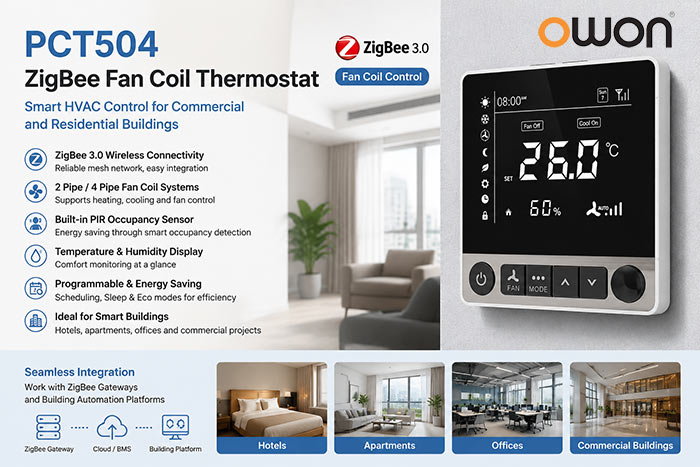
For commercial HVAC applications, solutions such as the OWON Zigbee Fan Coil Thermostat PCT504 are designed for fan coil systems in hotels, apartments, offices, and other smart building projects.
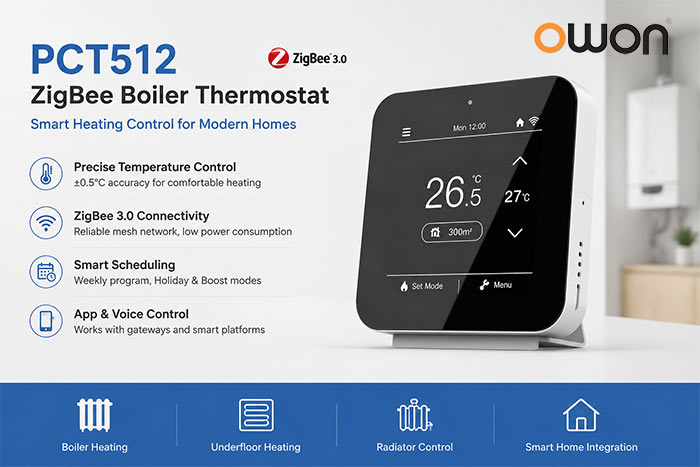
For European heating applications, the OWON Zigbee Boiler Thermostat PCT512 supports boiler-based heating control and integration with Zigbee heating ecosystems.
Zigbee Radiator Thermostats for Smart Heating Control
In European residential heating projects, Zigbee smart thermostatic radiator valves (TRVs) provide room-level temperature control by adjusting individual radiators based on user preferences and heating demand.
Compared with traditional radiator valves, Zigbee TRVs enable:
- individual room temperature management;
- heating schedules;
- integration with Zigbee gateways;
- coordinated control with boilers and room thermostats.
For example, OWON’s Zigbee Radiator Thermostat Solutions are designed for smart heating projects where homeowners, property managers, and system integrators require flexible room-by-room heating control.
Zigbee HVAC Controllers and Relays
Thermostats are not always the only control devices required in HVAC projects.
Controllers and relays can provide additional functions, including:
- switching heating equipment;
- controlling valves;
- managing external HVAC devices;
- integrating legacy equipment into smart systems.
These components are especially useful in retrofit projects where existing HVAC equipment needs to be upgraded without replacing the entire system.
A flexible controller architecture allows integrators to combine traditional HVAC equipment with modern wireless automation.
Zigbee Sensors for Smarter HVAC Management
Sensors play an important role in improving HVAC efficiency.
A thermostat only knows the temperature at its installation location. Additional sensors provide more information about actual room conditions.
Common Zigbee HVAC sensors include:
Temperature Sensors
Used for:
- room temperature monitoring;
- multi-zone heating control;
- improved comfort management.
Humidity Sensors
A Zigbee humidity sensor helps monitor indoor air conditions and supports better climate management.
Humidity data is useful in:
- offices;
- hotels;
- residential buildings;
- healthcare environments.
Occupancy Sensors
Occupancy detection allows HVAC systems to respond to actual usage conditions.
Examples:
- reducing HVAC operation in empty rooms;
- optimizing hotel room energy usage;
- improving office energy management.
Zigbee HVAC Applications
Hotels and Hospitality Buildings
Hotels require individual room comfort while controlling energy consumption.
Zigbee HVAC solutions can support:
- room-level temperature control;
- centralized management;
- occupancy-based strategies;
- easier maintenance.
Apartments and Multi-Family Buildings
Apartment projects often require scalable heating solutions.
Zigbee enables:
- independent room control;
- smart radiator integration;
- remote management;
- future system expansion.
Offices and Commercial Buildings
Commercial buildings benefit from intelligent HVAC management because occupancy patterns change throughout the day.
Connected HVAC systems can help:
- optimize operating schedules;
- reduce unnecessary heating and cooling;
- improve occupant comfort.
Zigbee HVAC vs Traditional HVAC Control
| Traditional HVAC Control | Zigbee HVAC Solution |
|---|---|
| Standalone devices | Connected device ecosystem |
| Manual adjustment | Automated scheduling and control |
| Limited system information | Sensor-based monitoring |
| Difficult expansion | Scalable wireless deployment |
| Separate control systems | Integrated smart building management |
Zigbee HVAC and Smart Building Integration
The future of HVAC is moving toward connected building ecosystems.
A Zigbee HVAC solution can become part of a larger automation system where:
- thermostats control temperature;
- sensors provide environmental data;
- gateways manage communication;
- building platforms coordinate multiple systems.
For system integrators, this approach provides greater flexibility compared with isolated HVAC controllers.
Instead of replacing existing systems completely, Zigbee enables gradual upgrades from traditional HVAC control toward smarter building management.
How to Choose a Zigbee HVAC Solution
Before selecting a Zigbee HVAC system, project teams should consider:
HVAC Compatibility
Ensure the thermostat or controller supports the heating or cooling equipment being used.
Communication Requirements
Confirm gateway compatibility and required integration methods.
Scalability
Consider whether the system may expand to additional rooms, sensors, or buildings.
Long-Term Support
For commercial projects, stable firmware, product availability, and technical support are important factors.
Conclusion
Zigbee HVAC solutions are becoming an important part of modern heating and cooling management. By connecting thermostats, controllers, sensors, and gateways, Zigbee enables more flexible, scalable, and intelligent HVAC control.
From residential heating systems to hotels, apartments, and commercial buildings, connected HVAC solutions help improve comfort while supporting energy-efficient operation.
As smart building requirements continue to grow, Zigbee provides a practical wireless foundation for the next generation of HVAC automation.
For companies looking for scalable Zigbee HVAC solutions, manufacturers with experience in thermostats, sensors, gateways, and OEM/ODM development can provide more complete support for different project requirements.
FAQ
What is Zigbee HVAC?
Zigbee HVAC refers to heating, ventilation, and air conditioning control systems that use Zigbee wireless communication to connect thermostats, sensors, controllers, and gateways for smarter building management.
Are Zigbee thermostats suitable for commercial buildings?
Yes. Zigbee thermostats are suitable for hotels, apartments, offices, and other commercial projects because they support scalable wireless networks and integration with multiple devices.
What is the difference between Zigbee HVAC and traditional HVAC control?
Traditional HVAC systems usually operate as independent devices, while Zigbee HVAC solutions allow thermostats, sensors, and controllers to communicate as part of a connected automation system.
Can Zigbee HVAC systems work with Home Assistant?
Yes. Many Zigbee HVAC devices can integrate with platforms such as Home Assistant through compatible Zigbee gateways or Zigbee2MQTT solutions.
Related reading:
[ Zigbee Fan Coil Thermostat for Smart Building HVAC Automation in Europe ]
Post time: Jul-28-2026