A smart thermostat for central air allows homeowners to manage indoor temperatures, control air conditioning remotely, and reduce unnecessary cooling through intelligent scheduling.
Whether you have a central air conditioner, a gas furnace with central AC, or a heat pump system, choosing a compatible thermostat is essential for reliable performance.
Here are seven practical tips for selecting the right smart thermostat for your central heating and cooling system.
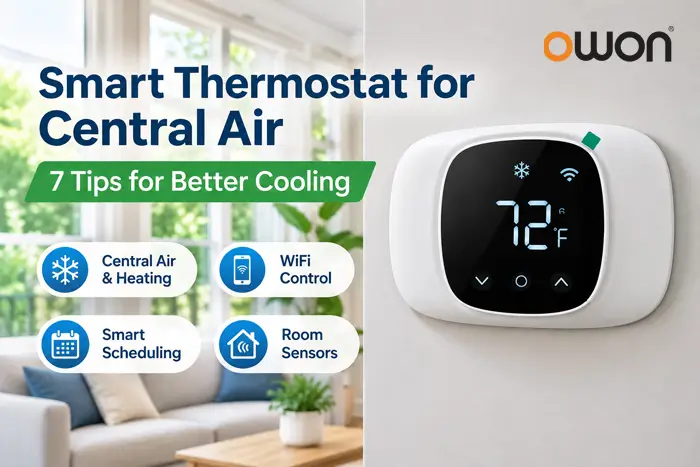
1. Can You Use a Smart Thermostat with Central Air?
Yes. Many North American central air conditioning systems use standard 24VAC thermostat controls, making them suitable for smart thermostat upgrades.
A smart AC thermostat communicates with the HVAC equipment to control cooling, heating, and fan operation according to temperature settings and schedules.
Unlike smart controllers designed for window or ductless air conditioners, a central air conditioning thermostat typically connects directly to the HVAC control wiring.
However, systems using proprietary communication protocols may require a dedicated thermostat or an approved interface.
2. Check Central Air and HVAC Compatibility
Before purchasing a smart thermostat for central air, identify your existing HVAC system, control voltage, wiring, and supported heating and cooling stages.
| HVAC System | Smart Thermostat Requirements |
|---|---|
| Single-stage central AC | 1-stage cooling support |
| Two-stage central AC | 2-stage cooling support |
| Gas furnace with central AC | Conventional heating and cooling control |
| Electric furnace with central AC | Compatible voltage and control stages |
| Heat pump | O/B reversing valve support |
| Heat pump with auxiliary heat | AUX and emergency heat support |
| Dual-fuel HVAC | Heat pump and furnace coordination |
| Communicating HVAC | Manufacturer-specific compatibility |
A compatible 24VAC smart thermostat supporting up to two cooling stages offers flexibility for many conventional residential HVAC systems.
Always verify equipment compatibility before replacing your existing thermostat.
3. Choose a Smart Thermostat for Central Heat and Air
Many North American homes use a single thermostat to control both central air conditioning and heating.
A smart thermostat for central heat and air can manage:
- Summer air conditioning
- Winter heating
- Automatic heating and cooling changeover
- Indoor fan operation
- Multi-stage HVAC equipment
- Heat pump and auxiliary heating
For homeowners with a gas furnace and central AC, a conventional heating and cooling thermostat may be sufficient.
For heat pump or dual-fuel systems, choose a thermostat specifically designed to support the required equipment configuration.
4. Does a Smart Thermostat for Central Air Need a C Wire?
Many smart thermostats require continuous 24VAC power to operate their WiFi connection, display, sensors, and electronic controls.
Common central air thermostat wiring terminals include:
| Terminal | Typical Function |
|---|---|
| R / Rc / Rh | 24VAC power |
| C | Common wire |
| Y1 | First-stage cooling or compressor control |
| Y2 | Second-stage cooling or compressor control |
| G | Indoor fan |
| W1 / W2 | Conventional heating or configured auxiliary heat |
| O/B | Heat pump reversing valve |
If your existing thermostat does not have a C wire, possible solutions include using an available unused conductor, installing a compatible C-wire adapter, or running a new thermostat cable.
Always follow the manufacturer’s wiring diagram. Turn off HVAC equipment power before inspecting or modifying thermostat wiring.
5. Improve Multi-Room Comfort with Remote Sensors
One common challenge with central air conditioning is uneven temperatures throughout the home.
Upstairs bedrooms may feel warmer than downstairs living areas, while rooms exposed to direct sunlight may require additional cooling.
A smart thermostat for central air with wireless room sensors can help address these temperature differences.
Compatible remote sensors allow the thermostat to:
- Monitor temperatures in multiple rooms
- Prioritize selected rooms
- Adjust temperature control based on participating sensors
- Improve comfort in frequently occupied areas
Remote room sensors are particularly useful in multi-story homes, larger apartments, and houses with uneven room temperatures.
However, remote sensors do not independently control airflow to each room. Independent room-by-room temperature control requires a compatible HVAC zoning system.
6. Can a Smart Thermostat Reduce Central AC Energy Costs?
A smart thermostat for central air can help reduce unnecessary cooling by adjusting HVAC operation around household routines.
Useful energy management features include:
- Seven-day programmable scheduling
- Automatic temperature adjustments
- Remote control when away from home
- Occupancy-based temperature management on supported models
- Scheduled precooling
- HVAC usage reports
Homeowners can schedule less intensive cooling when the house is unoccupied and restore comfortable temperatures before returning.
Actual energy savings depend on climate, insulation, HVAC efficiency, thermostat settings, and household behavior.
Homeowners in humid climates should also consider humidity management. A compatible smart thermostat with humidity control can coordinate with supported dehumidification equipment for improved indoor comfort.
7. How to Choose the Best Smart Thermostat for Central Air
The best smart thermostat for central air is not necessarily the most expensive model. It should match your HVAC equipment and provide the features your household actually needs.
| Feature | Why It Matters |
|---|---|
| 24VAC HVAC compatibility | Reliable equipment control |
| Multi-stage cooling | Supports compatible two-stage AC systems |
| WiFi app control | Remote temperature management |
| Programmable scheduling | Reduces unnecessary HVAC operation |
| C-wire adapter option | Simplifies compatible retrofit installations |
| Wireless room sensors | Improves multi-room comfort |
| Humidity control | Supports compatible humidity management equipment |
| Compressor protection | Helps prevent excessive short cycling |
Also consider installation requirements, manufacturer documentation, technical support, and total installation costs before purchasing.
Smart Thermostat Solutions for Central Air Conditioning
OWON Technology is a China-based smart thermostat manufacturer providing OEM/ODM development and manufacturing services for HVAC brands, distributors, contractors, and system integrators.
Its smart thermostat platforms are designed for compatible North American 24VAC central heating and cooling systems.
OWON PCT5231 – Smart WiFi Thermostat for Central Air
The OWON PCT5231 smart WiFi thermostat is designed for residential HVAC upgrades and connected temperature management.
Key features include:
- Up to 2H/2C conventional HVAC support
- Up to 4H/2C heat pump support
- Dual-fuel, auxiliary, and emergency heat control
- Up to 10 wireless room sensors
- Seven-day temperature, fan, and sensor scheduling
- WiFi remote control
- Optional C-wire adapter
- Adjustable temperature swing
The PCT5231 is a practical option for compatible central air conditioning systems, heat pumps, and residential thermostat replacement projects.
OWON PCT533 – Smart Thermostat with Humidity Control
The PCT533 provides advanced indoor comfort management for central heating and cooling applications.
Key features include:
- 4.3-inch color touchscreen
- Up to 2H/2C conventional HVAC support
- Up to 4H/2C heat pump support
- Built-in occupancy, temperature, and humidity sensing
- Support for compatible 1-wire or 2-wire humidifiers or dehumidifiers
- Wireless room sensor support
- Programmable scheduling and WiFi control
- C-wire adapter support
The PCT533 is particularly suitable for residential HVAC projects requiring additional humidity management and advanced comfort features.
Explore OWON WiFi thermostat solutions for central air conditioning applications, HVAC compatibility, and OEM/ODM customization options.
Frequently Asked Questions
Can I replace my old central air thermostat with a smart thermostat?
Yes, if the replacement thermostat is compatible with your HVAC equipment, control voltage, wiring, and heating and cooling stages.
Can a smart thermostat control both central air and heating?
Yes. Compatible smart thermostats can control central air conditioning, furnaces, and heat pumps from a single device.
Can I install a smart thermostat for central air without a C wire?
Yes, in compatible installations. A C-wire adapter or new thermostat cable can provide the continuous power required by many smart thermostats.
What is the best temperature setting for central air in summer?
There is no universal setting. Choose a comfortable temperature when at home and consider a higher cooling setpoint when away, while accounting for humidity, household needs, and HVAC performance.
Can a smart thermostat make my central AC cool faster?
Not necessarily. Cooling speed depends primarily on HVAC capacity, equipment condition, airflow, and building insulation. Smart thermostats improve control and scheduling but do not increase the cooling capacity of the equipment.
Conclusion
Choosing the right smart thermostat for central air starts with understanding your HVAC system, wiring, and indoor comfort requirements.
Features such as WiFi control, programmable scheduling, wireless room sensors, and humidity management can help homeowners achieve more convenient and efficient central heating and cooling.
For compatible 24VAC residential HVAC systems, smart thermostats such as the OWON PCT5231 and PCT533 offer flexible options for home upgrades and professional retrofit projects.
References
Post time: Nov-29-2026