Installing a smart thermostat with C wire is one of the most straightforward ways to upgrade a compatible home heating and cooling system. Unlike many traditional thermostats, smart models require continuous power to maintain WiFi connectivity, display operation, remote access, and advanced scheduling.
But what exactly is a C wire? What color is it, where does it connect, and can you install a smart thermostat if your existing system does not have one?
This guide explains everything homeowners and HVAC professionals should know before upgrading to a smart thermostat.
1. What Is a C Wire on a Smart Thermostat?
The C wire, also known as the common wire, provides the return path for continuous 24VAC power from the HVAC system’s transformer.
Together, the R and C terminals provide the power needed to operate compatible smart thermostats.
A smart thermostat with C wire can use this continuous power supply to support:
- WiFi connectivity and remote access
- Digital displays and touchscreens
- Programmable temperature schedules
- Wireless room sensor communication
- HVAC monitoring and smart automation
Unlike heating and cooling control wires, the C wire primarily serves a power supply function.
2. Why Does a Smart Thermostat Need a C Wire?
Traditional thermostats may operate using batteries or simple switching mechanisms. Smart thermostats typically require more power because of their connected features.
A dedicated C wire helps provide reliable power for these functions.
| Feature | Traditional Thermostat | Smart Thermostat with C Wire |
|---|---|---|
| Power supply | Battery or HVAC power | Continuous 24VAC power |
| WiFi connectivity | Usually unavailable | Supported |
| Remote app control | Usually unavailable | Supported |
| Temperature scheduling | Model dependent | Typically supported |
| Wireless room sensors | Less common | Available on selected models |
| HVAC usage reports | Less common | Available on selected models |
Not every smart thermostat requires a dedicated C wire, but models designed for continuous 24VAC power generally require a common connection or an approved alternative power solution.
3. What Color Is the C Wire on a Thermostat?
The C wire is commonly blue or black in North American HVAC installations. However, thermostat wire colors are not universally standardized.
The following table shows common thermostat wiring conventions.
| Terminal | Common Wire Color | Function |
|---|---|---|
| R / Rc / Rh | Red | 24VAC power |
| C | Blue or black | Common power connection |
| W / W1 | White | Heating control |
| Y / Y1 | Yellow | Compressor control |
| G | Green | Indoor fan control |
| O/B | Orange or dark blue | Heat pump reversing valve |
| W2 / AUX | Varies | Second-stage or auxiliary heating |
| Y2 | Varies | Second-stage cooling or compressor control |
Important: Always identify wires by their terminal labels rather than their colors. Previous installations may use different wiring conventions.
4. Where Do You Connect the C Wire on a Furnace?
In most conventional 24VAC HVAC systems, the C wire connects the thermostat’s C terminal to the common terminal on the furnace or air handler control board.
A typical conventional heating and cooling system uses the following connections:
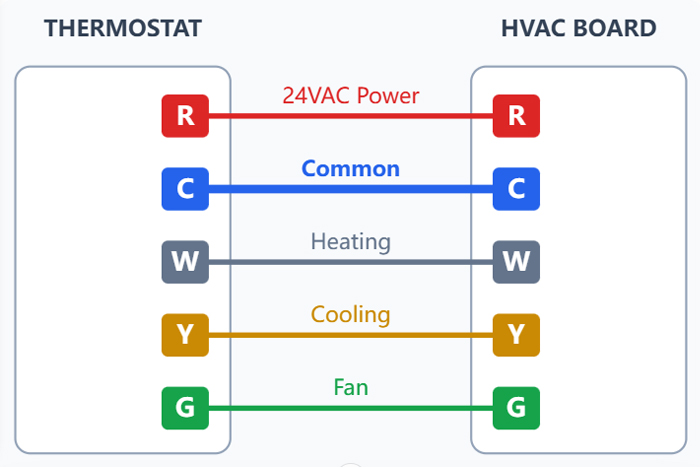
Before installing a smart thermostat with C wire:
- Turn off power to the HVAC equipment.
- Remove the old thermostat cover.
- Photograph the existing wiring and terminal labels.
- Identify the C terminal at both the thermostat and HVAC equipment.
- Follow the wiring diagram provided with your new thermostat.
Heat pumps, dual-fuel systems, multi-stage equipment, and systems with separate transformers may require different wiring configurations.
If you are unsure about the connections, consult a qualified HVAC technician. Incorrect wiring may damage the thermostat or HVAC control board.
5. What If There Is No C Wire for Your Thermostat?
Many older North American homes were originally equipped with battery-powered or mechanical thermostats that did not require a C wire.
If your existing thermostat does not have one, there are several possible solutions.
Use an Existing Unused Wire
Some thermostat cables contain an unused conductor behind the wall. If suitable, this wire can be connected to the common terminal at both ends.
Install a C-Wire Adapter
A compatible C-wire adapter can provide an alternative power solution without running an entirely new thermostat cable.
Compatibility depends on the existing HVAC wiring and the thermostat manufacturer’s requirements.
Run a New Thermostat Cable
Installing a new cable with additional conductors provides a long-term solution, particularly during HVAC renovations or equipment replacement.
Choose a Compatible Alternative Thermostat
Some thermostats are specifically designed for installations without a dedicated common wire. However, their power requirements and HVAC compatibility should still be checked carefully.
6. How Does a Smart Thermostat with C Wire Adapter Work?
A C-wire adapter is an accessory designed to provide continuous thermostat power using compatible existing HVAC wiring.
It is typically installed near the furnace or air handler control board.
For example, the OWON PCT5231 supports an optional C-wire adapter for selected installations where a dedicated common wire is unavailable.
According to the PCT5231 installation guide, the existing thermostat wiring must include the following connections to use its adapter:
- R, Rc, or Rh
- Y or Y1
- G
If neither a C wire nor these required connections is available, the existing wiring is not compatible with this installation method.
A smart thermostat with C wire adapter can be particularly useful for residential HVAC upgrades, rental apartments, and retrofit projects where installing new wiring would increase installation costs.
However, a C-wire adapter is not a universal solution for every two-wire heating system.
7. How to Choose the Best Smart Thermostat with C Wire
When choosing a smart thermostat, HVAC compatibility is more important than the number of smart features.
Consider the following requirements:
| Selection Factor | What to Check |
|---|---|
| Operating voltage | Compatibility with 24VAC HVAC systems |
| HVAC equipment | Furnace, central AC, heat pump or dual-fuel system |
| Heating and cooling stages | Single-stage or multi-stage support |
| Power requirements | Existing C wire or compatible adapter |
| Smart connectivity | WiFi, mobile app and remote control |
| Room sensors | Temperature and occupancy monitoring options |
| Scheduling | Flexible daily and weekly programming |
| Humidity control | Compatibility with humidifiers or dehumidifiers, if required |
For homeowners, reliable operation and ease of use are important. For HVAC contractors and property managers, installation compatibility, technical support, and long-term maintenance should also be considered.
Smart Thermostats with C Wire for North American 24VAC HVAC Systems
OWON Technology is a China-based smart thermostat manufacturer providing OEM/ODM development and manufacturing services for HVAC brands, distributors, contractors, and system integrators.
Both the OWON PCT5231 and PCT533 are designed for compatible North American 24VAC HVAC systems and require a C wire for continuous power. For installations without an existing C wire, both models support an optional C-wire adapter, subject to wiring compatibility.
OWON PCT5231 – Smart WiFi Thermostat with C Wire
The PCT5231 smart WiFi thermostat is designed for residential HVAC upgrades and flexible thermostat replacement.
Key features include:
- Continuous 24VAC power through a C wire
- Optional C-wire adapter for compatible retrofit installations
- Up to 2H/2C conventional and 4H/2C heat pump support
- Dual-fuel, auxiliary, and emergency heat control
- Up to 10 compatible wireless room sensors
- Seven-day programmable scheduling and WiFi app control
OWON PCT533 – Advanced Touchscreen Smart Thermostat with C Wire
The PCT533 combines continuous 24VAC power with advanced HVAC control and indoor comfort management.
Key features include:
- Standard C-wire connection for continuous power
- Optional C-wire adapter for compatible systems without an existing C wire
- 4.3-inch color touchscreen
- Built-in occupancy sensing and humidity control
- Multi-stage heat pump and dual-fuel support
- Wireless room sensor support and WiFi remote control
For installations without an existing C wire, the optional adapter requires compatible R (or Rc/Rh), Y/Y1, and G connections. Always verify the existing HVAC wiring before installation.
Explore OWON WiFi thermostat solutions for additional product specifications, HVAC compatibility, and OEM/ODM customization options.
Frequently Asked Questions
Does every smart thermostat need a C wire?
No. Some models use alternative power solutions. However, many smart thermostats designed for 24VAC HVAC systems require a C wire or a compatible power adapter.
Can I install a smart thermostat without a C wire?
Yes, in some installations. You may be able to use an unused conductor, install a compatible C-wire adapter, or run a new thermostat cable.
Is the C wire the same as a ground wire?
No. The C wire is the common connection in the 24VAC control circuit. It should not be confused with an electrical safety ground or a household AC neutral wire.
Can I use the G wire as a C wire?
Some HVAC configurations allow wiring modifications, but repurposing the G wire may affect independent fan control. Consult the thermostat installation guide and an HVAC professional before making changes.
Does a C wire provide 24 volts?
The voltage between the R and C terminals is typically nominally 24VAC. Together, these connections provide continuous power to a compatible smart thermostat.
Conclusion
A smart thermostat with C wire provides a reliable power solution for connected HVAC control, programmable scheduling, and remote temperature management.
If your existing HVAC system does not have a C wire, a compatible adapter or additional wiring may make an upgrade possible.
Before purchasing a thermostat, always verify the operating voltage, existing wiring, HVAC equipment type, and required heating and cooling stages.
Choosing the right thermostat for your HVAC system can help improve comfort, simplify operation, and support more efficient energy management.
References
- ENERGY STAR – Smart Thermostats
- OWON PCT5231-W-TY WiFi Thermostat Quick Start Guide
- OWON PCT533-W-TY WiFi Thermostat Quick Start Guide
Post time: Nov-26-2026