A 4 pipe fan coil thermostat is an essential HVAC control device for modern commercial buildings across Europe, especially in hotels, offices, apartments, hospitals, and mixed-use developments. As building owners continue to focus on energy efficiency, occupant comfort, and centralized climate management, fan coil HVAC systems remain one of the most widely used solutions in commercial environments.
Compared with standard room thermostats, fan coil thermostats are designed specifically for fan coil unit systems that require coordinated heating, cooling, valve control, and fan operation.
For HVAC engineers, system integrators, and facility managers, understanding how a 4 pipe fan coil thermostat works is important for improving indoor comfort, optimizing HVAC performance, and supporting modern building automation strategies.
What Is a 4 Pipe Fan Coil System?
A 4 pipe fan coil system is an HVAC configuration that uses separate hot water and chilled water pipes connected to the fan coil unit.
Unlike 2 pipe systems that switch seasonally between heating and cooling, 4 pipe systems can provide heating and cooling at the same time in different rooms or zones.
This flexibility makes 4 pipe fan coil systems especially suitable for:
- Hotels
- Office buildings
- Hospitals
- Apartment complexes
- Mixed-use commercial projects
Because different areas of a building may require different temperature conditions at the same time, independent room-level HVAC control becomes essential.

2 Pipe vs 4 Pipe Fan Coil Systems
Before selecting a thermostat, it is important to understand the differences between 2 pipe and 4 pipe HVAC systems.
| Feature | 2 Pipe Fan Coil System | 4 Pipe Fan Coil System |
|---|---|---|
| Heating & Cooling | Seasonal switching | Simultaneous heating & cooling |
| System Complexity | Lower | Higher |
| Installation Cost | Lower | Higher |
| Temperature Flexibility | Limited | More flexible |
| Common Applications | Residential and small projects | Hotels and commercial buildings |
A fan coil thermostat must support the correct HVAC configuration to ensure stable temperature control and efficient system operation.
What Does a 4 Pipe Fan Coil Thermostat Do?
A 4 pipe fan coil thermostat is designed to manage heating, cooling, fan operation, and valve control in fan coil HVAC systems.
Unlike a standard room thermostat, a fan coil thermostat must coordinate multiple HVAC functions simultaneously, including:
- Heating valve control
- Cooling valve control
- Fan motor operation
- Room temperature sensing
- Temperature scheduling
- Multi-speed airflow management
- Heating and cooling mode switching
In commercial HVAC projects, these functions are critical for maintaining stable indoor comfort and improving overall building energy efficiency.
How Fan Coil Unit Thermostats Control HVAC Systems
A fan coil unit thermostat continuously monitors indoor temperature and adjusts HVAC operation according to user settings, room demand, or programmed schedules.
In a typical FCU system, the thermostat may control:
- Fan operation
- Heating valve opening
- Cooling valve opening
- Ventilation modes
- Room temperature setpoints
- Occupancy-based energy-saving modes
For 4 pipe systems, the thermostat independently manages heating and cooling circuits. This allows one room to receive heating while another room receives cooling within the same building.
This level of flexibility is one of the main reasons why 4 pipe fan coil systems are widely used in hotels, offices, healthcare facilities, and large apartment projects.
How to Choose a Fan Coil Thermostat for Commercial Buildings
Selecting the right fan coil thermostat requires more than comparing basic specifications. HVAC engineers and system integrators should evaluate how the thermostat fits the actual building system.
System Compatibility
Confirm whether the project uses a 2 pipe or 4 pipe fan coil system. For 4 pipe systems, the thermostat should support separate heating and cooling control.
Voltage Requirements
Many commercial fan coil thermostats operate on line voltage, commonly 110–240V AC, especially in European HVAC projects.
Valve Control Logic
Check whether the thermostat can properly control heating and cooling valves according to the fan coil system design.
Fan Operation
Fan control should match the project requirements, including manual, automatic, or multi-speed operation depending on the fan coil unit.
Smart Building Integration
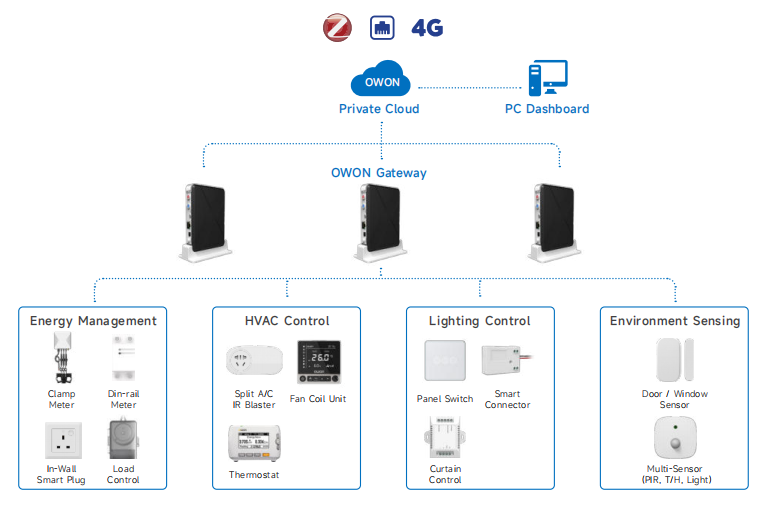
Modern commercial HVAC projects increasingly require compatibility with building management systems, gateways, and IoT platforms.
In many smart building environments, wireless HVAC control helps enable centralized management, flexible deployment, and room-level automation across hotels, apartments, and office buildings.
These HVAC devices are often integrated into a wireless BMS system that connects thermostats, sensors, gateways, and energy management platforms for centralized building automation and operational efficiency.
Retrofit Flexibility
Wireless communication technologies such as Zigbee can simplify deployment in existing buildings where additional communication wiring is difficult or expensive.
Example: OWON PCT504 Smart Fan Coil Thermostat
For smart HVAC projects in Europe, solutions such as the OWON PCT504 smart fan coil thermostat provide support for both 2 pipe and 4 pipe HVAC systems.
The OWON PCT504 is a smart 4 pipe fan coil thermostat designed for modern HVAC control in hotels, apartments, offices, and commercial buildings.
The thermostat supports heating and cooling control, fan operation management, programmable scheduling, and Zigbee-based wireless communication. It can also integrate with broader smart building HVAC systems for centralized management and energy optimization.
Such solutions are suitable for hotel HVAC projects, apartment buildings, office environments, and retrofit HVAC deployments where scalability, comfort, and automation are important.
Common Mistakes When Selecting Fan Coil Thermostats
One common mistake is using a standard room thermostat for a fan coil HVAC system.
Fan coil systems require dedicated thermostat control because they involve:
- Fan motors
- Heating valves
- Cooling valves
- Fan coil unit wiring
- System-specific HVAC control logic
Another common issue is selecting a thermostat without confirming whether the building uses a 2 pipe or 4 pipe HVAC configuration.
Ignoring these factors can lead to unstable temperature control, reduced HVAC efficiency, poor occupant comfort, and increased maintenance complexity.
Frequently Asked Questions About Fan Coil Thermostats
What is a 4 pipe fan coil thermostat?
A 4 pipe fan coil thermostat is a controller designed to independently manage heating and cooling circuits in commercial fan coil HVAC systems.
What is a fan coil thermostat?
A fan coil thermostat is a specialized HVAC controller used to manage heating, cooling, fan operation, valve control, and room temperature in fan coil unit systems.
Why are 4 pipe fan coil systems commonly used in hotels?
Hotels often require different rooms to maintain different temperature conditions at the same time. A 4 pipe fan coil system allows independent heating and cooling control across multiple rooms.
What is the difference between a room thermostat and a fan coil unit thermostat?
A standard room thermostat usually controls basic heating or cooling equipment. A fan coil unit thermostat is designed to control fan motors, heating valves, cooling valves, and operating modes in FCU systems.
Can fan coil thermostats support smart building systems?
Yes. Modern smart fan coil thermostats can integrate with building management systems, gateways, and wireless automation platforms such as Zigbee-based HVAC networks.
Conclusion
As commercial buildings across Europe continue upgrading their HVAC infrastructure, 4 pipe fan coil systems remain an important solution for flexible and energy-efficient climate control.
Selecting the right 4 pipe fan coil thermostat is essential for maintaining stable HVAC performance, improving occupant comfort, and supporting scalable building automation strategies.
From hotels and office buildings to apartment and retrofit projects, modern fan coil thermostats now play a central role in smart HVAC control and energy optimization.
Related reading:
[Zigbee Combi Boiler Thermostat for Heating & Hot Water Control in EU Homes]
Post time: Jan-15-2026