A Tuya energy monitor helps users track electricity consumption through connected devices and mobile apps. Depending on the model, it can monitor individual loads, whole-home electricity usage, or three-phase electrical systems.
With features such as real-time monitoring, historical energy data, and smart automation, Tuya-compatible energy monitors are used in homes, solar installations, and commercial energy management projects.
But how do they work, and which features actually matter?
What Is a Tuya Energy Monitor?
A Tuya energy monitor is an electricity monitoring device that connects to the Tuya ecosystem, typically through WiFi or a compatible gateway.
Depending on the hardware, it can measure:
- Voltage and current
- Active power (W)
- Energy consumption (kWh)
- Power factor and frequency
- Bidirectional energy flow for solar applications
Unlike a basic electricity meter with a local display, a connected energy monitor can make measurement data accessible through an app or energy management platform.
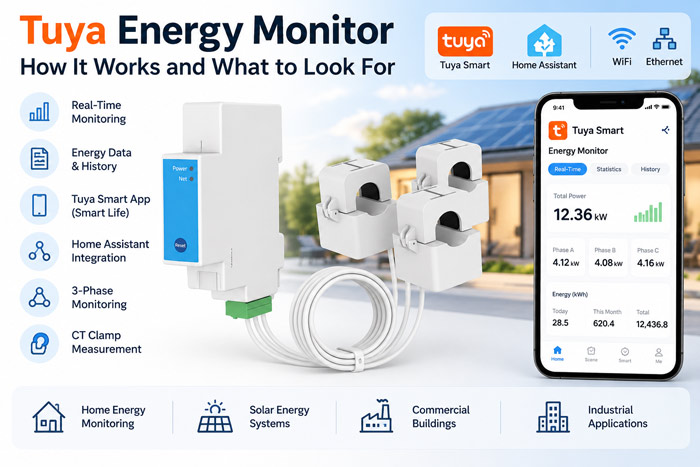
How Does the Tuya Energy Monitor App Work?
Compatible devices connect to Tuya Smart or Smart Life, allowing users to check energy information remotely.
Depending on the model, the app may provide real-time electricity readings, daily or monthly energy history, automation settings, and data export.
For example, users can review electricity consumption trends or configure supported automation scenarios based on measured electrical values.
However, not every Tuya energy monitor provides the same app features. Historical data availability, export functions, and automation capabilities should be confirmed before purchase.
Tuya Energy Monitor with CT Clamps
A Tuya energy monitor clamp uses a current transformer (CT) installed around an electrical conductor to measure current without passing the main load current through the meter.
CT-based monitoring is useful for electrical panels, solar installations, and retrofit energy management projects.
Some users search for monitors with 1x 80A or 2x 80A sensors. These configurations generally refer to the number and current rating of CT clamps.
For example, one CT may monitor a selected conductor, while two CTs may be used for separate circuits or particular electrical configurations.
The correct number of CTs depends on the wiring system and monitoring requirements. CT current ratings should also match the expected electrical load.
Tuya Energy Monitor for 3-Phase Systems
A tuya energy monitor 3 phase solution is designed to monitor electricity across three-phase electrical systems.
These monitors are useful for commercial buildings, workshops, solar installations, and other facilities with three-phase electrical loads.
For example, the OWON PC4713 uses three external CT clamps and supports three-phase four-wire, split-phase, and single-phase monitoring. It also provides WiFi and Ethernet connectivity and bidirectional measurement for energy consumption and solar production.
When selecting a three-phase monitor, confirm the supported wiring configuration, CT range, voltage requirements, and integration capabilities.
Can a Tuya Energy Monitor Work with Home Assistant?
Home Assistant allows users to bring energy monitoring data together with other connected devices in a centralized dashboard.
A tuya energy monitor home assistant integration can be useful for viewing electricity usage, tracking energy trends, and creating supported smart home automations.
However, compatibility depends on the specific device and integration method.
For example, the OWON PC4713 Tuya version supports Home Assistant integration, providing an option for projects that need connected electricity monitoring alongside other smart home devices.
Before choosing a monitor, confirm which energy measurements are available through the intended integration.
Smart Meter vs Energy Monitor: What’s the Difference?
Although the terms are sometimes used interchangeably, they can describe different purposes.
| Feature | Smart Utility Meter | Smart Energy Monitor |
|---|---|---|
| Main Purpose | Utility electricity metering | Energy visibility and management |
| Typical Installation | Utility metering point | Electrical panel or monitored load |
| Real-Time Monitoring | Depends on utility access | Commonly supported |
| App Integration | Utility-dependent | Depends on product |
| Circuit-Level Monitoring | Usually limited | Available on selected models |
A smart energy monitor is generally intended for understanding and managing electricity consumption. It should not be assumed suitable for utility billing unless specifically certified.
How to Choose the Right Tuya Energy Monitor
There is no single best Tuya energy monitor for every installation.
Before selecting one, consider:
Electrical System: Single-phase, split-phase, or three-phase.
CT Configuration: Number of sensors and supported current range.
Monitoring Scope: Individual load, whole-home, or multi-circuit monitoring.
App and Data Features: Real-time readings, historical data, and export requirements.
Platform Compatibility: Tuya Smart, Smart Life, Home Assistant, or other supported integrations.
Installation: Confirm wiring, CT orientation, panel space, and network requirements.
For professional energy monitoring projects, electrical compatibility and data integration are often more important than app features alone.
FAQ
Are Tuya energy monitors worth it?
They can be useful when real-time electricity visibility, historical energy data, or automation helps users understand and manage consumption. Their value depends on the monitoring requirements and available features.
Does a Tuya energy monitor require WiFi?
Not always. WiFi models connect directly to a compatible network, while other Tuya devices may use Zigbee and require a gateway.
Can a Tuya energy monitor measure solar energy?
Yes, if the model supports bidirectional energy measurement and is installed in the appropriate electrical configuration.
Where can I find a Tuya energy monitor manual?
Installation, pairing, reset, and CT configuration procedures depend on the manufacturer and model. Always use the documentation supplied for the specific device.
Conclusion
A Tuya energy monitor provides a convenient way to track electricity consumption through connected monitoring and supported automation.
Whether the application involves a single electrical load, a home energy system, or a three-phase commercial installation, choosing the right monitor requires checking CT configuration, electrical compatibility, app functions, and integration requirements.
For energy management projects, reliable measurement and platform compatibility matter more than connectivity alone.
Looking for a Tuya energy monitor for solar, 3-phase, or smart building projects?
Explore OWON’s smart energy monitoring solutions or contact our team to discuss CT configurations, Home Assistant integration, and OEM/ODM requirements.
Post time: Oct-09-2026


