You probably think a door sensor is simple
Let me guess your mental model.
A door sensor is just there to tell you two things:
- your door is open
- your door is closed
That’s it.
Clean. Simple. Almost boring.
And honestly, that’s exactly how most people stop thinking about it.
But here is where I need to gently ruin that simplicity for you:
your system is not only watching the door
it is also supposed to watch whether the sensor is still there
That second part is where tamper alarm quietly shows up.
What your door sensor is actually doing
Let’s break it down in a very unromantic way.
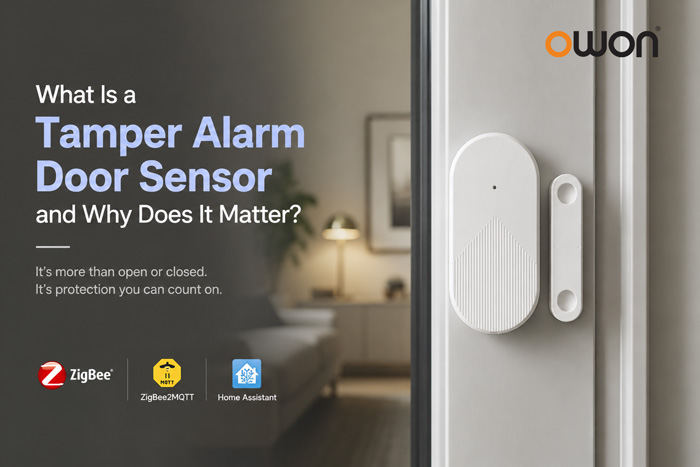
Your typical door/window sensor is just two parts:
- a magnet on your door
- a sensor unit on the frame
When the door closes, everything aligns nicely.
When the door opens, the alignment breaks.
And your system says:
“OK, someone opened the door.”
Simple logic.
But here is the gap you probably don’t think about:
what if someone removes the sensor before opening the door?
Now your system has no idea that anything changed.
That’s the blind spot.
The part nobody talks about: what if the sensor disappears?
In real life, things are not always elegant.
A sensor can be:
- pulled off the wall
- opened and disabled
- moved slightly out of position
- damaged without triggering “door open” logic
And your system?
It may still happily assume everything is fine.
That is… not great.
Especially if you are relying on it for security.
So what is a tamper alarm actually doing?
Let’s keep this very simple.
A tamper alarm is your sensor quietly asking:
“Am I still physically OK?”
More technically:
- if the casing is opened
- if the device is removed
- if the mounting is disturbed
it triggers an alert.
So instead of only watching the door, your system also watches the device itself.
Think of it like this:
your sensor is slightly paranoid about its own existence
and honestly, that’s a good thing
Why you already have it (even if you never noticed)
Here is something important:
You are not “adding” tamper alarm as a feature.
You already have it.
Almost every modern door sensor includes it by default.
Why?
Because engineers like me (yes, slightly grumpy ones) assume one thing:
devices will be touched, moved, or messed with at some point
So instead of pretending that won’t happen, we design for it.
That’s all tamper alarm is.
No magic. Just realism.
Tamper alarm vs door open alarm (don’t mix them up)
This is where people sometimes get confused.
So let me separate it clearly for you:
| What you care about | Door open detection | Tamper alarm |
|---|---|---|
| What is happening | Someone opened the door | Someone touched the sensor |
| Focus | Entry event | Device integrity |
| Trigger | Magnet separation | Physical interference |
| Question answered | “Is someone entering?” | “Is the system still intact?” |
So no, they are not competing.
They are two different questions.
And you actually need both.
Why this matters more in real deployments than you think
If you are using this in:
- smart home security
- rental properties
- hotel rooms
- multi-unit deployments
then you are not just asking:
“Did something happen?”
You are also asking:
“Would I still know if someone disabled the system first?”
And that is exactly the gap tamper alarm is trying to close.
Not perfectly.
But reliably enough to matter.
A small reality check: yes, it can be annoying sometimes
Because tamper detection is sensitive, it can sometimes trigger when:
- the sensor is loosely mounted
- someone bumps the wall
- the casing is not fully closed
- long-term vibration happens
So yes, occasionally it feels a bit “too alert”.
But here is the trade-off you are accepting:
slightly annoying alerts
or silently broken security
Most people, once they understand it, stop complaining.
Where you’ll see this in real products
If you look at modern Zigbee door/window sensors, you will almost always see:
- door open/close detection
- tamper alarm
- low battery alert
It is not a premium tier feature.
It is just part of how these devices are expected to behave now.
Conclusion: you are not just monitoring doors
Let’s bring it back to something simple.
A door sensor tells you what the door is doing.
A tamper alarm tells you whether you can still trust the sensor telling you that.
That’s it.
Not flashy. Not complicated.
But in real security systems, that second part is what prevents you from believing everything is fine… when it actually isn’t.
And if you are deploying these at scale, that difference is exactly what saves you from surprises later.
FAQ
What is a tamper alarm in a door sensor?
It is a built-in function that alerts you when the sensor itself is opened, removed, or physically interfered with.
Do all door sensors have tamper alarm?
Most modern ones do. It is considered a standard security function, not an optional upgrade.
Why should you care about tamper detection?
Because it helps you know not only what is happening at the door, but also whether your sensor system is still intact.
Can tamper alarms trigger false alerts?
Yes. If your installation is loose or unstable, the sensor may occasionally trigger tamper alerts even without malicious intent.
Related reading:
[Why Door Sensors Are Often the First Smart Home Product Retailers Add]
Post time: Jul-06-2026