A Practical Compatibility Checklist for HVAC Contractors
Replacing a thermostat in a dual fuel HVAC system should never begin with choosing a touchscreen or comparing mobile apps. The first priority is compatibility.
For HVAC contractors, selecting the wrong thermostat can lead to installation delays, unnecessary service callbacks, incorrect heat pump operation, or poor customer satisfaction. Even when the HVAC equipment is working properly, an incompatible thermostat may prevent the system from switching correctly between the heat pump and the furnace.
Whether you’re replacing an existing thermostat during a retrofit or specifying controls for a new installation, verifying compatibility before ordering can save hours of troubleshooting later.
This guide explains the key checks HVAC professionals should make before selecting a thermostat for a dual fuel HVAC system, helping reduce installation risks and improve long-term system performance.
Why Compatibility Matters More Than Features
When comparing smart thermostats, it’s easy to focus on features such as WiFi connectivity, voice assistants, touchscreen displays, or mobile apps. While these functions improve user experience, they have little value if the thermostat cannot properly control the HVAC equipment.
For contractors, compatibility affects far more than convenience. It determines whether the system can be installed correctly the first time and whether it will operate reliably throughout its service life.
A thermostat that fully matches the HVAC system helps contractors:
- Complete installations more efficiently
- Reduce costly return visits
- Minimize wiring and configuration errors
- Improve customer satisfaction
- Protect HVAC equipment from incorrect operation
Instead of asking “Which thermostat has the most features?”, contractors should first ask:
“Will this thermostat work correctly with this specific dual fuel HVAC system?”
What Makes a Dual Fuel HVAC System Different?
A dual fuel HVAC system combines two heating sources:
- A heat pump for efficient heating during mild and moderate weather
- A gas or propane furnace that provides heating when outdoor temperatures become too low for the heat pump to operate efficiently
Unlike a standard heat pump system with electric auxiliary heat, a dual fuel system requires the thermostat to manage two different heating technologies and switch between them according to the system configuration.
Because every installation is different, contractors should always verify the equipment requirements instead of assuming any heat pump thermostat will support dual fuel operation.
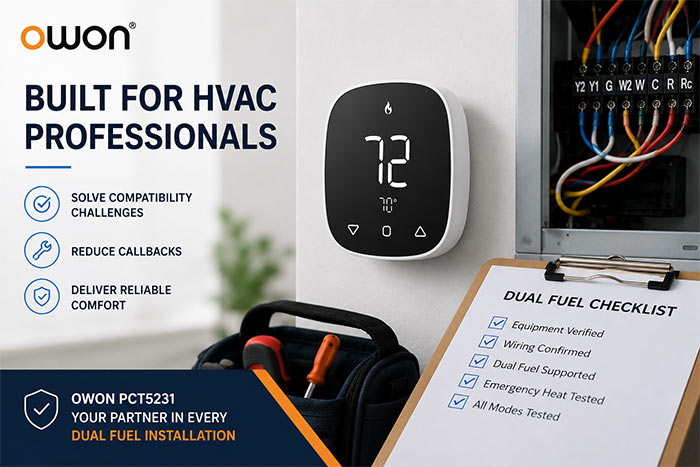
Five Compatibility Checks Before Ordering a Thermostat
Before recommending or installing a thermostat, HVAC contractors should verify the following items.
1. Confirm the Existing HVAC Configuration
Start by identifying the equipment already installed.
Key information includes:
- Heat pump model
- Indoor furnace model
- Number of compressor stages
- Number of furnace heating stages
- Conventional 24VAC or proprietary communicating system
Many compatibility issues occur because installers assume the equipment configuration instead of confirming it.
2. Verify Dual Fuel Control Capability
Not every heat pump thermostat supports dual fuel operation.
The thermostat should clearly support:
- Heat pump and furnace control
- Automatic switching between heating sources
- Emergency Heat mode
- Proper auxiliary or alternative heat configuration
Always verify these capabilities in the manufacturer’s specifications before installation.
3. Check Wiring Before Selecting the Thermostat
Before ordering a replacement thermostat, inspect the existing wiring rather than relying on the previous thermostat model.
Typical dual fuel systems may require terminals such as:
- R / Rc
- C
- Y1
- Y2
- W1
- W2 or AUX
- O/B
- G
Do not rely on wire colors alone. Always identify each conductor by its terminal connection at the HVAC equipment.
If a C-wire is unavailable, determine whether the thermostat supports a compatible C-wire adapter before planning the installation.
4. Confirm Installer Configuration Options
Even a compatible thermostat requires proper installer setup.
Verify that the thermostat allows configuration of:
- Heat pump system type
- Number of compressor stages
- Furnace heating stages
- Reversing valve (O/B)
- Emergency Heat
- Compressor protection delay
Incorrect installer settings are one of the most common causes of unnecessary callbacks after thermostat replacement.
5. Plan to Test Every Operating Mode
Installation should not end once the thermostat powers on.
Before leaving the job site, verify:
- First-stage cooling
- Second-stage cooling (if applicable)
- Heat pump heating
- Furnace heating
- Emergency Heat
- Fan operation
Testing every operating mode ensures the thermostat and HVAC equipment communicate correctly under real operating conditions.
The Most Common Thermostat Mistakes That Lead to HVAC Callbacks
For most HVAC contractors, a callback rarely happens because of a defective thermostat. More often, it’s caused by compatibility assumptions or installation details that were overlooked during the initial visit.
Below are some of the most common issues seen in dual fuel retrofit projects.
Assuming Every Heat Pump Thermostat Supports Dual Fuel
Many WiFi thermostats advertise heat pump compatibility, but that doesn’t necessarily mean they can properly manage a dual fuel system.
Before installation, verify that the thermostat supports:
- Dual fuel or hybrid heat operation
- Emergency Heat mode
- Multi-stage heat pump control
- Alternative heating source configuration
Reading the specification sheet before ordering is often faster than troubleshooting after installation.
Skipping Equipment Verification
Not every home with a heat pump is configured the same way.
Before selecting a thermostat, confirm:
- Heat pump model
- Indoor furnace model
- Number of compressor stages
- Heating stages
- Existing control voltage
Taking a few minutes to verify the equipment can prevent hours of troubleshooting later.
Incorrect Installer Configuration
Even when the wiring is correct, incorrect installer settings can prevent the HVAC system from operating as expected.
Always review settings such as:
- Heat pump type
- Compressor stages
- Reversing valve (O/B)
- Heating source
- Emergency Heat configuration
A properly configured thermostat is just as important as correct wiring.
Not Testing Every Operating Mode
Many installation issues only appear after the customer begins using the system.
Before leaving the job site, test:
- Cooling
- Heating
- Heat pump staging
- Furnace operation
- Emergency Heat
- Fan control
Verifying each operating mode helps reduce unnecessary return visits.
What Contractors Should Look for in a Dual Fuel Thermostat
Instead of comparing consumer features, HVAC contractors should evaluate whether a thermostat is designed for professional installation and long-term compatibility.
Important considerations include:
Reliable HVAC Compatibility
Choose a thermostat that clearly specifies compatibility with conventional 24VAC HVAC systems and supports the required heating and cooling stages.
Flexible Installation
Features such as installer configuration menus, optional C-wire solutions, and clear wiring documentation can simplify retrofit projects and reduce installation time.
Support for Advanced Heat Pump Systems
Modern HVAC projects increasingly require support for:
- Multi-stage heat pumps
- Dual fuel systems
- Emergency Heat
- Auxiliary heat
- Remote room sensors
Selecting a thermostat that already supports these functions helps avoid future upgrades.
Long-Term Reliability
Contractors should also consider:
- Firmware stability
- Technical documentation
- Product availability
- Replacement continuity
- Manufacturer support
These factors become increasingly important for contractors who install thermostats across multiple projects each year.
An Example of a Thermostat Designed for North American HVAC Systems
Many thermostat manufacturers offer products for residential HVAC applications, but contractors should look beyond marketing features and confirm whether the thermostat platform is designed for North American 24VAC systems.
One example is the OWON PCT5231 WiFi Thermostat, which supports:
- Conventional 24VAC HVAC systems
- Up to 4H/2C heat pump configurations
- Dual fuel (hybrid heat) operation
- Emergency Heat
- Up to 10 wireless remote sensors
- Seven-day scheduling
- Maintenance reminders
- Energy usage reports
- Optional C-wire adapter for compatible retrofit projects
Rather than serving as a consumer gadget, these capabilities make it suitable for contractors working on residential replacements, heat pump retrofits, and light commercial HVAC projects where compatibility and installation efficiency are priorities.
For projects requiring additional comfort features such as built-in humidity sensing, occupancy detection, or humidifier/dehumidifier control, the OWON PCT533 provides another option within the same North American HVAC platform.
Contractor’s Pre-Installation Compatibility Checklist
Before ordering or installing a thermostat for a dual fuel HVAC system, verify the following:
| Checklist Item | Status |
|---|---|
| Confirm the HVAC system uses conventional 24VAC controls | □ |
| Verify the heat pump model and compressor stages | □ |
| Verify the furnace type and heating stages | □ |
| Check available thermostat wiring | □ |
| Confirm C-wire availability or compatible adapter | □ |
| Verify dual fuel compatibility | □ |
| Confirm Emergency Heat support | □ |
| Verify O/B configuration requirements | □ |
| Configure installer settings correctly | □ |
| Test every operating mode before project completion | □ |
Following a consistent checklist helps reduce installation errors, improves commissioning efficiency, and provides a more reliable experience for both contractors and homeowners.
Frequently Asked Questions
Can any smart thermostat control a dual fuel HVAC system?
No.
A thermostat may support a heat pump but still lack the control logic required for a dual fuel system. Before installation, verify that the thermostat explicitly supports the required heating stages, emergency heat, and dual fuel or hybrid heat operation.
Is a dual fuel thermostat the same as a heat pump thermostat?
Not always.
Most dual fuel systems use a heat pump together with a gas or propane furnace. While every dual fuel thermostat supports a heat pump, not every heat pump thermostat is designed to manage a dual fuel system.
Always verify compatibility with the installed HVAC equipment rather than relying on product descriptions alone.
What should HVAC contractors verify before replacing a thermostat?
Before ordering a replacement thermostat, contractors should confirm:
- HVAC equipment type
- Heat pump and furnace stages
- Existing thermostat wiring
- 24VAC compatibility
- Emergency Heat requirements
- Installer configuration options
- Available C-wire or compatible power solution
A structured compatibility check before installation is often the easiest way to prevent unnecessary callbacks.
Does every dual fuel HVAC system require a 4H/2C thermostat?
No.
The required thermostat depends on the equipment installed.
Some dual fuel systems operate with fewer heating stages, while others require full 4H/2C capability to control multiple compressor stages and backup heating correctly.
Always match the thermostat to the actual HVAC configuration rather than choosing the highest stage count by default.
Can WiFi thermostats simplify future maintenance?
Yes.
For many contractors, WiFi connectivity provides more than remote control. It can simplify troubleshooting, confirm operating status, reduce unnecessary service visits, and make it easier to guide homeowners through basic settings without visiting the property.
Final Thoughts
Choosing a thermostat for a dual fuel HVAC system is ultimately about reducing installation risk.
Experienced HVAC contractors know that successful projects begin long before the thermostat is mounted on the wall. Verifying the HVAC configuration, confirming wiring, checking staging requirements, and selecting a thermostat designed for the application can prevent many of the issues that lead to costly callbacks.
Consumer features such as touchscreen displays or voice control may improve the user experience, but professional installations depend first on compatibility, reliable configuration, and long-term system stability.
For contractors working with North American 24VAC HVAC systems, selecting a smart thermostat platform that supports dual fuel operation, multi-stage heat pumps, emergency heat, and future retrofit requirements provides greater flexibility across a wide range of residential projects.
Related reading:
[WiFi Smart HVAC Control Solution for Residential and Light Commercial Systems]
Post time: Jul-15-2026