The HVAC industry is moving toward more efficient and intelligent systems. Variable speed compressors, variable capacity heat pumps, and advanced air handling technologies are becoming increasingly common in residential and light commercial applications.
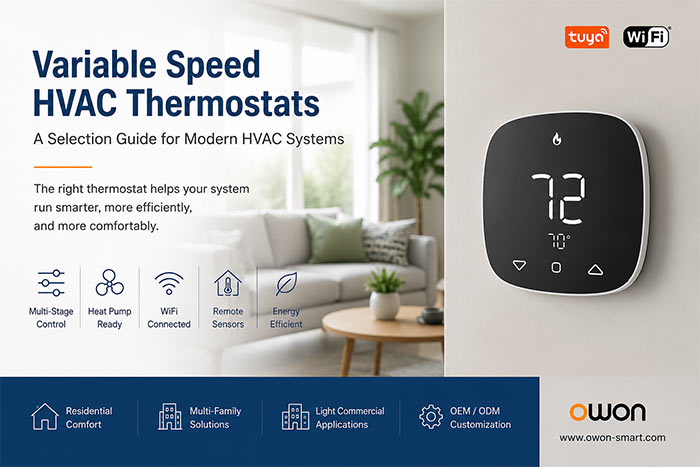
However, upgrading to a variable speed HVAC system is not only about selecting advanced equipment. The thermostat also plays an important role in ensuring the system operates correctly and delivers the expected comfort and energy efficiency.
For HVAC contractors, system integrators, and equipment manufacturers, choosing the right variable speed HVAC thermostat requires careful consideration of compatibility, control capability, communication requirements, and future smart HVAC integration.
This guide explains what HVAC professionals should consider when selecting a thermostat for modern variable speed systems.
What Is a Variable Speed HVAC System?
A variable speed HVAC system uses advanced motor and compressor technologies to adjust output according to actual heating or cooling demand.
Unlike traditional single-stage systems that operate only at full capacity, variable speed systems can operate at different capacity levels.
For example:
- A system may run at lower capacity during mild weather
- Increase output gradually when demand rises
- Maintain more stable indoor temperatures
- Reduce unnecessary cycling
This approach improves:
- Energy efficiency
- Temperature consistency
- Indoor comfort
- Equipment performance
Because variable speed HVAC systems can operate across multiple output levels, the thermostat must provide appropriate control signals and support the equipment configuration.
Why Thermostat Compatibility Matters for Variable Speed HVAC Systems
One of the most important considerations when selecting a thermostat is compatibility.
A variable speed HVAC system typically requires more advanced control compared with a basic single-stage furnace or air conditioner.
Depending on the equipment design, the thermostat may need to support:
- Multi-stage heating and cooling
- Heat pump operation
- Auxiliary heat
- Emergency heat
- Dual fuel applications
- Advanced scheduling
- Remote sensors
A thermostat that does not match the HVAC system capability may limit performance or prevent certain features from operating correctly.
For HVAC professionals, thermostat selection should always start with understanding the HVAC equipment requirements rather than simply choosing a thermostat based on appearance or smart features.
Variable Speed vs Single-Stage and Two-Stage Thermostats
Understanding the differences between thermostat control levels helps explain why modern HVAC systems require more advanced solutions.
| System Type | How It Operates | Thermostat Requirements |
|---|---|---|
| Single-stage HVAC | One heating or cooling output level | Basic thermostat control |
| Two-stage HVAC | Low and high output operation | Multi-stage thermostat support |
| Variable speed HVAC | Continuously adjusts capacity based on demand | Advanced compatibility and control capability |
Variable speed systems provide the highest level of comfort and efficiency, but they require a thermostat platform capable of supporting modern HVAC functions.
In many residential and light commercial projects, a properly matched smart thermostat can help users take advantage of advanced HVAC features.
Key Features to Look for in a Variable Speed HVAC Thermostat
When evaluating a thermostat for variable speed HVAC applications, HVAC professionals should consider several important features.
Multi-Stage HVAC Support
Variable speed systems often rely on advanced staging control.
A suitable thermostat should support the required heating and cooling stages, especially for:
- Heat pumps
- High-efficiency furnaces
- Multi-stage air conditioning systems
This allows the HVAC equipment to operate more efficiently instead of frequently switching between full power and off cycles.
Heat Pump and Dual Fuel Compatibility
Many variable speed systems are based on heat pump technology.
For these applications, thermostat support for heat pump functions is essential.
Important features may include:
- Reversing valve control
- Auxiliary heat
- Emergency heat
- Dual fuel switching
These functions are particularly important in North American HVAC markets where heat pumps are widely used for both heating and cooling.
Smart Connectivity and Remote Management
Modern HVAC projects increasingly require connected control.
A WiFi thermostat can provide:
- Mobile app access
- Remote temperature adjustment
- Energy monitoring
- Scheduling
- Cloud-based management
For property managers, smart home providers, and HVAC integrators, these features create additional value beyond traditional temperature control.
Remote Sensor Support
Variable speed HVAC systems are often installed in larger homes, apartments, offices, and multi-room environments.
Remote sensors help improve comfort by measuring temperature in different locations instead of relying only on the thermostat wall location.
Applications include:
- Multi-zone comfort management
- Apartment buildings
- Hotels
- Large residential properties
- Office environments
Applications of Variable Speed HVAC Thermostats
Variable speed thermostat solutions are increasingly used in:
Residential Smart HVAC Projects
Homeowners expect better comfort, lower energy consumption, and remote control capabilities.
Smart thermostats help maximize the benefits of high-efficiency HVAC equipment.
Apartments and Multifamily Buildings
Property managers need reliable HVAC control across multiple units.
Features such as scheduling, remote monitoring, and temperature management can improve operational efficiency.
Light Commercial HVAC Systems
Offices, retail spaces, and hospitality projects often require flexible temperature control combined with energy management.
A compatible smart thermostat platform can support these requirements.
Example: Variable Speed HVAC Thermostat Solutions for North American Systems
For example, thermostat manufacturers developing solutions for North American HVAC markets often focus on compatibility with 24VAC systems, heat pumps, multi-stage equipment, and smart control requirements.
The OWON PCT5231 WiFi Thermostat is one example of a thermostat platform designed for North American HVAC applications. It supports multi-stage conventional systems, heat pumps, auxiliary heat, emergency heat, and dual fuel configurations.
With support for up to 10 wireless remote sensors, the PCT5231 can help improve temperature management in larger residential and light commercial projects where balanced comfort is important.
For applications requiring additional environmental monitoring, the OWON PCT533 WiFi Thermostat adds features such as humidity monitoring, humidity control outputs, occupancy sensing, and a color touchscreen interface.
These examples demonstrate how modern thermostat platforms are evolving to support more advanced HVAC systems while maintaining compatibility with traditional 24VAC infrastructure.
How HVAC Professionals Choose the Right Variable Speed Thermostat
Before selecting a thermostat, HVAC professionals should evaluate:
1. HVAC Equipment Compatibility
Confirm:
- System type
- Number of heating and cooling stages
- Heat pump requirements
- Available wiring
2. Project Requirements
Consider:
- Residential or commercial application
- Remote monitoring needs
- Multi-zone requirements
- Energy management goals
3. Future Expansion
A thermostat platform that supports additional features can provide more flexibility as customer requirements change.
Examples include:
- Remote sensors
- Smart home integration
- Cloud connectivity
- Energy reporting
Frequently Asked Questions
What is a variable speed HVAC thermostat?
A variable speed HVAC thermostat is a thermostat designed to control advanced HVAC systems that adjust heating or cooling output based on demand rather than operating only at full capacity.
Do variable speed HVAC systems need a special thermostat?
Yes, many variable speed systems require thermostats with advanced compatibility, including multi-stage control, heat pump support, and equipment-specific functions.
Can a smart thermostat work with a variable speed HVAC system?
Yes, if the thermostat supports the required HVAC configuration. Compatibility should always be verified before installation.
Is a variable speed HVAC system more efficient?
Variable speed systems can improve efficiency and comfort by adjusting output according to actual demand, reducing unnecessary cycling and maintaining more stable temperatures.
What thermostat features are important for heat pump variable speed systems?
Important features include heat pump compatibility, auxiliary heat support, emergency heat control, multi-stage operation, and remote sensor support.
Conclusion
Variable speed HVAC systems represent the future of high-efficiency heating and cooling. However, achieving the full benefits of these systems depends on selecting a thermostat that matches the equipment requirements.
For HVAC contractors, system integrators, and equipment manufacturers, thermostat compatibility, smart control capability, and future expansion options should be key considerations during product selection.
As smart HVAC adoption continues to grow, advanced WiFi thermostat platforms that support multi-stage systems, heat pumps, remote sensors, and connected control will play an increasingly important role in modern residential and light commercial HVAC applications.
Related reading:
[Multi-Stage Thermostat: A Complete Guide for Modern HVAC Systems]
Post time: Jul-13-2026