Introduction
Modern HVAC projects are moving beyond simple temperature adjustment. Building owners, HVAC contractors, and system integrators increasingly require solutions that provide flexible control, reliable communication, and integration with wider automation platforms.
In many smart building projects, interoperability is becoming an important consideration. Instead of relying on closed ecosystems, engineers are looking for open communication methods that allow thermostats, sensors, gateways, and automation platforms to work together.
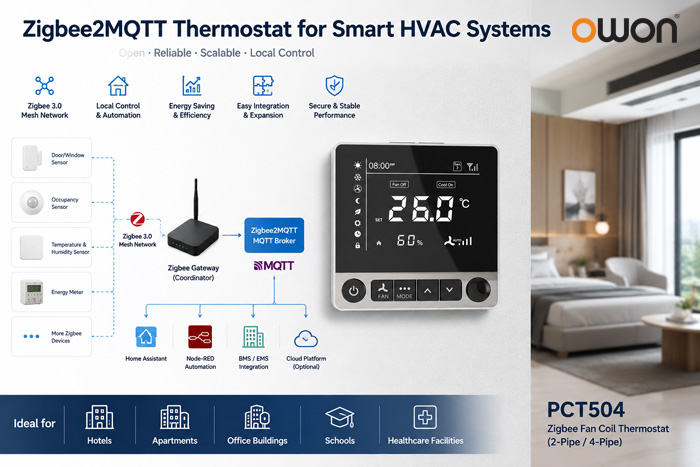
A Zigbee2MQTT thermostat provides one practical approach by connecting Zigbee-based HVAC devices with MQTT-enabled automation systems. This enables local control, flexible automation, and integration with platforms such as Home Assistant, Node-RED, and other smart building solutions.
For commercial and residential HVAC applications, the key is not only controlling temperature, but creating a complete environment where HVAC devices can communicate with sensors, gateways, and building management platforms.
What Role Does Zigbee2MQTT Play in HVAC Systems?
Zigbee2MQTT acts as a communication bridge between Zigbee devices and MQTT-based automation platforms.
A typical architecture may include:
Zigbee Thermostat → Zigbee Gateway/Coordinator → Zigbee2MQTT → Automation Platform → HVAC System
Through this architecture, HVAC devices can exchange information with other connected systems.
Typical functions include:
- temperature monitoring;
- heating and cooling control;
- automation scheduling;
- sensor-based adjustments;
- centralized system management.
For system integrators, this open approach provides more flexibility when designing HVAC solutions for different building requirements.
Why Use Zigbee-Based Thermostats for Smart HVAC Projects?
Flexible Wireless Installation
Many commercial buildings and retrofit projects face challenges with additional wiring.
Wireless Zigbee communication can simplify installation in applications such as:
- hotels;
- apartments;
- offices;
- renovated buildings.
Zigbee mesh networking also allows powered devices to help extend communication coverage across larger areas.
Local Automation and System Flexibility
Compared with cloud-dependent solutions, local automation provides advantages for projects that require reliable operation and customized control logic.
Through MQTT-based integration, system developers can create automation rules based on:
- temperature;
- occupancy;
- humidity;
- schedules;
- energy management requirements.
Integration with Multiple Devices
A modern HVAC system usually requires more than a thermostat.
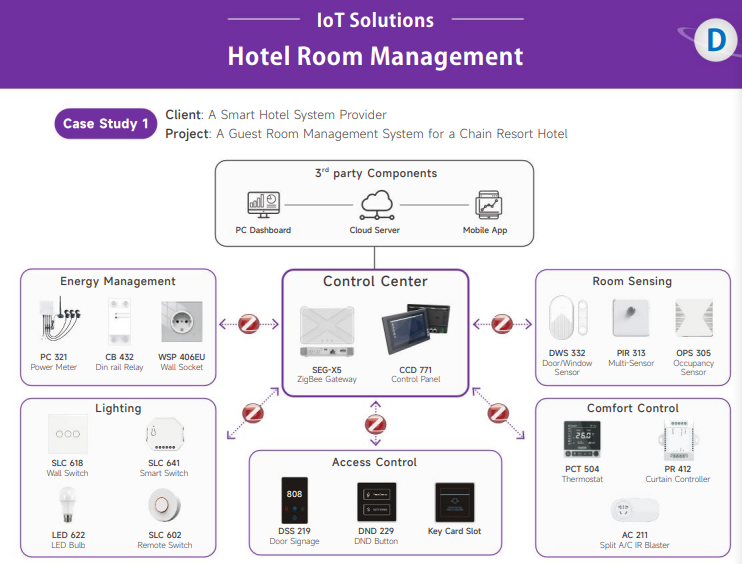
A complete smart HVAC solution may include:
- Zigbee thermostats;
- temperature sensors;
- humidity sensors;
- occupancy sensors;
- controllers;
- gateways.
This allows HVAC operation to respond to actual room conditions rather than fixed settings only.
Key Considerations When Selecting a Zigbee Thermostat
Choosing the right thermostat depends on the HVAC system, integration requirements, and project goals.
HVAC System Compatibility
Different HVAC applications require different thermostat designs.
For example:
Fan Coil HVAC Systems
Hotels, apartments, and commercial buildings commonly use fan coil systems.
For these applications, a Zigbee fan coil thermostat should support:
- fan speed control;
- heating and cooling modes;
- 2-pipe or 4-pipe systems;
- integration with building automation platforms.
For example, OWON’s PCT504 Zigbee Fan Coil Thermostat is designed for commercial HVAC applications such as hotels, serviced apartments, offices, and smart building projects.
Boiler and Residential Heating Systems
European residential heating projects often use boiler-based systems.
A suitable Zigbee thermostat should support:
- heating control;
- scheduling;
- integration with heating equipment;
- connection with smart heating devices.
For example, OWON’s PCT512 Zigbee Boiler Thermostat is designed for European heating applications and can be integrated into Zigbee-based automation systems.
Radiator Heating Systems
In European residential buildings, smart thermostatic radiator valves (TRVs) are commonly used for room-level heating control.
A Zigbee smart thermostatic radiator valve can help manage:
- individual room temperature;
- heating schedules;
- radiator output;
- energy-saving strategies.
This approach is especially useful for multi-room heating systems where different areas require different comfort settings.
Zigbee2MQTT Thermostats and Home Assistant Integration
Home Assistant is widely used in smart home and building automation projects because of its flexibility and local control capabilities.
When connected through Zigbee2MQTT, compatible thermostats can be integrated with Home Assistant to support:
- temperature monitoring;
- automation rules;
- heating schedules;
- dashboard visualization;
- integration with other smart devices.
For professional projects, Home Assistant can also work together with MQTT-based systems and customized automation solutions.
The important consideration is not only whether a thermostat connects to a platform, but whether it can provide stable communication and the required control functions for the application.
External Sensors and Advanced Temperature Control
In many HVAC applications, the thermostat location is not always the ideal place to measure room temperature.
For example:
- a thermostat may be installed near a door;
- a room may have uneven temperature distribution;
- different zones may require independent monitoring.
A Zigbee thermostat with external sensor support can improve temperature accuracy by allowing remote measurement.
External sensors are useful for:
- multi-zone heating;
- apartments;
- hotels;
- underfloor heating systems;
- rooms requiring precise temperature control.
By combining thermostats with temperature, humidity, and occupancy sensors, HVAC systems can make better decisions based on real environmental conditions.
Scheduling and Automation in Smart HVAC Systems
Heating and cooling requirements often change throughout the day.
Through automation platforms, Zigbee-based thermostats can support scheduling strategies such as:
- reducing heating during unoccupied periods;
- maintaining comfort before arrival;
- adjusting temperature based on building usage patterns.
For commercial buildings, these functions can help improve operational efficiency while maintaining occupant comfort.
Practical Applications of Zigbee HVAC Integration
Hotels and Hospitality
Hotels require both guest comfort and efficient energy management.
Connected HVAC systems can support:
- room-level temperature control;
- occupancy-based strategies;
- centralized management;
- easier maintenance.
Apartments and Multi-Family Buildings
Apartment projects benefit from scalable heating solutions.
Zigbee-based HVAC systems can support:
- individual room control;
- radiator heating management;
- remote configuration;
- future system expansion.
Smart Offices and Commercial Buildings
Office buildings often have changing occupancy patterns.
Integrated HVAC solutions can help optimize:
- heating and cooling schedules;
- energy consumption;
- indoor comfort.
Best Practices for Zigbee2MQTT HVAC Deployment
Select Devices Based on HVAC Requirements
A thermostat should be selected according to the actual HVAC equipment, not only wireless compatibility.
Important factors include:
- fan coil or boiler system;
- heating or cooling requirements;
- sensor requirements;
- installation environment.
Plan Zigbee Network Coverage
Large buildings should consider Zigbee network design carefully.
Proper placement of powered Zigbee devices and gateways helps maintain reliable communication.
Combine HVAC Data with Other Building Information
The greatest value of smart HVAC comes from combining different data sources.
Examples include:
- occupancy detection;
- door/window status;
- energy monitoring;
- environmental sensing.
Conclusion
Zigbee2MQTT thermostats provide a flexible option for modern HVAC automation by connecting Zigbee devices with open integration platforms.
For residential heating, commercial HVAC, and smart building projects, the combination of thermostats, sensors, gateways, and automation platforms enables more efficient and adaptable climate control.
Rather than replacing HVAC systems completely, Zigbee integration provides a practical pathway for upgrading existing buildings with smarter control capabilities.
For example, solutions such as OWON’s Zigbee fan coil thermostats, Zigbee boiler thermostats, and smart heating devices support different HVAC requirements across commercial and residential applications.
FAQ
What is a Zigbee2MQTT thermostat?
A Zigbee2MQTT thermostat is a Zigbee-enabled thermostat that can communicate with MQTT-based automation platforms through Zigbee2MQTT, enabling flexible HVAC integration and local control.
Can Zigbee2MQTT thermostats work with Home Assistant?
Yes. Compatible Zigbee thermostats can be integrated with Home Assistant through Zigbee2MQTT to support monitoring, automation, and smart HVAC control.
Do Zigbee thermostats support external sensors?
Some Zigbee thermostats support external sensors, allowing more accurate temperature measurement and improved multi-zone HVAC management.
Can Zigbee thermostats support scheduling?
Yes. Through automation platforms, Zigbee thermostats can support temperature schedules and customized heating or cooling strategies.
Are Zigbee thermostats suitable for commercial HVAC projects?
Yes. Zigbee thermostats can be used in hotels, apartments, offices, and smart buildings when matched with compatible HVAC systems and integration platforms.
Related reading:
[Zigbee2MQTT Door Sensors: Local Control, Security, and Building Automation]
Post time: Jul-11-2026


