Introduction
As smart home adoption continues to expand across Europe, Australia, and other international markets, buyers are becoming more specific about the smart plugs they search for.
A growing number of searches now include terms such as zigbee smart plug 16a, rather than simply “zigbee smart plug.”
This shift reflects a practical concern. Buyers are no longer evaluating smart plugs solely based on app control or automation features. Instead, they want to know whether a device can safely support the electrical loads commonly found in real homes, apartments, hospitality projects, and energy management systems.
For system integrators, smart home brands, distributors, and property technology providers, understanding the importance of load capacity is becoming increasingly important when selecting connected devices for deployment.
Why Are Buyers Specifically Searching for 16A Zigbee Smart Plugs?
When users search for a 16A Zigbee smart plug, they are usually not looking for a different automation experience.
They are looking for confidence.
Specifically, they want to know whether the device can safely handle the appliances they intend to control and monitor.
Typical examples include:
- Electric kettles
- Portable heaters
- Coffee machines
- Water heaters
- Air fryers
- Window air conditioners
- Dehumidifiers
- High-power kitchen appliances
These devices often draw significantly more power than lamps, televisions, or charging equipment.
As energy monitoring becomes more common, buyers are increasingly paying attention to the relationship between appliance load requirements and smart plug specifications.
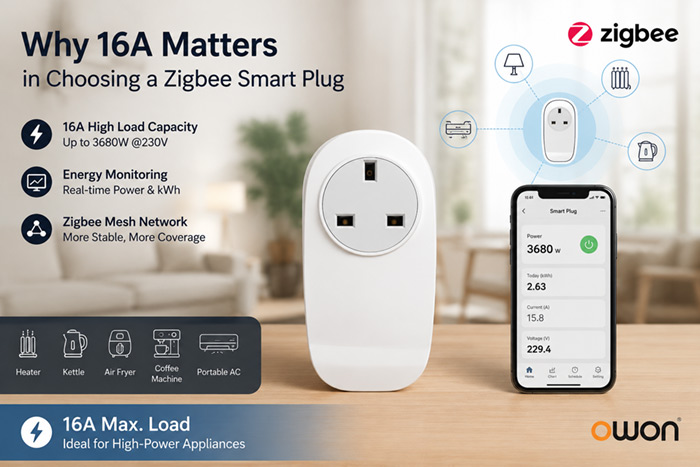
10A vs 16A: What Is the Real Difference?
One of the most common misunderstandings in the smart plug market is assuming that all smart plugs are suitable for the same applications.
In reality, load capacity directly impacts where a device can be safely deployed.
Typical Comparison
| Specification | 10A Smart Plug | 16A Smart Plug |
|---|---|---|
| Maximum Power @230V | Approx. 2300W | Approx. 3680W |
| Lighting Control | Suitable | Suitable |
| TVs & Electronics | Suitable | Suitable |
| Coffee Machines | Suitable | Suitable |
| Electric Kettles | Near Limit | Better Choice |
| Portable Heaters | Often Limited | Recommended |
| Air Fryers | Often Limited | Recommended |
| High-Power Appliances | Not Ideal | Better Fit |
For many modern households, appliance power requirements continue to increase.
As a result, many installers and distributors prefer 16A devices because they provide greater deployment flexibility across a wider range of applications.
Which Appliances Typically Benefit from a 16A Smart Plug?
Load capacity becomes particularly important when energy monitoring is part of the project.
Many energy-saving initiatives focus on appliances that consume the largest amount of electricity rather than the smallest.
These often include:
Heating Equipment
Portable heaters remain among the highest electricity-consuming appliances in many homes and apartments.
Being able to monitor runtime and energy consumption can help identify significant savings opportunities.
Kitchen Appliances
Kettles, coffee machines, air fryers, and similar appliances can generate substantial peak loads.
A higher-rated plug provides additional operating margin and long-term reliability.
HVAC-Related Equipment
Portable air conditioners, dehumidifiers, and ventilation equipment often operate for extended periods.
Monitoring these devices can provide valuable energy insights.
Hospitality Applications
Hotels and serviced apartments frequently deploy appliance-level control to reduce unnecessary energy consumption in guest rooms.
In these environments, selecting the appropriate load rating is an important design consideration.
Why 16A Is Becoming More Important in Energy Monitoring Projects
Energy monitoring is no longer limited to utility meters or distribution panels.
Today, many projects seek visibility at the appliance level.
A zigbee plug with energy monitoring allows users to track:
- Real-time power consumption
- Current and voltage
- Total energy usage (kWh)
- Runtime patterns
- Appliance-specific energy behavior
However, monitoring only small loads provides limited value.
Many of the most meaningful energy-saving opportunities are associated with higher-consumption devices.
This is one reason why 16A smart plugs are receiving increasing attention in residential, hospitality, and property management projects.
The ability to safely control and monitor larger electrical loads creates more opportunities for meaningful energy optimization.
Common Mistakes When Selecting a Zigbee Smart Plug
Mistake 1: Focusing Only on App Features
Many buyers compare mobile apps while overlooking electrical specifications.
In reality, load capacity often has a greater impact on long-term deployment success.
Mistake 2: Ignoring Future Expansion
A smart plug selected for lighting today may later be used to control higher-load appliances.
Choosing a higher-capacity device provides greater flexibility.
Mistake 3: Overlooking Energy Monitoring Quality
Not all monitoring functions provide the same level of visibility.
Accurate appliance-level data is critical for effective energy management programs.
Mistake 4: Forgetting About Network Infrastructure
A Zigbee smart plug does more than switch appliances.
Because it is mains-powered, it can also function as a Zigbee routing device, helping strengthen mesh network coverage throughout a property.
This is one reason many installers also view Zigbee smart plugsas practical network infrastructure devices.
Beyond Appliance Control: The Value of Zigbee Mesh Networking
One advantage often overlooked by first-time buyers is the role smart plugs play within a Zigbee network.
Unlike battery-powered sensors, powered Zigbee devices typically participate in mesh routing.
This means a smart plug can:
- Extend Zigbee coverage
- Improve communication reliability
- Reduce network dead zones
- Strengthen large deployments
For projects involving multiple sensors, thermostats, and automation devices, this additional functionality can significantly improve overall system performance.
Example: OWON WSP403 for 16A Zigbee Applications
For distributors, system integrators, and smart home brands seeking a higher-capacity Zigbee solution, the OWON WSP403 combines several features that align with modern energy-management requirements.
The device supports:
- Zigbee connectivity
- Appliance-level energy monitoring
- Remote switching
- Scheduling functions
- Zigbee mesh routing
- Multi-region deployment compatibility
Its 16A rating makes it suitable for a broader range of appliances compared with lower-capacity alternatives, while integrated monitoring functions help provide greater visibility into electricity consumption.
This combination makes the WSP403 relevant for smart home projects, residential energy management, hospitality deployments, and property technology applications.
Conclusion
As smart home and energy-management projects become more sophisticated, electrical load capacity is becoming an increasingly important part of device selection.
For many installers and solution providers, the question is no longer whether a smart plug supports automation. The more important question is whether it can safely support the appliances that generate the most meaningful energy data.
Understanding the difference between 10A and 16A devices helps ensure that smart plug deployments remain reliable, scalable, and capable of supporting real-world energy management objectives.
For projects involving higher-power appliances, a 16A Zigbee smart plug can provide both greater flexibility and better long-term deployment value.
FAQ
Why do buyers search for a 16A Zigbee smart plug?
Most buyers want to ensure the device can safely control and monitor higher-power appliances such as heaters, kettles, air fryers, and portable air conditioners.
Is a 16A Zigbee smart plug better than a 10A model?
Not necessarily. The best choice depends on the intended application. However, 16A models typically provide greater flexibility for future deployments.
Can a 16A Zigbee smart plug monitor electricity usage?
Yes. Many models include energy-monitoring functions that measure power consumption and accumulated energy usage.
Can a Zigbee smart plug improve network coverage?
Yes. Most mains-powered Zigbee plugs function as routing devices that help strengthen and extend Zigbee mesh networks.
What industries commonly use 16A Zigbee smart plugs?
Residential automation, hospitality, rental housing, property management, and energy-management projects commonly deploy higher-capacity Zigbee smart plugs.
Post time: Jun-13-2026