Introduction
As heat pump adoption continues to expand across North America, HVAC professionals are increasingly encountering systems that rely on auxiliary heat to maintain comfort during extreme weather conditions. While many thermostats claim heat pump compatibility, not all are designed to properly manage auxiliary heat, emergency heat, and hybrid heating configurations.
For distributors, HVAC contractors, OEM brands, and system integrators, selecting a WiFi thermostat for heat pump with auxiliary heat support is critical to ensuring reliable performance, customer satisfaction, and long-term HVAC efficiency.
This guide explains what HVAC professionals should evaluate when selecting thermostats for heat pump systems that incorporate auxiliary heat.
Why Auxiliary Heat Compatibility Matters
Heat pumps are highly efficient in moderate temperatures because they transfer heat rather than generate it directly. However, when outdoor temperatures drop significantly, heat pump efficiency decreases.
To maintain indoor comfort, many systems automatically activate an additional heating source known as auxiliary heat (Aux Heat).
Auxiliary heat may include:
- Electric resistance heating
- Gas furnace backup heating
- Dual fuel heating systems
- Supplemental heating elements
If a thermostat cannot properly manage auxiliary heat stages, homeowners may experience:
- Reduced comfort
- Excessive energy consumption
- Incorrect temperature control
- Frequent HVAC service calls
This is why auxiliary heat compatibility should be a key consideration during thermostat selection.
What Should a Thermostat Support for Heat Pump Systems?
When evaluating a thermostat for heat pump with auxiliary heat, HVAC professionals should verify several critical capabilities.
Multi-Stage Heat Pump Control
Modern heat pump systems commonly require:
- 1H/1C Heat Pump
- 2H/2C Heat Pump
- Multi-stage compressor control
Proper staging helps maximize efficiency while maintaining stable indoor temperatures.
Auxiliary Heat Management
The thermostat should support:
- Auxiliary Heat (Aux Heat)
- Alternative Heat
- Secondary Heating Stages
This allows the system to automatically engage supplemental heating when needed.
Emergency Heat Operation
Emergency Heat is different from Auxiliary Heat.
Emergency Heat is manually activated when the heat pump itself is unavailable or malfunctioning.
Professional-grade thermostats should support both operating modes.
Reversing Valve Control
Heat pumps rely on reversing valves to switch between heating and cooling modes.
A compatible thermostat must properly support O/B reversing valve configurations used by North American HVAC equipment.
Auxiliary Heat vs Emergency Heat
Many end users confuse Auxiliary Heat with Emergency Heat.
| Function | Auxiliary Heat | Emergency Heat |
|---|---|---|
| Operation | Automatic | Manual |
| Purpose | Assist heat pump during cold weather | Backup when heat pump fails |
| Energy Consumption | Higher than normal heat pump operation | Usually highest operating cost |
| Typical Usage | Cold outdoor temperatures | Equipment failure or maintenance |
Understanding this distinction helps HVAC contractors properly configure and explain system operation to customers.
Dual Fuel and Hybrid Heat Applications
Many newer residential HVAC installations combine:
- Heat Pump
- Gas Furnace
This configuration is commonly called:
- Dual Fuel
- Hybrid Heat
In these systems, the thermostat automatically determines the most efficient heating source based on outdoor conditions.
For distributors and HVAC professionals, selecting a WiFi thermostat for heat pump with auxiliary heat that also supports dual fuel functionality can simplify inventory management while serving a broader customer base.
Smart Features HVAC Buyers Now Expect
Beyond HVAC compatibility, modern buyers increasingly expect smart thermostat functionality.
Important features include:
- Mobile app control
- Remote HVAC monitoring
- Energy usage reports
- Voice assistant integration
- Smart scheduling
- Occupancy-based optimization
- Remote room sensors
These capabilities help improve both comfort and energy efficiency.
For example, a modern smart thermostat for heat pump system can automatically adjust temperatures based on occupancy schedules, weather conditions, and user preferences.
Example Solutions for Heat Pump Projects
Professional HVAC projects often require thermostats capable of supporting advanced heat pump configurations.
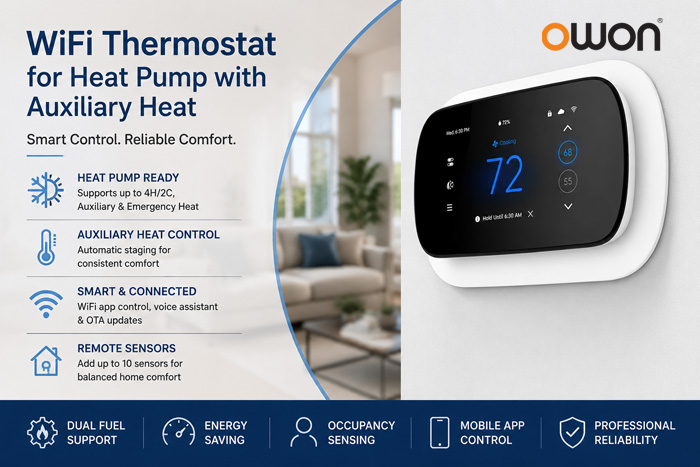
For example, the OWON PCT5231 supports:
- Conventional HVAC systems
- Heat pumps
- Auxiliary heat
- Emergency heat
- Dual fuel / hybrid heat systems
- Up to 10 remote room sensors
making it a practical 24VAC thermostat solution for residential and light commercial HVAC projects.
For projects requiring advanced features such as occupancy sensing, humidity control, energy usage tracking, and smart home integration, the OWON PCT533 provides additional flexibility while maintaining compatibility with modern heat pump applications.
For OEM brands and system integrators, these capabilities can help simplify deployment across multiple HVAC system types.
Common Compatibility Mistakes to Avoid
When selecting thermostats for heat pump projects, HVAC professionals should avoid several common mistakes:
Choosing Conventional-Only Thermostats
Not all WiFi thermostats support heat pump logic.
Always verify heat pump compatibility.
Ignoring Auxiliary Heat Support
A thermostat that cannot properly manage auxiliary heating stages may create comfort and efficiency issues.
Overlooking Dual Fuel Requirements
Many modern installations require automatic switching between heat pump and furnace operation.
Focusing Only on Smart Features
Mobile apps and voice control are useful, but HVAC compatibility should always be verified first.
FAQ
What is auxiliary heat on a heat pump system?
Auxiliary heat is a supplemental heating source that automatically activates when outdoor temperatures are too low for the heat pump to efficiently maintain indoor comfort.
Does every heat pump require auxiliary heat?
Not always. However, many North American heat pump systems use auxiliary heating to improve cold-weather performance.
Can a WiFi thermostat control auxiliary heat?
Yes. A properly designed WiFi thermostat for heat pump with auxiliary heat can automatically manage both primary heat pump operation and auxiliary heating stages.
What is the difference between auxiliary heat and emergency heat?
Auxiliary heat operates automatically when needed. Emergency heat is manually activated when the heat pump is unavailable or not functioning correctly.
Can smart thermostats support dual fuel systems?
Yes. Advanced thermostats designed for North American HVAC systems can support dual fuel and hybrid heat configurations.
Conclusion
As heat pump adoption continues to grow, HVAC professionals must pay closer attention to thermostat compatibility requirements. Selecting a WiFi thermostat for heat pump with auxiliary heat involves more than choosing a device with mobile app control or smart home integration.
Proper support for auxiliary heat, emergency heat, dual fuel systems, and multi-stage heat pump operation is essential for long-term performance and customer satisfaction.
For distributors, OEM brands, HVAC contractors, and system integrators, choosing thermostats that combine HVAC compatibility with modern smart features can help future-proof projects while delivering greater value to end users.
Post time: Jun-12-2026