If you are working in smart home distribution or building your own private label brand, you probably already noticed something slightly uncomfortable.
On paper, Zigbee door sensors are extremely boring products.
And yet in real business life, they either sell quietly and steadily… or they slowly turn into a pile of “we need to check this issue” emails.
There is rarely anything in between.
Let’s be honest about what you are actually selling
You are not really selling a Zigbee door sensor.
You are selling something that:
- your customer installs once
- hopefully never complains about again
- quietly runs in the background for years
If it does that job well, nobody talks about it.
And in your business, that is usually a good sign.
Why you should not trust datasheets too much
If you only look at specifications, most Zigbee door and window sensors look identical.
Same Zigbee 3.0 label.
Same claimed battery life.
Same “works with smart home systems” sentence.
Very clean. Very convincing. Almost too clean.
But you already know what happens later:
One batch behaves perfectly.
Another batch behaves like it is having a bad day.
And your support inbox suddenly becomes very creative.
What actually matters in real business use
If you remove all marketing language, your real decision factors are much simpler than brochures suggest.
1. Will your customers stop asking questions after installation
You do not want “smart home excitement”.
You want silence.
If users are not asking questions, it usually means your smart home door sensor is doing its job properly.
And yes, that is exactly what you want.
2. Will it behave the same in every market
You may ship to different countries, different housing types, different usage habits.
And suddenly the same Zigbee door sensor behaves slightly differently.
Not broken. Just inconsistent enough to be annoying.
And inconsistency is expensive.
3. Will it survive real-world usage, not lab conditions
Lab environments are polite.
Real homes are not.
Doors slam. Batteries sit too long. Users ignore low battery warnings. Networks get messy.
A good Zigbee door sensor does not care.
It just continues working without creating drama.
A small but important reality about compatibility
You will often hear customers mention Home Assistant compatible Zigbee sensor or Zigbee2MQTT compatible sensor.
But what they are really saying is simple:
They want things to work without thinking too much.
Not because they care about protocols.
But because they care about not getting support tickets.
If your product behaves predictably in those environments, you have already solved most of the problem.
What good products in this category quietly share
If you look at long-term successful Zigbee door sensors, you will notice something interesting.
They are not impressive.
They are consistent.
They usually have:
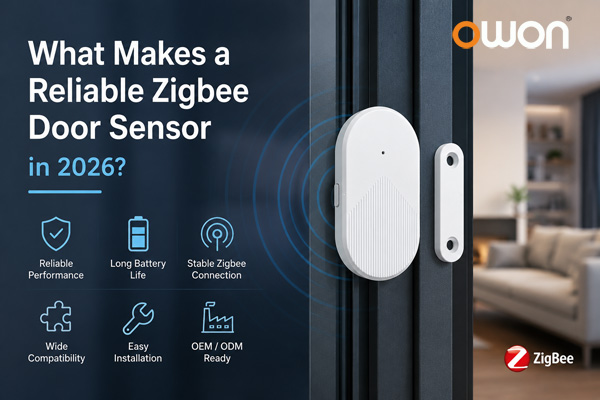
- stable Zigbee 3.0 behavior
- predictable performance across batches
- reasonable battery life without surprises
- simple installation experience
- OEM or white label readiness
Nothing exciting.
But very difficult to replace once they are working.
A realistic example of what distributors actually choose
In many private label cases, products like OWON DWS332 are selected for very practical reasons.
Not because they are revolutionary.
But because they are predictable.
They fit naturally into Zigbee door sensor product lines, work in common Home Assistant compatible Zigbee sensor environments, and support Zigbee2MQTT compatible sensor deployments without unnecessary complexity.
From a distributor or brand perspective, this is not a “feature story”.
It is a “reduce risk” decision.
Why some products stay in your catalog and others disappear
If you look at your product catalog over time, you will notice something slightly uncomfortable.
The products that survive are not always the most advanced ones.
They are the ones that:
- do not generate constant support requests
- do not behave differently across batches
- do not create unpredictable returns
- do not require frequent explanation
In other words:
They are boring in the best possible way.
And boring products are usually the ones that quietly keep your business stable.
Final thought
When you choose a Zigbee door sensor, you are not just choosing hardware.
You are choosing how many customer emails, support tickets, and maintenance requests you will receive over the next 12 to 24 months.
And if everything goes well, the best outcome is surprisingly simple:
You stop hearing about it completely.
Because a reliable Zigbee door sensor is not the one with the longest feature list.
It is the one that gets installed once, works consistently, and quietly does its job year after year.
For distributors, system integrators, and OEM brands, that reliability is often the difference between a successful project and an ongoing support burden.
Post time: Jun-12-2026