A zigbee humidity sensor home assistant setup can do much more than simply display humidity levels. It allows users to automate bathroom ventilation, HVAC airflow, dehumidifiers, and indoor comfort management through real-time environmental monitoring.
As Home Assistant continues to grow in popularity, more users are integrating Zigbee environmental sensors into smart home and smart building automation systems.
Compared with traditional standalone humidity monitoring, Home Assistant enables Zigbee sensors to become active automation triggers for:
- smart ventilation
- HVAC optimization
- energy-saving workflows
- smart alerts
- occupancy-based automation
This article explains how Zigbee humidity sensors work with Home Assistant and how they are used in practical automation scenarios.
Why Zigbee Sensors Are Popular in Home Assistant
Many Home Assistant users prefer Zigbee devices because Zigbee offers:
- low power consumption
- reliable mesh networking
- local control capability
- scalable device deployment
- stable wireless communication
Compared with Wi-Fi sensors, Zigbee humidity sensors are often more suitable for long-term environmental monitoring because they consume less power and place less load on the local network.
Most Zigbee humidity sensors support:
- Zigbee2MQTT
- ZHA (Zigbee Home Automation)
- Tuya Zigbee gateways
- Home Assistant dashboards
This flexibility makes Zigbee particularly attractive for smart homes, hotels, offices, and building automation projects.
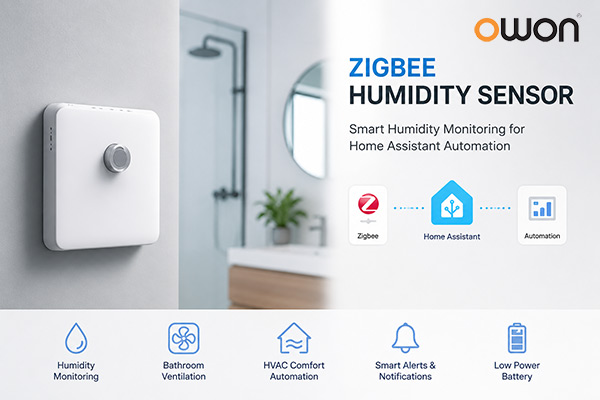
Zigbee Humidity Sensor Home Assistant Integration
Most Zigbee humidity sensors can integrate with Home Assistant through either Zigbee2MQTT or ZHA.
Once connected, humidity data can be displayed in:
- Home Assistant dashboards
- automation panels
- mobile apps
- environmental monitoring systems
Users can create automation rules based on humidity thresholds, occupancy conditions, schedules, or HVAC logic.
For example:
- turn on a bathroom fan when humidity rises above 70%
- activate a dehumidifier automatically
- send alerts if humidity becomes abnormal
- adjust HVAC airflow dynamically
Because Home Assistant supports local automation, users can maintain fast response times without depending entirely on cloud services.
Smart Bathroom Ventilation Automation
Bathroom humidity automation is one of the most common Zigbee humidity sensor applications.
After showers or hot water usage, humidity levels can increase rapidly and lead to:
- mirror fogging
- mold growth
- mildew
- unpleasant odors
- long-term moisture problems
A Home Assistant automation can automatically activate an exhaust fan when humidity exceeds a predefined threshold and turn it off when humidity returns to normal levels.
This helps improve indoor comfort while reducing unnecessary fan runtime.
Wireless Zigbee deployment is especially useful in bathroom retrofit projects where additional control wiring may be difficult to install.
HVAC & Indoor Comfort Optimization
Humidity monitoring is also valuable for HVAC automation.
Home Assistant can use humidity data to:
- optimize ventilation timing
- improve airflow control
- reduce overcooling
- activate humidifiers or dehumidifiers
- maintain more stable indoor comfort conditions
This type of automation is increasingly used in:
- smart homes
- hotels
- offices
- apartments
- commercial buildings
By combining humidity sensing with occupancy and temperature data, automation systems can make more intelligent environmental control decisions.
Zigbee2MQTT vs ZHA for Humidity Sensors
Most Home Assistant users integrate Zigbee humidity sensors through either:
- Zigbee2MQTT
- ZHA (Zigbee Home Automation)
Both platforms support humidity reporting, dashboard monitoring, and automation workflows.
Zigbee2MQTT
Popular among advanced users because it offers:
- broad device compatibility
- flexible MQTT integration
- advanced automation configuration
- local control capability
ZHA
Integrated directly into Home Assistant and easier for beginners to configure.
Many users choose ZHA for smaller residential automation projects.

Battery-Powered Zigbee Humidity Sensors
Most Zigbee humidity sensors use low-power battery-powered designs for flexible wireless installation.
A zigbee humidity sensor aaa battery design is particularly useful in:
- bathrooms
- apartments
- hotels
- retrofit projects
- office spaces
because it eliminates the need for additional wiring.
Battery-powered Zigbee sensors can operate for long periods while maintaining stable communication through Zigbee mesh networking.
For example, OWON PIR323 supports Zigbee 3.0 communication with low-power operation using two AAA batteries.
Combining Humidity Sensors with Smart Switch Automation
Humidity automation becomes even more powerful when integrated with smart relays or switches.
A zigbee humidity sensor switch workflow may include:
- automatically turning on bathroom exhaust fans
- controlling dehumidifiers
- triggering ventilation systems
- activating smart relays
- adjusting HVAC airflow
This type of automation helps improve energy efficiency while reducing manual intervention.
In modern smart buildings, humidity sensors are increasingly used as active automation triggers instead of standalone monitoring devices.
Multi-Sensor Integration for Smarter Automation
Many Home Assistant projects now use Zigbee multi-sensors to simplify deployment.
Instead of installing separate devices for:
- humidity sensing
- motion detection
- temperature monitoring
a single device can combine multiple sensing functions together.
For example, OWON PIR323 integrates:
- humidity sensing
- temperature monitoring
- PIR motion detection
- optional vibration detection
within one Zigbee 3.0 multi-sensor platform.
This type of integrated sensor architecture helps improve automation flexibility while reducing installation complexity.
What to Consider Before Deployment
Before deploying Zigbee humidity sensors with Home Assistant, users should consider:
- gateway compatibility
- Zigbee mesh coverage
- reporting interval configuration
- automation thresholds
- battery maintenance
- sensor placement strategy
Proper network design helps improve long-term automation stability and responsiveness.
FAQ About Zigbee Humidity Sensor Home Assistant Integration
Can a Zigbee humidity sensor work with Home Assistant?
Yes. Most Zigbee humidity sensors support Home Assistant through Zigbee2MQTT or ZHA integration for automation and dashboard monitoring.
What is the best use case for a Zigbee humidity sensor in Home Assistant?
Bathroom ventilation automation is one of the most common use cases because humidity thresholds can automatically control exhaust fans and ventilation systems.
Are Zigbee humidity sensors battery powered?
Most Zigbee humidity sensors use low-power battery-powered wireless designs for flexible installation.
Why choose Zigbee instead of Wi-Fi for humidity monitoring?
Zigbee generally offers lower power consumption, better scalability, and more reliable mesh networking for smart automation projects.
Conclusion
A zigbee humidity sensor home assistant integration provides much more than simple humidity monitoring.
By combining wireless Zigbee sensing with Home Assistant automation logic, users can create smarter systems for:
- bathroom ventilation
- HVAC optimization
- smart alerts
- indoor comfort management
- energy-saving automation
As more users adopt Home Assistant for smart homes and smart building projects, Zigbee humidity sensor integration will continue becoming increasingly important for intelligent environmental automation.
Related reading:
[Zigbee Motion Sensor for Home Assistant: Integration Guide for Smart Automation Projects]
Post time: May-11-2026