Selecting a thermostat for a modern heat pump system is no longer as simple as matching the voltage or choosing a WiFi model. Today’s high-efficiency HVAC systems often include multiple compressor stages, auxiliary heating, emergency heat, and even dual fuel operation. These systems require a thermostat capable of coordinating every stage correctly.
If the thermostat cannot properly manage the HVAC equipment, homeowners may experience uneven temperatures, unnecessary auxiliary heat operation, increased energy costs, or reduced equipment lifespan.
This guide explains what a 4H/2C heat pump system is, which thermostat features matter most, and how to choose a compatible thermostat for long-term comfort and efficiency.
What Is a 4H/2C Heat Pump System?
A 4H/2C heat pump system refers to an HVAC configuration with:
- Four heating stages
- Two cooling stages
In most residential applications, the heating stages typically include:
- First-stage compressor heating
- Second-stage compressor heating
- First-stage auxiliary heat
- Second-stage auxiliary heat or emergency heat
Cooling is provided through two compressor stages that automatically adjust output according to the home’s heating or cooling demand.
Compared with single-stage systems, multi-stage heat pumps provide:
- More stable indoor temperatures
- Lower energy consumption
- Better humidity control
- Reduced equipment cycling
- Improved comfort throughout the year
These systems are becoming increasingly common in newer homes, cold-climate regions, and premium HVAC installations.
Why Choosing the Right Thermostat Matters
A thermostat is the control center of the entire HVAC system.
Even if the heat pump itself supports multiple stages, the system cannot perform as designed if the thermostat lacks the necessary control capabilities.
An incompatible thermostat may result in:
- Auxiliary heat activating too early
- Compressor stages operating incorrectly
- Emergency heat failing to engage when needed
- Higher operating costs
- Reduced indoor comfort
- Increased equipment wear
For this reason, HVAC professionals generally recommend verifying thermostat compatibility before installation rather than assuming all smart thermostats support multi-stage heat pumps.
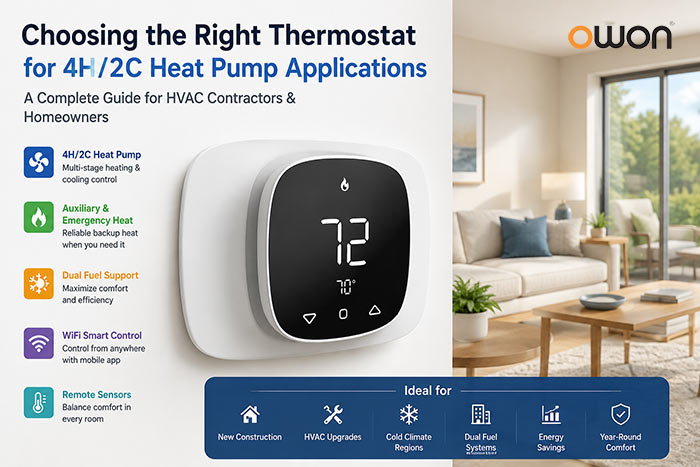
Eight Features Every 4H/2C Heat Pump Thermostat Should Include
1. True 4H/2C Compatibility
Some smart thermostats advertise multi-stage support but only operate with 2H/2C systems.
Always verify that the thermostat explicitly supports:
- Two compressor stages
- Auxiliary heating
- Emergency heat
- Multi-stage heat pump operation
Compatibility information should be listed in the product specifications rather than assumed from marketing descriptions.
2. Auxiliary Heat Management
Auxiliary heat provides additional heating when outdoor temperatures become too low for the heat pump to maintain indoor comfort.
An appropriate thermostat should:
- Automatically determine when auxiliary heat is needed
- Minimize unnecessary auxiliary heat operation
- Maintain comfort while reducing electricity consumption
Proper auxiliary heat management has a significant impact on winter energy efficiency.
3. Emergency Heat Support
Emergency heat is designed for situations where the heat pump cannot operate correctly, such as equipment failure or severe weather conditions.
A compatible thermostat should allow homeowners or HVAC technicians to activate emergency heat independently from normal heat pump operation.
This feature is particularly valuable in colder regions where uninterrupted heating is essential.
4. Dual Fuel Compatibility
Many North American homes combine a heat pump with a gas furnace.
These systems are commonly known as dual fuel or hybrid heat systems.
Instead of relying entirely on electric auxiliary heating, the thermostat automatically switches between the heat pump and furnace according to outdoor conditions.
Compared with traditional electric auxiliary heat, dual fuel systems often provide:
- Lower heating costs
- Better cold-weather performance
- Improved seasonal efficiency
If a home uses both a furnace and a heat pump, the thermostat should specifically support dual fuel control.
5. Flexible Wiring Options
Before purchasing any thermostat, homeowners should verify wiring compatibility.
Most modern smart thermostats require:
- R
- C
- Y1
- Y2
- W1
- W2
- G
- O/B
Some older homes do not include a dedicated C-wire.
In these situations, thermostats that support an optional C-wire adapter can simplify installation without requiring new wiring. Both the OWON PCT5231 and PCT533 support an optional C-wire adapter for compatible retrofit installations.
6. Remote Room Sensors
Large homes often experience temperature differences between rooms.
Remote sensors allow the thermostat to measure conditions in multiple locations rather than relying only on the hallway thermostat.
Benefits include:
- Reduced hot and cold spots
- Better comfort upstairs and downstairs
- More accurate room prioritization
- Improved zoning performance
This feature is especially useful for larger residential properties.
7. Intelligent Scheduling
A quality thermostat should provide flexible scheduling rather than simple day and night programming.
Modern scheduling features typically include:
- Seven-day scheduling
- Multiple daily time periods
- Vacation mode
- Temporary hold
- Permanent hold
These functions help balance comfort and energy savings throughout the week.
8. Smart Connectivity
WiFi connectivity has become a standard expectation for many homeowners.
Useful smart features include:
- Mobile app control
- Remote monitoring
- Energy usage reports
- Voice assistant compatibility
- Automatic software updates
While these features do not directly improve HVAC performance, they enhance convenience and system management.
Understanding Dual Fuel vs. Standard Heat Pump Systems
Many homeowners confuse dual fuel systems with standard heat pump systems.
The difference lies in the backup heating source.
A standard heat pump relies on electric auxiliary heat during colder weather.
A dual fuel system automatically switches between a heat pump and a gas furnace depending on outdoor conditions.
For regions with long winters, dual fuel systems can reduce heating costs while maintaining reliable indoor comfort.
Common Thermostat Wiring for 4H/2C Systems
Most multi-stage heat pump thermostats include terminals such as:
- Rc
- Rh
- C
- Y1
- Y2
- W1
- W2
- G
- O/B
Some models also provide terminals for humidifiers, dehumidifiers, or optional accessories.
Correct wiring is essential to ensure each compressor stage, auxiliary heater, and reversing valve operates properly.
Common Installation Mistakes
Even experienced installers occasionally encounter compatibility issues.
Some of the most common mistakes include:
- Selecting the wrong heat pump configuration
- Incorrect O/B reversing valve settings
- Missing auxiliary heat configuration
- Forgetting emergency heat setup
- Incorrect staging configuration
- Ignoring firmware setup after installation
Following the manufacturer’s installation instructions and system configuration process helps avoid these problems.
Example of a Modern 4H/2C Thermostat
Several thermostat manufacturers now offer models specifically designed for North American multi-stage HVAC systems.
For example, the OWON PCT5231 WIFI smart thermostat supports:
- 4H/2C heat pump systems
- Dual fuel switching
- Emergency heat
- Up to 10 wireless remote sensors
- Energy usage reports
- Optional C-wire adapter
- Mobile app control
- Seven-day scheduling
These capabilities make it suitable for many modern residential heat pump installations requiring advanced HVAC control.
For homeowners seeking additional comfort features, another example is the OWON PCT533, which adds a 4.3-inch touchscreen, humidity monitoring, occupancy sensing, humidifier/dehumidifier control, and compatibility with the same class of 24VAC multi-stage HVAC systems.
Frequently Asked Questions
Can any smart thermostat work with a 4H/2C heat pump?
No. Many smart thermostats only support single-stage or 2H/2C systems. Always verify compatibility before purchasing.
What is the difference between 2H/2C and 4H/2C?
A 2H/2C thermostat controls two heating stages and two cooling stages. A 4H/2C thermostat additionally supports multiple auxiliary heating stages and emergency heat for advanced heat pump systems.
Does a 4H/2C thermostat require a C-wire?
Many WiFi thermostats require a C-wire for continuous power. If one is unavailable, some models offer an optional C-wire adapter for compatible systems.
Is auxiliary heat the same as emergency heat?
No. Auxiliary heat operates automatically when additional heating is required. Emergency heat is manually selected when the heat pump is unavailable or malfunctioning.
Can a 4H/2C thermostat control a dual fuel system?
Only if the thermostat specifically supports dual fuel or hybrid heat operation. This feature allows automatic switching between a heat pump and a furnace.
Conclusion
Choosing the right thermostat for a 4H/2C heat pump application involves much more than selecting a WiFi-enabled device. Compatibility with multi-stage compressors, auxiliary heat, emergency heat, dual fuel systems, wiring requirements, and remote sensing all play a critical role in HVAC performance.
Whether you are upgrading an existing system, specifying equipment for a new installation, or evaluating thermostat platforms for OEM projects, selecting a thermostat designed for advanced heat pump applications helps maximize comfort, improve efficiency, and protect long-term HVAC reliability.
Related reading:
[Multi-Stage Thermostat: A Complete Guide for Modern HVAC Systems]
Post time: Jul-08-2026