Industrial facilities are under increasing pressure to reduce energy costs, improve operational efficiency, and gain better visibility into electrical consumption.
Whether managing a manufacturing plant, commercial building, solar installation, or energy storage system, reliable energy data has become essential for making informed decisions. This is why many engineers and system integrators continue to rely on the RS485 energy meter as a practical and cost-effective solution for industrial power monitoring and Energy Management System (EMS) integration.
However, not all energy meters are designed for the same applications. Choosing the right device requires understanding communication protocols, installation methods, electrical system compatibility, and integration requirements.
This guide explains what to look for when selecting an RS485 energy meter for industrial projects.
Why RS485 Remains Popular in Industrial Energy Monitoring
Despite the growth of Ethernet and cloud-based IoT platforms, RS485 remains one of the most widely used communication standards in industrial environments.
The reasons are straightforward:
- Long communication distance
- Excellent noise immunity
- Reliable operation in electrical rooms
- Simple multi-device networking
- Broad compatibility with PLCs, EMS, BMS, and SCADA systems
For many facilities, a wired RS485 network remains more predictable and easier to maintain than a wireless-only solution.
As a result, the power meter RS485 architecture continues to be widely used in factories, commercial buildings, solar plants, and energy storage systems.
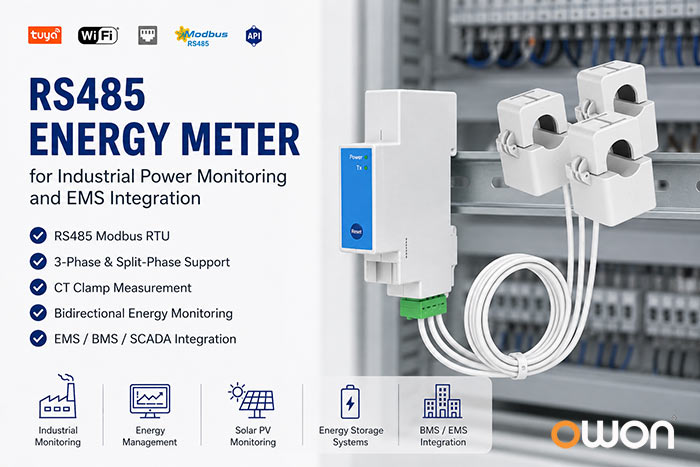
What Is an RS485 Energy Meter?
An RS485 energy meter measures electrical parameters and transmits data through an RS485 communication network.
Depending on the model, the meter may provide:
- Voltage
- Current
- Frequency
- Power Factor
- Active Power
- Reactive Power
- Apparent Power
- Energy Consumption
- Energy Generation
Many industrial systems use a modbus RS485 energy meter because Modbus RTU has become a standard protocol for communication between meters, controllers, PLCs, and EMS platforms.
The meter continuously collects electrical data and makes it available to supervisory software for monitoring, analysis, reporting, and automation.
Why CT Clamp Energy Meters Are Preferred for Retrofit Projects
In many facilities, shutting down production lines or rewiring electrical panels is not practical.
This is where a CT clamp energy meter offers significant advantages.
Instead of routing the full load current through the meter, external current transformers (CTs) are installed around conductors to measure current flow.
Benefits include:
- Faster installation
- Reduced downtime
- Non-invasive deployment
- Easier retrofit projects
- Support for higher current applications
For industrial power monitoring projects, CT clamp designs are often preferred over direct-connected meters.
They are especially useful for:
- Manufacturing facilities
- Commercial buildings
- Data centers
- Solar PV systems
- Battery energy storage systems
Key Features to Look for in a 3-Phase Energy Meter with RS485
When evaluating a 3 phase energy meter with RS485, consider the following factors.
Electrical System Compatibility
The meter should support the electrical system used at the site:
- Single-phase
- Split-phase
- Three-phase 3-wire
- Three-phase 4-wire
A flexible meter platform can simplify deployment across different projects.
Communication Options
Many modern industrial projects require more than just Modbus RTU.
Look for meters that support:
- RS485 (Modbus RTU)
- Modbus TCP
- Ethernet
- MQTT
- HTTP APIs
This provides greater flexibility for future EMS and cloud integration.
Bidirectional Energy Monitoring
For solar and energy storage applications, the meter should be able to measure:
- Grid import
- Grid export
- Energy consumption
- Energy generation
This capability is critical for solar self-consumption analysis and export control strategies.
Data Accuracy
Verify:
- Measurement accuracy
- CT accuracy
- Supported CT ranges
- Calibration specifications
Reliable data is essential for energy optimization and reporting.
Modbus RTU vs Modbus TCP: Which Is Better?
One common question is whether to choose a traditional RS485 network or a network-based Modbus TCP solution.
Modbus RTU (RS485)
Advantages:
- Lower installation cost
- Excellent electrical noise immunity
- Widely supported by industrial equipment
- Reliable long-distance communication
Best suited for:
- Factories
- Industrial panels
- PLC-based systems
- Existing RS485 infrastructure
Modbus TCP
Advantages:
- Faster communication
- Easier integration with modern EMS platforms
- Simplified networking over Ethernet
Best suited for:
- Building management systems
- Cloud-connected energy platforms
- Large-scale monitoring projects
Many facilities now deploy both technologies, using Modbus RTU for field devices and Modbus TCP for higher-level management systems.
Common Applications of RS485 Energy Meters
Industrial Power Monitoring
Monitor production equipment, compressors, pumps, motors, and process loads.
Energy Management Systems (EMS)
Collect real-time electrical data for energy analysis, reporting, and optimization.
Building Management Systems (BMS)
Integrate energy data into centralized building automation platforms.
Solar PV Monitoring
Track solar generation, facility consumption, and grid import/export energy flows.
Battery Energy Storage Systems
Monitor charging, discharging, and energy balancing performance.
Utility Sub-Metering
Support tenant billing, departmental allocation, and energy efficiency programs.
Example: RS485 Energy Meter for EMS Integration
For projects requiring industrial communication and flexible deployment, products such as the OWON PC4713 provide a practical approach to energy monitoring.
The PC4713 combines CT clamp-based measurement with RS485 communication, Modbus RTU, Modbus TCP, and bidirectional energy monitoring capabilities. It supports single-phase, split-phase, and three-phase systems while providing real-time visibility into voltage, current, power factor, active power, reactive power, apparent power, and energy usage.
This type of architecture is particularly suitable for EMS integration, solar monitoring, energy storage projects, and industrial power management applications where reliable communication and scalable deployment are required.
How to Choose the Right RS485 Energy Meter
Before selecting a meter, ask the following questions:
- What electrical system will be monitored?
- Is CT clamp installation required?
- Will the meter connect to an EMS or BMS?
- Is Modbus RTU sufficient, or is Modbus TCP also needed?
- Will the project involve solar PV or energy storage?
- Are future cloud or MQTT integrations planned?
The answers will help narrow the selection and avoid future integration challenges.
Conclusion
An RS485 energy meter remains one of the most reliable solutions for industrial power monitoring and EMS integration.
When evaluating options, focus on communication flexibility, CT clamp compatibility, bidirectional monitoring, and support for both Modbus RTU and Modbus TCP. These factors can significantly improve deployment flexibility and long-term project scalability.
For industrial facilities, commercial buildings, solar PV systems, and energy storage projects, selecting the right energy meter with RS485 Modbus capabilities can provide the foundation for more accurate monitoring, better energy management, and smarter operational decisions.
Related reading:
[Modbus Energy Meter Selection Guide for Solar, EMS and Industrial Applications]
Post time: Jun-29-2026